Welcome at the Interface Culture program website.
Acting as creative artists and researchers, students learn how to advance the state of the art of current interface technologies and applications. Through interdisciplinary research and team work, they also develop new aspects of interface design including its cultural and social applications. The themes elaborated under the Master's programme in relation to interactive technologies include Interactive Environments, Interactive Art, Ubiquitous Computing, game design, VR and MR environments, Sound Art, Media Art, Web-Art, Software Art, HCI research and interaction design.

The Interface Culture program at the Linz University of Arts Department of Media was founded in 2004 by Christa Sommerer and Laurent Mignonneau. The program teaches students of human-machine interaction to develop innovative interfaces that harness new interface technologies at the confluence of art, research, application and design, and to investigate the cultural and social possibilities of implementing them.
The term "interface" is omnipresent nowadays. Basically, it describes an intersection or linkage between different computer systems that makes use of hardware components and software programs to enable the exchange and transmission of digital information via communications protocols.
However, an interface also describes the hook-up between human and machine, whereby the human qua user undertakes interaction as a means of operating and influencing the software and hardware components of a digital system. An interface thus enables human beings to communicate with digital technologies as well as to generate, receive and exchange data. Examples of interfaces in very widespread use are the mouse-keyboard interface and graphical user interfaces (i.e. desktop metaphors). In recent years, though, we have witnessed rapid developments in the direction of more intuitive and more seamless interface designs; the fields of research that have emerged include ubiquitous computing, intelligent environments, tangible user interfaces, auditory interfaces, VR-based and MR-based interaction, multi-modal interaction (camera-based interaction, voice-driven interaction, gesture-based interaction), robotic interfaces, natural interfaces and artistic and metaphoric interfaces.
Artists in the field of interactive art have been conducting research on human-machine interaction for a number of years now. By means of artistic, intuitive, conceptual, social and critical forms of interaction design, they have shown how digital processes can become essential elements of the artistic process.
Ars Electronica and in particular the Prix Ars Electronica's Interactive Art category launched in 1991 has had a powerful impact on this dialog and played an active role in promoting ongoing development in this field of research.
The Interface Cultures program is based upon this know-how. It is an artistic-scientific course of study to give budding media artists and media theoreticians solid training in creative and innovative interface design. Artistic design in these areas includes interactive art, netart, software art, robotic art, soundart, noiseart, games & storytelling and mobile art, as well as new hybrid fields like genetic art, bioart, spaceart and nanoart.
It is precisely this combination of technical know-how, interdisciplinary research and a creative artistic-scientific approach to a task that makes it possible to develop new, creative interfaces that engender progressive and innovative artistic-creative applications for media art, media design, media research and communication.
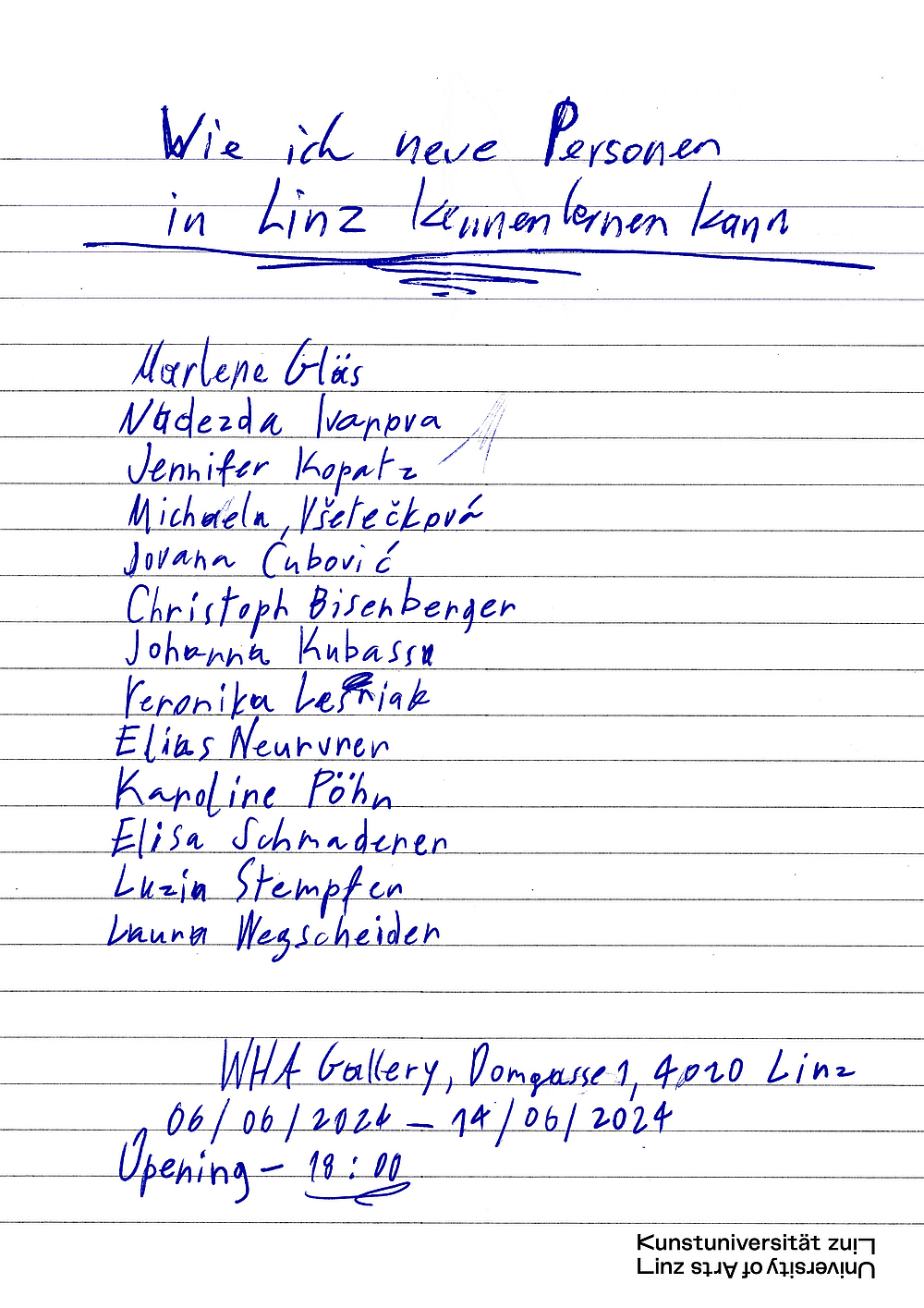
Wie ich neue Personen in Linz kennen lernen kann
Eröffnung: 6. Juni 2024; Ausstellung bis 14. Juni 2024 Galerie WHA, Domgasse 1, 4020 Linz
Projekt im Rahmen des Kurses „Künstlerbuch“ von Svetlana Shuvaeva, Experimentelle Gestaltung.
Wie viele Elemente der in der Ausstellung präsentierten Werke ist auch der Satz „Wie ich neue Menschen in Linz kennen lernen kann“ eine gefundene Phrase. Es gibt keinen Aufschluss über das Verständnis der ausgestellten Werke, stellt jedoch einen wichtigen Leitfaden für die bevorstehenden Treffen dar. Die Treffen von Menschen, die sich irgendwie für Bücher interessieren. Die meisten Ausstellungsteilnehmer formierten sich rund um den Experimentalkurs „Künstlerbuch“ innerhalb der Experimentellen Gestaltung. Einige Teilnehmer und ihre Arbeiten sind uns spontan im Vorbereitungsprozess der Ausstellung begegnet. Da das Buchformat offensichtlich viele Menschen anzieht, ist es eines der Ziele der Ausstellung, eine Gemeinschaft von Künstlerbuchliebhabern in Linz und darüber hinaus zu bilden.
Neben der Begegnung mit Menschen erleben wir in den ausgestellten Buchobjekten auch die Begegnung ihrer Autoren mit verschiedenen Aspekten ihres Lebens. Wir treffen auf eine alte bestickte Urgroßmutter-Serviette, die wir beim Umzug in ein anderes Land mitgenommen haben. Die Serviette wird zu einem Portal zur Geschichte ihres Schöpfers, den der Autor nie kennengelernt hat. Obwohl der Autor kaum über Informationen verfügt, versucht er, dieses Bild mit grafischen Mitteln für sich selbst zu erstellen. Wir treffen das Lieblingsbuch des Autors, das ihm in einem Moment der Wut in die Hände fiel. Dieses Treffen endet mit seiner Zerstörung und dem anschließenden Wiederaufbau, jedoch in Form einer anderen poetischen Einheit, ausgedrückt in der Dynamik heilender Stiche. Wir erleben das Vergehen der Sommerferien, wenn die Tage langsam zusammenwachsen und sich in verschiedene Muster falten, wie kühlende Schatten in den Gassen. Während der Quarantäne müssen wir uns täglich auf engstem Raum in unserem Zuhause aufhalten. Wir begegnen der Stadt und ihren Werbeplakaten, deren Grafiken im Buch, befreit von ihrer kommerziellen Verantwortung, zu neuem Leben erwachen. Wir stoßen auf die Erkenntnis, dass man Bücher lieben kann, sie aber aus irgendeinem Grund nie liest. Wir begegnen unserem eigenen Körper, der blutet. Es gibt viele verschiedene Begegnungen, deren Echo in unseren vergangenen und zukünftigen Büchern weiterlebt.
Teilnehmende Studierende
Marlene Gläß, Nadezhda Ivanova, Jennifer Kopatz, Michaela Všetečková, Jovana Ćubović, Christoph Biesenberger, Johanna Kubassa, Veronika Lesniak, Elias Neururer, Karoline Pöhn, Elisa Schmaderer, Luzia Stempfer, Laura Wegscheider
Wie ich neue Personen in Linz kennen lernen kann