Welcome at the Interface Culture program website.
Acting as creative artists and researchers, students learn how to advance the state of the art of current interface technologies and applications. Through interdisciplinary research and team work, they also develop new aspects of interface design including its cultural and social applications. The themes elaborated under the Master's programme in relation to interactive technologies include Interactive Environments, Interactive Art, Ubiquitous Computing, game design, VR and MR environments, Sound Art, Media Art, Web-Art, Software Art, HCI research and interaction design.

The Interface Culture program at the Linz University of Arts Department of Media was founded in 2004 by Christa Sommerer and Laurent Mignonneau. The program teaches students of human-machine interaction to develop innovative interfaces that harness new interface technologies at the confluence of art, research, application and design, and to investigate the cultural and social possibilities of implementing them.
The term "interface" is omnipresent nowadays. Basically, it describes an intersection or linkage between different computer systems that makes use of hardware components and software programs to enable the exchange and transmission of digital information via communications protocols.
However, an interface also describes the hook-up between human and machine, whereby the human qua user undertakes interaction as a means of operating and influencing the software and hardware components of a digital system. An interface thus enables human beings to communicate with digital technologies as well as to generate, receive and exchange data. Examples of interfaces in very widespread use are the mouse-keyboard interface and graphical user interfaces (i.e. desktop metaphors). In recent years, though, we have witnessed rapid developments in the direction of more intuitive and more seamless interface designs; the fields of research that have emerged include ubiquitous computing, intelligent environments, tangible user interfaces, auditory interfaces, VR-based and MR-based interaction, multi-modal interaction (camera-based interaction, voice-driven interaction, gesture-based interaction), robotic interfaces, natural interfaces and artistic and metaphoric interfaces.
Artists in the field of interactive art have been conducting research on human-machine interaction for a number of years now. By means of artistic, intuitive, conceptual, social and critical forms of interaction design, they have shown how digital processes can become essential elements of the artistic process.
Ars Electronica and in particular the Prix Ars Electronica's Interactive Art category launched in 1991 has had a powerful impact on this dialog and played an active role in promoting ongoing development in this field of research.
The Interface Cultures program is based upon this know-how. It is an artistic-scientific course of study to give budding media artists and media theoreticians solid training in creative and innovative interface design. Artistic design in these areas includes interactive art, netart, software art, robotic art, soundart, noiseart, games & storytelling and mobile art, as well as new hybrid fields like genetic art, bioart, spaceart and nanoart.
It is precisely this combination of technical know-how, interdisciplinary research and a creative artistic-scientific approach to a task that makes it possible to develop new, creative interfaces that engender progressive and innovative artistic-creative applications for media art, media design, media research and communication.
Tina Blau. Im Freien
31. Jänner 2026 bis 25. Mai 2026 Museum Pfalzgalerie, Museumsplatz 1, Kaiserslautern (D)
Interface Culture Universitätsprofessor Laurent Mignonneau stellt im Museum Pfalzgalerie Kaiserslautern aus. Gezeigt wird die interaktive Installation Interactive Plant Growing - entstanden durch die Zusammenarbeit von Christa Sommerer und Laurent Mignonneau.
Sie zählt zu den bedeutendsten österreichischen Landschaftsmalerinnen. Meisterhaft fängt sie das Licht ein, wie es durch Wolkenschichten bricht oder Schatten unter Bäumen wirft. Und doch ist Tina Blau nahezu unbekannt. Das mpk stellt sie umfassend in einer Ausstellung vor. Als Impressionistin malte sie en plein air, direkt vor dem Motiv, und entwickelte so ihre Bildsprache, mit der Tina Blau den Aufbruch in die Moderne wagte. Zwischen 1872 und 1916 entstanden außergewöhnliche Werke, die die Malerin während ihrer zahlreichen Studienreisen u.a. nach Italien, Frankreich und in die Niederlande geschaffen hat. Zu ihren Lebzeiten nahm Tina Blau an wichtigen Ausstellungen teil, fand, wie wenige Malerinnen, Käufer für ihre avantgardistische Kunst und übte Lehrtätigkeiten an neu gegründeten Kunstschulen für Mädchen und jungen Frauen in München und Wien aus. In diesem Kontext zielt die Ausstellung darauf ab, die Rolle Tina Blaus als eine durchsetzungsfähige Frau und ihre Position als großartige Landschaftsmalerin in einem männerdominierten Kunstbetrieb hervorzuheben und zu profilieren.
Mit den Künstler*innen Simone Nieweg, Fotografie, Christa Sommerer & Laurent Mignonneau, interaktive Installation.
Kuratorin: Dr.in Annette Reich
Interactive Plant Growing
(Christa Sommerer & Laurent Mignonneau, 1992)
The rate of growth deserves to be studied as a necessary preliminary to the theoretical study of form, and organic form itself is found, mathematically speaking, to be a function of time. (....) We might call the form of an organism an event in space-time, and not merely a configuration in space." (D´Arcy Thompson,On Growth and Form, Cambridge University Press,1942.) "Interactive Plant Growing" is an installation, which deals with the principle of the growth of virtual plant organisms and their change and modification in real time in the 3-dimensional virtual space of a computer. These modifications of predefined "artificially living plant organisms" are mainly based on the principle of development and evolution in time. The artificial growing of program - based plants is an expression of the desire to discover the principle of life, which is always defined by the transformations and morphogenesis of certain organisms. Interactive Plant Growing connects the real time growing of virtual plants in the tridimensional space of the computer to real living plants, which can be touched or approached by human viewers differentiation.
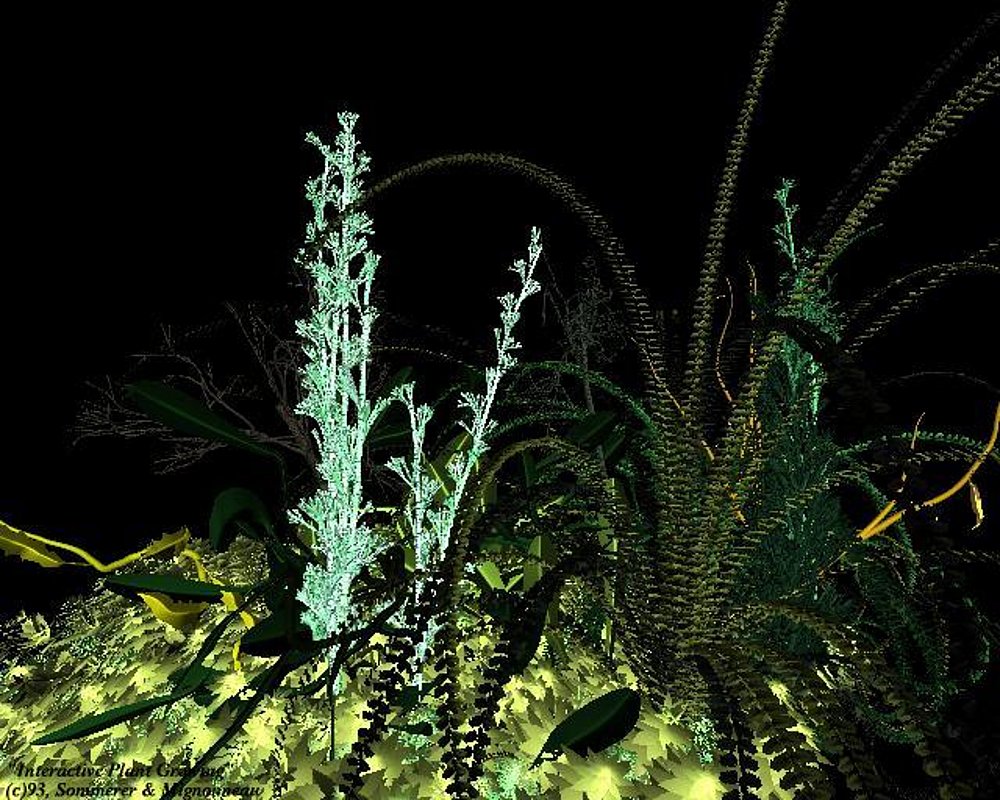
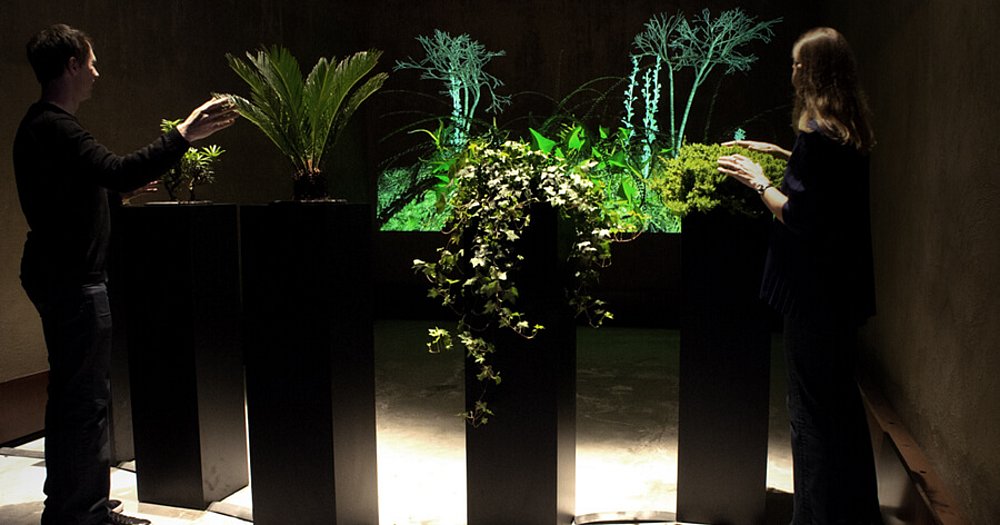
"Interactive Plant Growing" (1992) © Christa Sommerer & Laurent Mignonneau