Welcome at the Interface Culture program website.
Acting as creative artists and researchers, students learn how to advance the state of the art of current interface technologies and applications. Through interdisciplinary research and team work, they also develop new aspects of interface design including its cultural and social applications. The themes elaborated under the Master's programme in relation to interactive technologies include Interactive Environments, Interactive Art, Ubiquitous Computing, game design, VR and MR environments, Sound Art, Media Art, Web-Art, Software Art, HCI research and interaction design.

The Interface Culture program at the Linz University of Arts Department of Media was founded in 2004 by Christa Sommerer and Laurent Mignonneau. The program teaches students of human-machine interaction to develop innovative interfaces that harness new interface technologies at the confluence of art, research, application and design, and to investigate the cultural and social possibilities of implementing them.
The term "interface" is omnipresent nowadays. Basically, it describes an intersection or linkage between different computer systems that makes use of hardware components and software programs to enable the exchange and transmission of digital information via communications protocols.
However, an interface also describes the hook-up between human and machine, whereby the human qua user undertakes interaction as a means of operating and influencing the software and hardware components of a digital system. An interface thus enables human beings to communicate with digital technologies as well as to generate, receive and exchange data. Examples of interfaces in very widespread use are the mouse-keyboard interface and graphical user interfaces (i.e. desktop metaphors). In recent years, though, we have witnessed rapid developments in the direction of more intuitive and more seamless interface designs; the fields of research that have emerged include ubiquitous computing, intelligent environments, tangible user interfaces, auditory interfaces, VR-based and MR-based interaction, multi-modal interaction (camera-based interaction, voice-driven interaction, gesture-based interaction), robotic interfaces, natural interfaces and artistic and metaphoric interfaces.
Artists in the field of interactive art have been conducting research on human-machine interaction for a number of years now. By means of artistic, intuitive, conceptual, social and critical forms of interaction design, they have shown how digital processes can become essential elements of the artistic process.
Ars Electronica and in particular the Prix Ars Electronica's Interactive Art category launched in 1991 has had a powerful impact on this dialog and played an active role in promoting ongoing development in this field of research.
The Interface Cultures program is based upon this know-how. It is an artistic-scientific course of study to give budding media artists and media theoreticians solid training in creative and innovative interface design. Artistic design in these areas includes interactive art, netart, software art, robotic art, soundart, noiseart, games & storytelling and mobile art, as well as new hybrid fields like genetic art, bioart, spaceart and nanoart.
It is precisely this combination of technical know-how, interdisciplinary research and a creative artistic-scientific approach to a task that makes it possible to develop new, creative interfaces that engender progressive and innovative artistic-creative applications for media art, media design, media research and communication.
Vulnerability of the Moving Body
28. Jänner 2026, 14.00 Uhr Kunstuniversität Linz, Domgasse 1, Audimax A
Die Abteilung Kunstgeschichte / Kunsttheorie lädt zum Gastvortrag im Rahmen der Gastprofessur von Attilia Fattori Franchini.
This lecture reflects on what it means to build a performance programme from the ground up within a contemporary art institution, especially at a moment when live work demands new forms of attention, care, and structural commitment. It outlines the strategies developed to carve out space and duration for performance within environments that often celebrate experimentation rhetorically while restricting it structurally.
Anchored in vulnerability as a guiding concept, the lecture examines the dynamics between artist, institution, and audience, considering how embracing the precarious, the embodied, and the time-based can challenge institutional habits and open pathways toward more responsive and imaginative cultural infrastructures.
Joel Valabrega is a curator based in Porto and Milan. In 2024, she curated the Luxembourg Pavilion at the 60th International Venice Biennale and the Present Future section of Artissima Art Fair (Nov 2024 and Nov 2025). From 2020 to 2024, she was Curator of Performance and Moving Image at Mudam—Museum of Modern Art, Luxembourg, and in 2025, she became Head of Programme / Curator at Galeria Municipal do Porto.
Recent projects include the performance festival Fogo Fátuo(2025), the experimental exhibition Workers in Song by Billy Bultheel & James Richards (2024), the performative group exhibition After Laughter Comes Tears (2023), and the performance festival The Illusion of the End (2022). From 2016 to 2022, Valabrega co-ran the project space MEGA in Milan and has held curatorial roles at institutions such as V-A-C Foundation in Moscow and Venice (2018–19) and Triennale Milano (2020).
She edited After Laughter Comes Tears (Lenz Press, 2023), Tarek Atoui: Waters’ Witness #02 (Mudam/Les presses du réel, 2022), and the artist book form is void void is color (2020), and contributes regularly to exhibition catalogues and magazines.
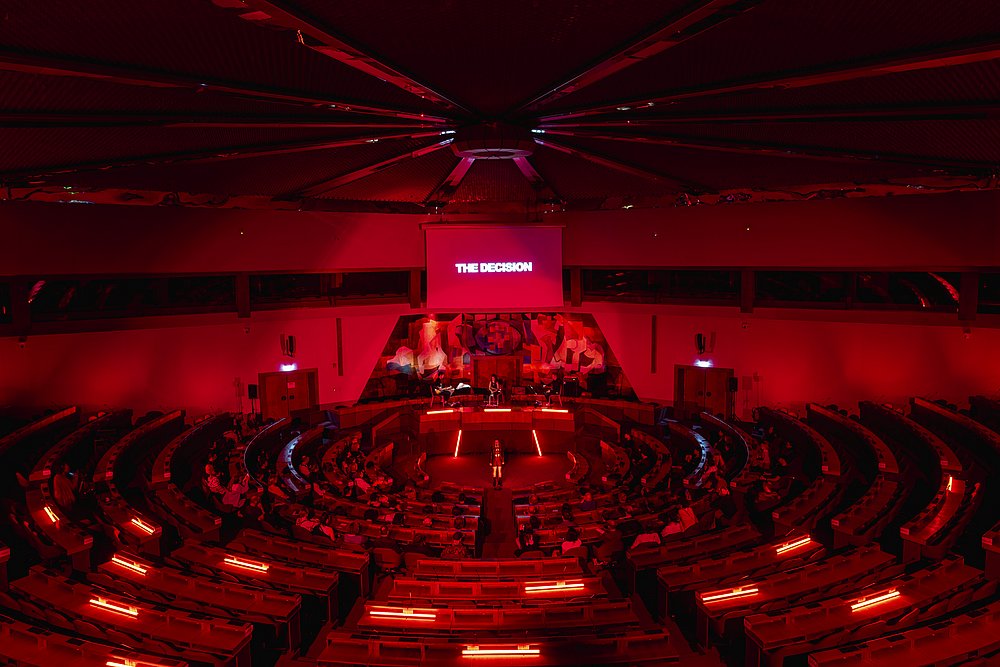
© Fabrizio Vatieri