Welcome at the Interface Culture program website.
Acting as creative artists and researchers, students learn how to advance the state of the art of current interface technologies and applications. Through interdisciplinary research and team work, they also develop new aspects of interface design including its cultural and social applications. The themes elaborated under the Master's programme in relation to interactive technologies include Interactive Environments, Interactive Art, Ubiquitous Computing, game design, VR and MR environments, Sound Art, Media Art, Web-Art, Software Art, HCI research and interaction design.

The Interface Culture program at the Linz University of Arts Department of Media was founded in 2004 by Christa Sommerer and Laurent Mignonneau. The program teaches students of human-machine interaction to develop innovative interfaces that harness new interface technologies at the confluence of art, research, application and design, and to investigate the cultural and social possibilities of implementing them.
The term "interface" is omnipresent nowadays. Basically, it describes an intersection or linkage between different computer systems that makes use of hardware components and software programs to enable the exchange and transmission of digital information via communications protocols.
However, an interface also describes the hook-up between human and machine, whereby the human qua user undertakes interaction as a means of operating and influencing the software and hardware components of a digital system. An interface thus enables human beings to communicate with digital technologies as well as to generate, receive and exchange data. Examples of interfaces in very widespread use are the mouse-keyboard interface and graphical user interfaces (i.e. desktop metaphors). In recent years, though, we have witnessed rapid developments in the direction of more intuitive and more seamless interface designs; the fields of research that have emerged include ubiquitous computing, intelligent environments, tangible user interfaces, auditory interfaces, VR-based and MR-based interaction, multi-modal interaction (camera-based interaction, voice-driven interaction, gesture-based interaction), robotic interfaces, natural interfaces and artistic and metaphoric interfaces.
Artists in the field of interactive art have been conducting research on human-machine interaction for a number of years now. By means of artistic, intuitive, conceptual, social and critical forms of interaction design, they have shown how digital processes can become essential elements of the artistic process.
Ars Electronica and in particular the Prix Ars Electronica's Interactive Art category launched in 1991 has had a powerful impact on this dialog and played an active role in promoting ongoing development in this field of research.
The Interface Cultures program is based upon this know-how. It is an artistic-scientific course of study to give budding media artists and media theoreticians solid training in creative and innovative interface design. Artistic design in these areas includes interactive art, netart, software art, robotic art, soundart, noiseart, games & storytelling and mobile art, as well as new hybrid fields like genetic art, bioart, spaceart and nanoart.
It is precisely this combination of technical know-how, interdisciplinary research and a creative artistic-scientific approach to a task that makes it possible to develop new, creative interfaces that engender progressive and innovative artistic-creative applications for media art, media design, media research and communication.
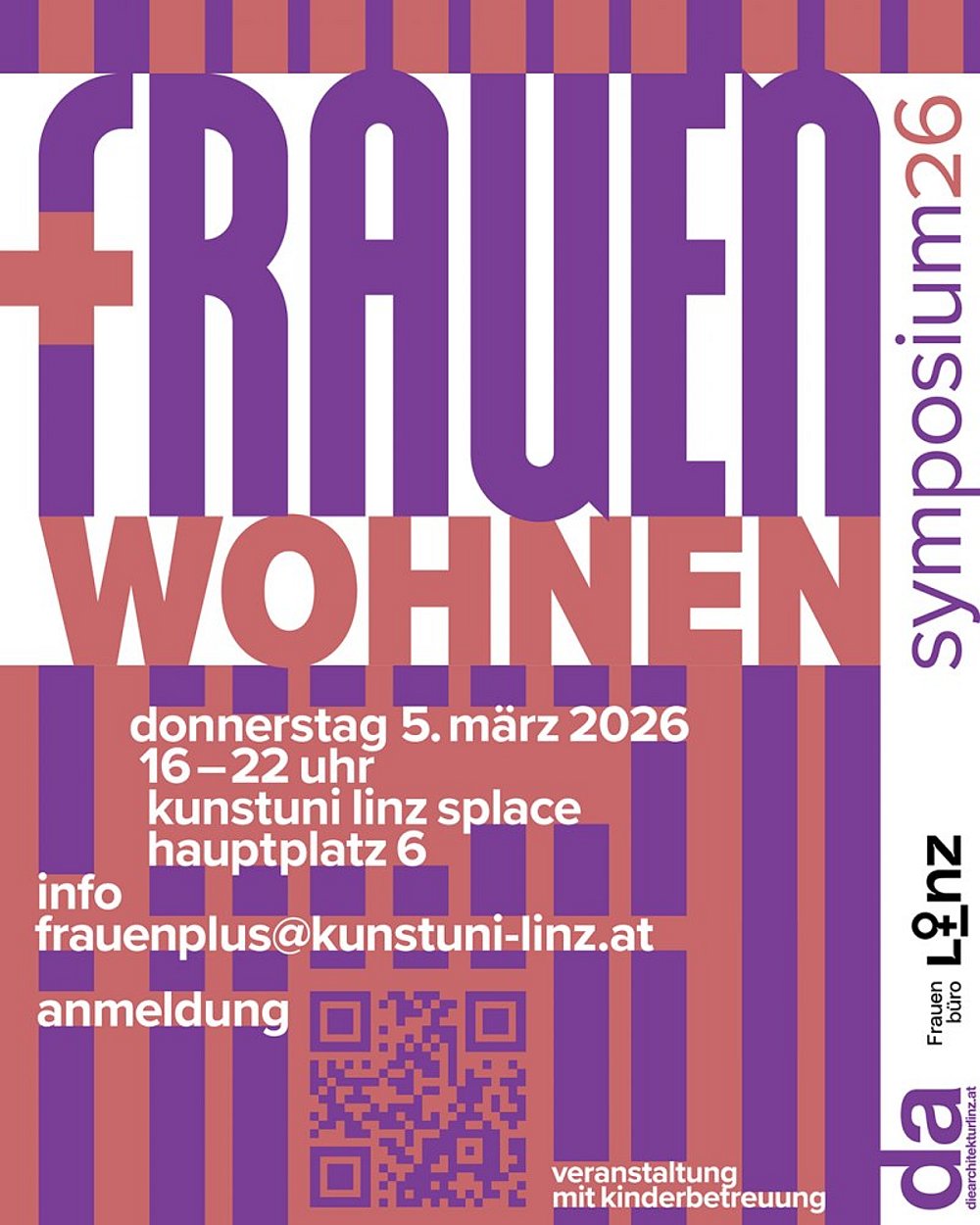
Symposium Frauen + Wohnen
5. März 2026, 16.00 Uhr splace am Hauptplatz, Hauptplatz 6, 4020 Linz
Das Institut für Architektur lädt zum Symposium.
Das Symposium Frauen+Wohnen beleuchtet das Thema Wohnen – konkreter Wohnen von Frauen, Wohnen für Frauen. Wohnpolitik und Wohnmodelle beeinflussen unser tägliches Leben. Historisch wurden Frauen oft von Entscheidungsprozessen in der Architektur und Stadtplanung ausgeschlossen. In Folge wurden ihre Bedürfnisse und Perspektiven nicht ausreichend berücksichtigt.
Vor diesem Hintergrund findet die Auseinandersetzung mit aktuellen und alternativen Wohnpraktiken statt, die zu einer inklusiveren und gerechteren Gesellschaft beitragen können. Von Co-Housing-Projekten bis zu gemeinschaftsbasierten Initiativen entstehen neue oder neu gelebte Wohnformen, die auf Bedürfnisse diverser Lebensrealitäten reagieren. Diese Modelle setzen sich mit Themen wie finanzieller Unabhängigkeit, sozialen Netzwerken und Schutz vor Gewalt auseinander.
Das Potenzial durch hinterfragen sozialer Strukturen, politischer und wirtschaftlicher Rahmenbedingungen Missstände zu thematisieren und daraus Schlüsse zu ziehen, die in reale Wohnpraxis übersetzt oder in den politischen Diskurs aufgenommen werden können, stehen im Fokus.
Ziel der Veranstaltung ist es, Positionen zu präsentieren, zu diskutieren und nachhaltig zu stärken. Die Veranstaltung soll weiters gezielt die Vernetzung unterschiedlicher Fachbereiche und Institutionen anregen.
In Kooperation mit dem Frauenbüro Linz und dem afo, architekturforum oberösterreich. Unterstützt durch die Kunstuniversität Linz, die Kammer der Ziviltechniker*innen | Architekt*innen und Ingenieurkonsulent*innen für Oberösterreich und Salzburg und der Brau Union Österreich AG.
Ablauf der Veranstaltung
16.00 Uhr Begrüßung
16.30 Uhr Sarah Zeller (Projekt JUNO – Zentrum für Getrennt- und Alleinlebende)
17.00 Uhr Katrin Rheingans (Wohnen in beengten Wohnverhältnissen in Haushalten mit Kindern)
17.30 Uhr Marlies Binder (der Remisenhof als Linzer Beispiel)
18.15 Uhr Katrin Pilz (Einküchenhaus, Verein zur Erforschung emanzipatorischer Wohnmodelle)
18.45 Uhr Michaela Moser
19.30 Uhr Podiumsdiskussion
20.30 Uhr Häppchen & gemütlicher Ausklang
Moderation: Antonia Titze
Kinderbetreuung wird vor Ort durch die Kinderfreunde angeboten!
Begleitveranstaltungen
- Ausstellung *wohnen: 12 Studierende stellen ihre Perspektiven auf ausgewählte feministische und queere österreichische Wohnprojekte vor, splace, Galerie der Kunstuniversität Linz
- Buchbesprechung, Theorie im Keller: Sabina Riss: Frauengerechter* Wohnbau in Österreich –
Gleichstellungspolitischer Anspruch und strukturelle Relevanz von Modellprojekten, Mi 11.3.2026, 19:00 im afo, architekturforum oberösterreich - Finissage der Ausstellung *wohnen, Donnerstag, 12. März 2026, 18.00 Uhr im splace, Galerie der Kunstuniversität Linz