
Bachelor Programme Art and Visual Practice (Teacher Training)
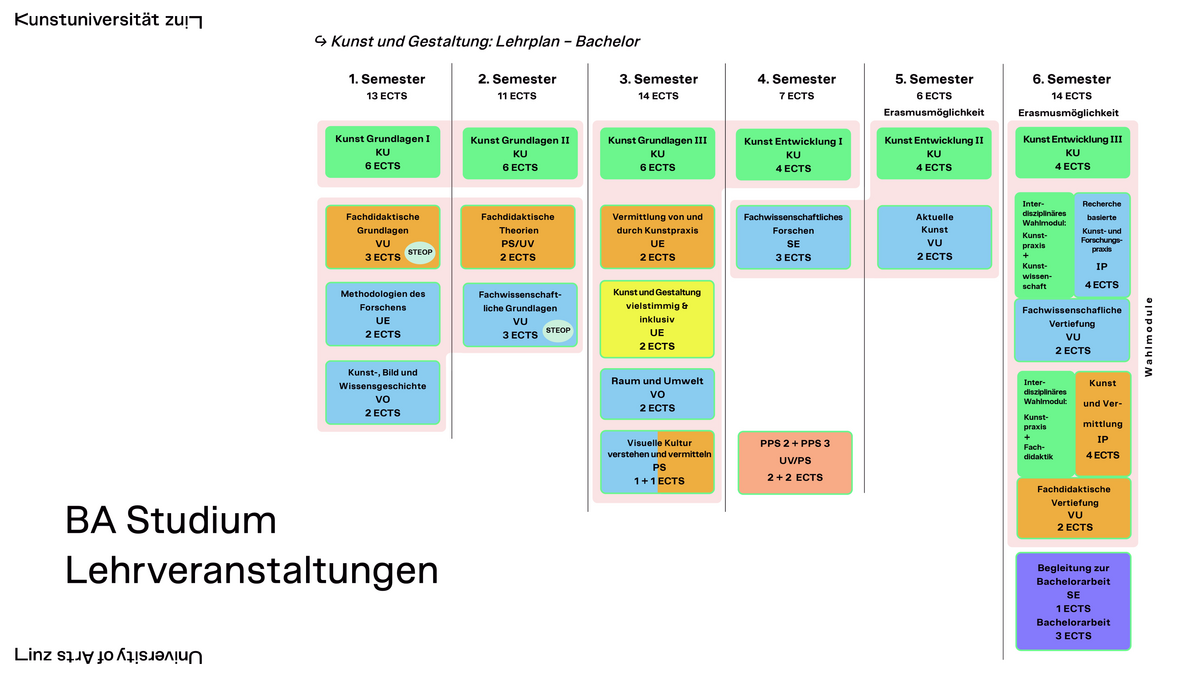
In the Bachelor's degree course in Art and Visual Practice, artistic practice is at the beginning and center of the course. Individual artistic processes, experimental work and the reflective examination of contemporary and historical art form the foundation of the course. Artistic production, reflection and mediation are understood as equally important dimensions of art education practice and tested in their interaction.
Building on this, a solid foundation of didactic and academic skills is developed, enabling students to act in a reflective and responsible pedagogical manner. Practical and theoretical knowledge are combined and taught in such a way that they can be applied confidently in specific teaching situations. Students learn to promote creative thinking and action as well as linguistic expression in a targeted manner and to perceive the personal, cognitive and sensorimotor development of learners in a differentiated way in the context of subject-specific requirements.
A reflective approach to analog and digital media is developed, as is the ability to meaningfully combine subject areas in interdisciplinary projects. Social and affective aspects such as relationship building, teamwork, communication and the ability to deal with conflict are seen as essential prerequisites for an appreciative teaching environment that is conducive to learning.
The course raises awareness of diversity and inclusion and promotes a perspective on school interactions that is critical of discrimination. At the same time, basic scientific, analytical and artistic-research methods are taught in order to systematically reflect on and further develop one's own practice.
Art is understood as a cultural medium of communication whose social significance, particularly in the context of technological change, is analyzed and integrated into pedagogical action.
Teaching on the Bachelor's degree course in Art and Design takes place in studios, workshops and seminar rooms, as well as in places where art is exhibited, produced and discussed, in natural and everyday spaces and in experimental settings.
The aim is an in-depth examination of personal action spaces and the development of relationships with the places we inhabit. Artistic processes open up connections to ourselves and the surrounding environment. Art is understood as an open process that facilitates dialog, creates relationships and actively shapes social spaces.
The combination of subject-specific, artistic and theoretical exploration that is part of the course is reflected in school practice. The educational science and pedagogical-practical training is offered and coordinated by the Center for Pedagogical-Practical Studies (PPS). A total of three internships are planned, including two specialist internships in the subject of art and design, in which the content developed is tested and reflected upon in a school context. PPS CENTER
The Bachelor's degree course thus imparts sound basic knowledge and basic professional skills, which are deepened, expanded and continued in a research-oriented manner in the subsequent Master's degree course. It takes place in cooperation with theUniversity of Teacher Education Upper Austria ph-ooe.at and the Private University College of Teacher Education of the Diocese of Linz www.phdl.at and is thus integrated into a cross-institutional training network that combines subject-specific, didactic and educational science perspectives.
Teacher training program in the Central Cluster - Linz/Salzburg

Master Programme Art and Visual Practice (Teacher Training)
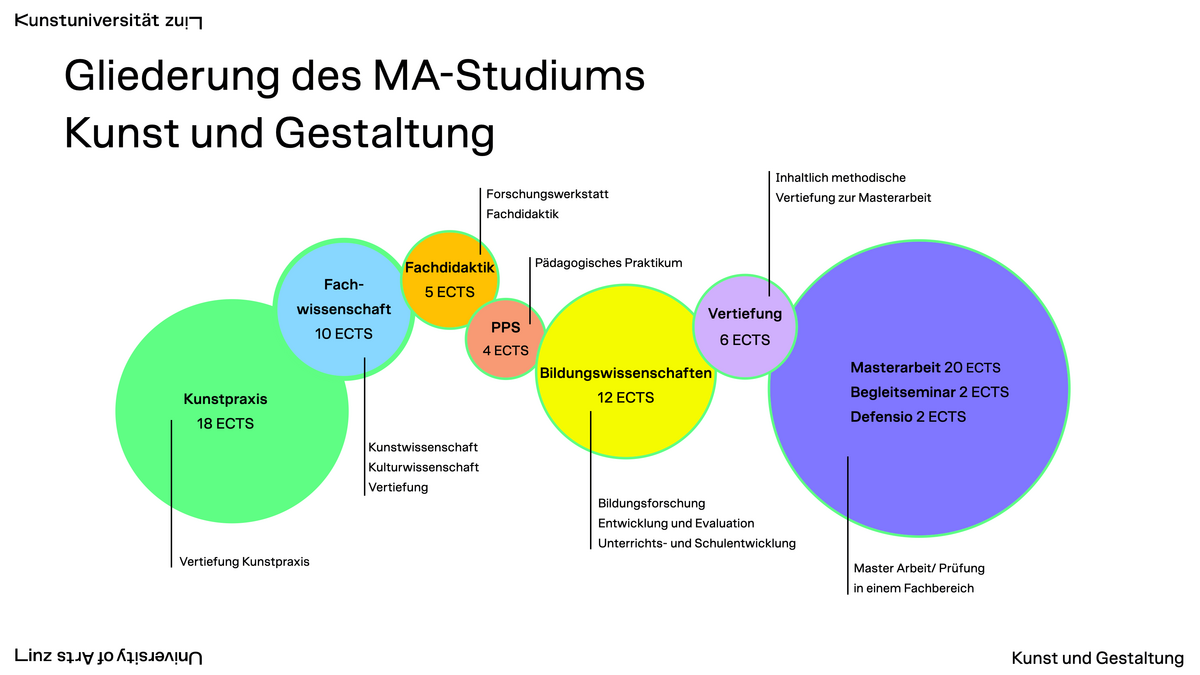
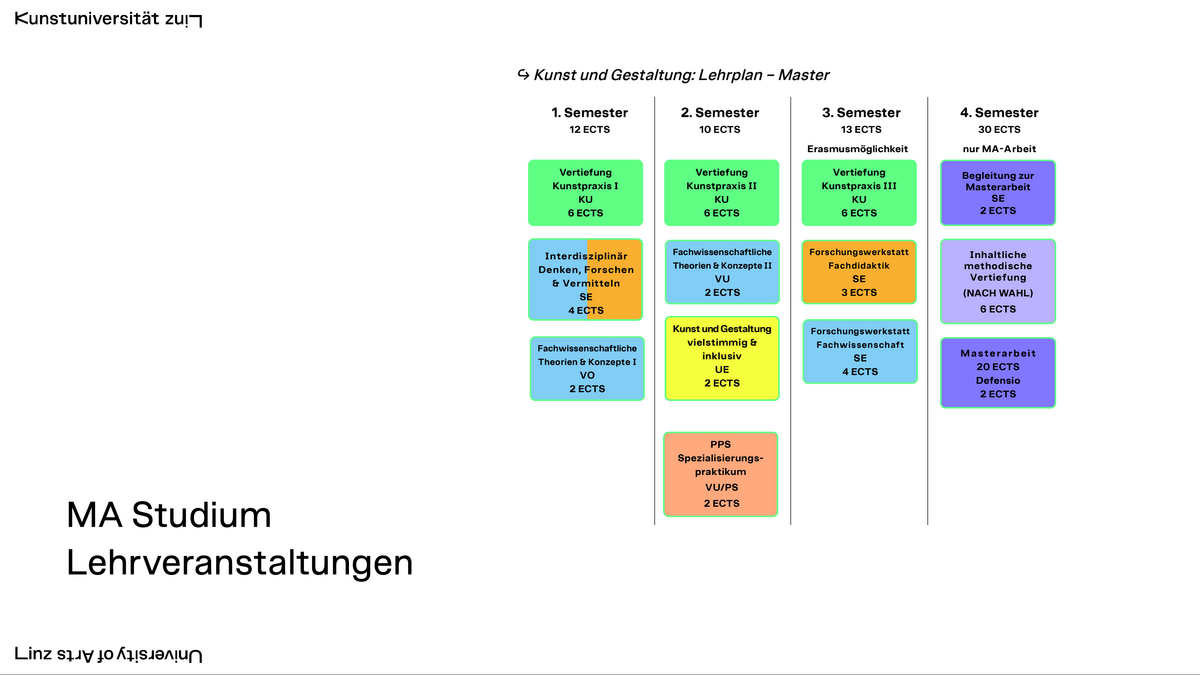
The Master's degree program in Art and Visual Practice is an essential part of the teacher training and systematically builds on the Bachelor's degree program. It imparts the in-depth subject-specific, didactic and academic skills required for the qualified exercise of the teaching profession and consistently continues the professionalization laid down in the Bachelor's degree course.
The artistic, art education and academic skills acquired in the Bachelor's degree program are systematically deepened and expanded. The course strengthens the mutual interpenetration of artistic practice, subject didactics and subject science and intensifies the interdisciplinary dialog. In this way, a networked way of thinking and acting is promoted, which can reflect on and professionally deal with complex technical, social and school-related issues.
The continuous professional exchange between students and teachers is closely linked to artistic processes and school situations. In a dialogical process, concrete teaching experiences, artistic projects and didactic issues are jointly reflected upon, theoretically substantiated and further developed. On this basis, independent focal points and challenging projects are created in which artistic, didactic and academic perspectives are brought together.
This creates the prerequisites for reflective and confident action in the school context.
Links
Curricula Bachlor Programme Teacher Training
Credits/recognition
Central media workshop
(video editing suites, video studio, photo studio, darkrooms, recording studio and equipment rental)
ÖH
www.kuenstlerischepraxis.at
Course lists
Curriculum
The current curriculum comes into force at the start of the course in October 2026. Curriculum 2026
The 2024 curriculum expires on September 30, 2029. Curriculum 2024