Welcome at the Interface Culture program website.
Acting as creative artists and researchers, students learn how to advance the state of the art of current interface technologies and applications. Through interdisciplinary research and team work, they also develop new aspects of interface design including its cultural and social applications. The themes elaborated under the Master's programme in relation to interactive technologies include Interactive Environments, Interactive Art, Ubiquitous Computing, game design, VR and MR environments, Sound Art, Media Art, Web-Art, Software Art, HCI research and interaction design.

The Interface Culture program at the Linz University of Arts Department of Media was founded in 2004 by Christa Sommerer and Laurent Mignonneau. The program teaches students of human-machine interaction to develop innovative interfaces that harness new interface technologies at the confluence of art, research, application and design, and to investigate the cultural and social possibilities of implementing them.
The term "interface" is omnipresent nowadays. Basically, it describes an intersection or linkage between different computer systems that makes use of hardware components and software programs to enable the exchange and transmission of digital information via communications protocols.
However, an interface also describes the hook-up between human and machine, whereby the human qua user undertakes interaction as a means of operating and influencing the software and hardware components of a digital system. An interface thus enables human beings to communicate with digital technologies as well as to generate, receive and exchange data. Examples of interfaces in very widespread use are the mouse-keyboard interface and graphical user interfaces (i.e. desktop metaphors). In recent years, though, we have witnessed rapid developments in the direction of more intuitive and more seamless interface designs; the fields of research that have emerged include ubiquitous computing, intelligent environments, tangible user interfaces, auditory interfaces, VR-based and MR-based interaction, multi-modal interaction (camera-based interaction, voice-driven interaction, gesture-based interaction), robotic interfaces, natural interfaces and artistic and metaphoric interfaces.
Artists in the field of interactive art have been conducting research on human-machine interaction for a number of years now. By means of artistic, intuitive, conceptual, social and critical forms of interaction design, they have shown how digital processes can become essential elements of the artistic process.
Ars Electronica and in particular the Prix Ars Electronica's Interactive Art category launched in 1991 has had a powerful impact on this dialog and played an active role in promoting ongoing development in this field of research.
The Interface Cultures program is based upon this know-how. It is an artistic-scientific course of study to give budding media artists and media theoreticians solid training in creative and innovative interface design. Artistic design in these areas includes interactive art, netart, software art, robotic art, soundart, noiseart, games & storytelling and mobile art, as well as new hybrid fields like genetic art, bioart, spaceart and nanoart.
It is precisely this combination of technical know-how, interdisciplinary research and a creative artistic-scientific approach to a task that makes it possible to develop new, creative interfaces that engender progressive and innovative artistic-creative applications for media art, media design, media research and communication.
Siegfried Fruhauf feiert Weltpremiere auf der Berlinale
Der Lehrende und Absolvent der Kunstuniversität Linz Siegfried Fruhauf präsentiert auf der Berlinale seinen Film FLIM FLAM. Die 76. internationalen Filmfestspiele finden vom 12. bis 22. Februar 2026 in Berlin statt.
FLIM FLAM beginnt mit einer Anweisung: „Focus on the center for one minute!“ (Konzentrieren Sie sich eine Minute lang auf die Mitte!), bevor ein Muster aus konzentrischen Kreisen erscheint, die von der Makroaufnahme einer Kinoleinwand abgeleitet sind und im Uhrzeigersinn vor einem körnigen, grau-weißen Feld rotieren. Sie überholen und überdecken einander, verschmelzen vorübergehend, um an den Rändern kleine Wellen und Wirbel, Spiralen innerhalb von Spiralen zu schlagen, ehe sie völlig zum Halt kommen. Die Punkte frieren fest; der Blick der Betrachtenden jedoch bewegt sich weiter, taumelt unsicher von einer Seite zur anderen.
Der altmodische Begriff „flim-flam“ bezeichnet einen normalerweise von Hochstapler:innen oder Magier:innen ausgeführten Akt der Täuschung. Auch Film besitzt für Fruhauf diese Fähigkeit. Er überzeugt das Publikum, die Zweifel beiseite zu legen und sich völlig seiner Illusion hinzugeben, auch wenn diese Realität augenscheinlich konstruiert ist. Ununterbrochen blitzt ein aus Rufzeichen bestehendes Raster, zoomt ein und aus, schwenkt hin und her und scheint dabei größere Diagramme, Wortteile und nicht entzifferbare Zeichen zu formen. An irgendeinem Punkt fiel mir auf, dass diese Interpunktion umgedreht, auf den Kopf gestellt wurde, während ich vom Schwall an Information, der hochrasanten Betriebsamkeit und dem im Hintergrund laufenden hörbaren Prasseln von Regen auf der Tonspur abgelenkt war. Ganz ähnlich hält eine metronomische Taktspur ein unbarmherziges mechanisches Tempo aufrecht, während stotterndes Archivmaterial von rennenden Zebras übereinandergelegt, verlangsamt oder beschleunigt wird und sich in eine amorphe Masse auflöst: Das Zebra tarnt sich, indem es nicht mehr von der Herde zu unterscheiden ist.
Allerdings geht es dabei um mehr als um filmische Taschenspielertricks. Fruhauf kehrt zu Aufnahmen eines Miniatur-Spielzeugzebras zurück, das zwischen den Handflächen eines Kindes gehalten wird. Dieser Filmausschnitt wird geschnitten, geklebt, umgekehrt und bis an die Grenzen der Unlesbarkeit manipuliert. Gleichermaßen wird mit dem Spielzeug gespielt, das durch Öffnen und Schließen der Hände abwechselnd verborgen und offengelegt wird. Die vorgebliche „Wahrheit“, die Film verspricht, hängt immer vom jeweiligen Blickwinkel bzw. der Position ab, von Rahmung, Zusammenhang und Beweggründen. Dieses Medium ist inhärent unzuverlässig, rutschig und Veränderungen unterworfen. Es steckt sogar unmittelbar im Titel: Einmal schnell die Buchstaben getauscht, und aus „Flim“ wird plötzlich „Film“. (Chris Clarke, Übersetzung: Thomas Taborsky)
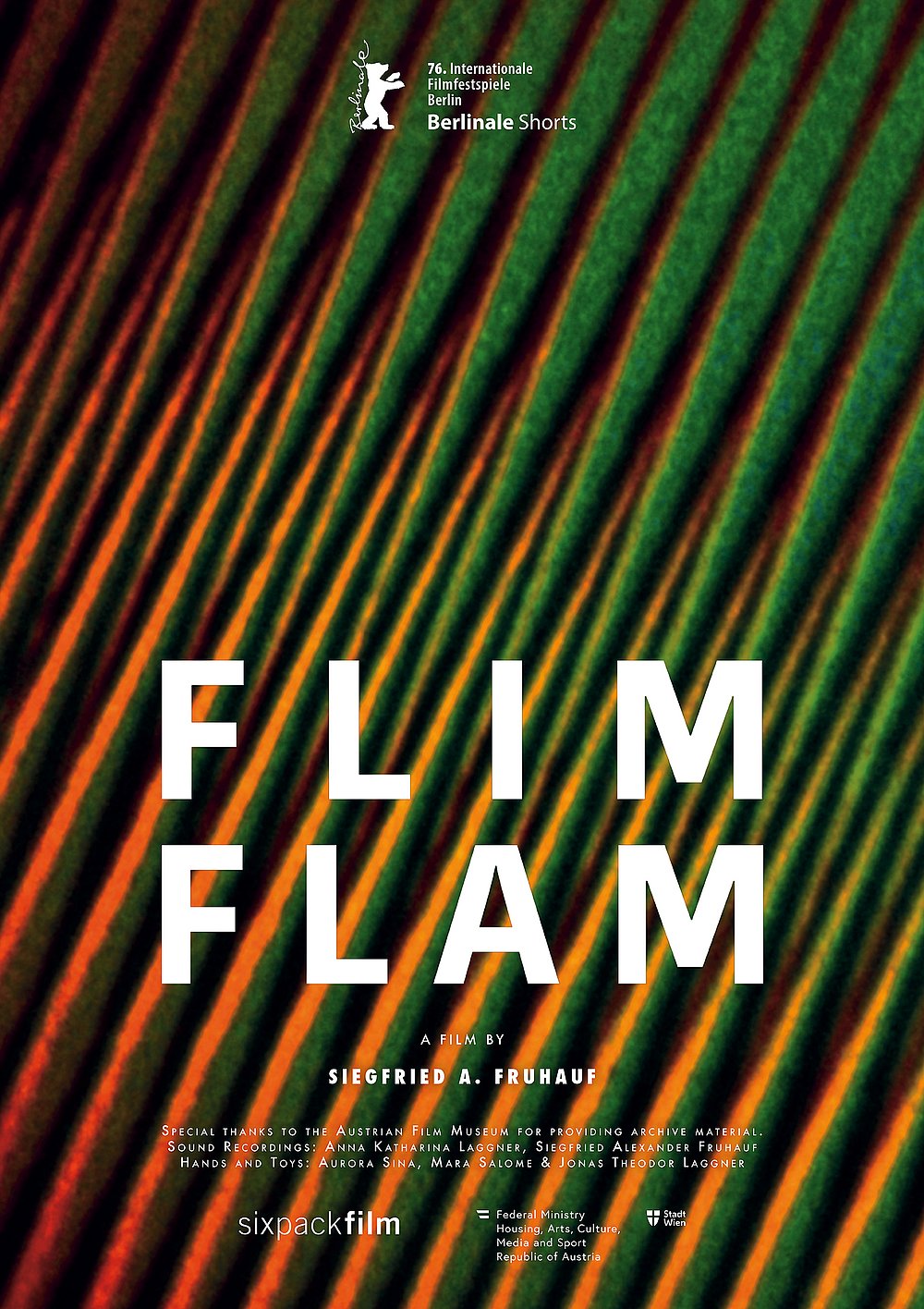
Filmplakat "FLIM FLAM", 2026