Welcome at the Interface Culture program website.
Acting as creative artists and researchers, students learn how to advance the state of the art of current interface technologies and applications. Through interdisciplinary research and team work, they also develop new aspects of interface design including its cultural and social applications. The themes elaborated under the Master's programme in relation to interactive technologies include Interactive Environments, Interactive Art, Ubiquitous Computing, game design, VR and MR environments, Sound Art, Media Art, Web-Art, Software Art, HCI research and interaction design.

The Interface Culture program at the Linz University of Arts Department of Media was founded in 2004 by Christa Sommerer and Laurent Mignonneau. The program teaches students of human-machine interaction to develop innovative interfaces that harness new interface technologies at the confluence of art, research, application and design, and to investigate the cultural and social possibilities of implementing them.
The term "interface" is omnipresent nowadays. Basically, it describes an intersection or linkage between different computer systems that makes use of hardware components and software programs to enable the exchange and transmission of digital information via communications protocols.
However, an interface also describes the hook-up between human and machine, whereby the human qua user undertakes interaction as a means of operating and influencing the software and hardware components of a digital system. An interface thus enables human beings to communicate with digital technologies as well as to generate, receive and exchange data. Examples of interfaces in very widespread use are the mouse-keyboard interface and graphical user interfaces (i.e. desktop metaphors). In recent years, though, we have witnessed rapid developments in the direction of more intuitive and more seamless interface designs; the fields of research that have emerged include ubiquitous computing, intelligent environments, tangible user interfaces, auditory interfaces, VR-based and MR-based interaction, multi-modal interaction (camera-based interaction, voice-driven interaction, gesture-based interaction), robotic interfaces, natural interfaces and artistic and metaphoric interfaces.
Artists in the field of interactive art have been conducting research on human-machine interaction for a number of years now. By means of artistic, intuitive, conceptual, social and critical forms of interaction design, they have shown how digital processes can become essential elements of the artistic process.
Ars Electronica and in particular the Prix Ars Electronica's Interactive Art category launched in 1991 has had a powerful impact on this dialog and played an active role in promoting ongoing development in this field of research.
The Interface Cultures program is based upon this know-how. It is an artistic-scientific course of study to give budding media artists and media theoreticians solid training in creative and innovative interface design. Artistic design in these areas includes interactive art, netart, software art, robotic art, soundart, noiseart, games & storytelling and mobile art, as well as new hybrid fields like genetic art, bioart, spaceart and nanoart.
It is precisely this combination of technical know-how, interdisciplinary research and a creative artistic-scientific approach to a task that makes it possible to develop new, creative interfaces that engender progressive and innovative artistic-creative applications for media art, media design, media research and communication.
HALLO ERDE
Ausstellung 20. bis 24. April 2026 Kunstuniversität Linz, Hauptplatz 8, Hörsaal E
Vernissage & Finissage: 24. April, 2026, 17.00 bis 23.00 Uhr
im Rahmen der Langen Nacht der Forschung.
Eine sich entwickelnde Ausstellung im Rahmen der Diskursveranstaltung Let’s talk about... Regeneration and Repair, der Abteilung Kunst und Gestaltung.
Montagmorgen Hörsaal E: Menschen, Stühle, Material, Vorträge, Inputs. Drei Tage Zeit. Skulpturen sind der Auftrag. Das Material: biologisch abbaubar, Zero Footprint. Wir quetschen und rollen, wir schnüren und pappen, hoffen, dass alles hält. Lehm trifft Jute, Ton auf Äste. Spucke und Ketchup sind Klebstoff. Rote Rübe: tolle Farben. Freitagabend Hörsaal E: Eine Ausstellung. Ein Umgang mit Raum, Form und Vergänglichkeit. Aufstellen und Umfallen, Idee und Schwerkraft. Das Ergebnis wandert auf den Kompost. Jetzt.
Die Ausstellung HALLO ERDE ist kein fertiges Ergebnis, sondern ein offener Prozess. Sie versteht sich als Labor, in dem Studierende experimentieren und sich auf regenerative Kreisläufe einlassen. Im Mittelpunkt stehen nicht abgeschlossene Werke, sondern konkrete Handlungen. Der Raum wird zum offenen Feld, in dem Werkzeuge, Farben und Materialien nicht neutral eingesetzt, sondern gemeinsam befragt und erprobt werden – als Bedingungen neuer Formen des Zusammen-Seins. Der Ausstellungsraum ist eine Einladung zum Mitdenken, Umarbeiten, Reparieren, Liegenlassen sowie zum Wieder- oder Andersverwenden.
Re-Generation wird als Haltung und Methode verstanden – als achtsamer Umgang mit Material, Zeit und Verantwortung. Am Ende geht nichts verloren: Materialien fließen zurück in den Kreislauf, werden Kompost und zur Grundlage für neue lebendige Prozesse außerhalb der Kunstuniversität.
Mit Beiträgen u.a. von Gundula Allerstorfer, Christina Berer, Juli Doppler, Livia Eibl, Jana Fleischmann, Kerstin Fürweger, Susanna Elfi Geiblinger, Melina Gold, Theresa Hohenthal, Alina Hinterhölzl, Michelle Juhasz, Eliseo Kettwig, Niko Koller, Sophie Kronlachner, Justina Liberman, Lena Lorenz, Lara Neuburger, Maren Oberleitner, Teresa Pawlowski, Markus Pötzlberger, Emily Schauer, Celina Schmalzer, Amelie Steinek, Jakob Maria Stöger, Philipp Stiebitzhofer, Emma Straßer, Gulnar Tinkhauser, Naya Liliane Töbich, Klara Weingartner, Katharina Weinhandl, Katharina Wolschlager.
Konzipiert von der Abteilung Kunst und Gestaltung (Stefan Brandmayr, Nikolaus Gansterer, Christoph Holzeis, Moritz Matschke, Jutta Strohmaier)
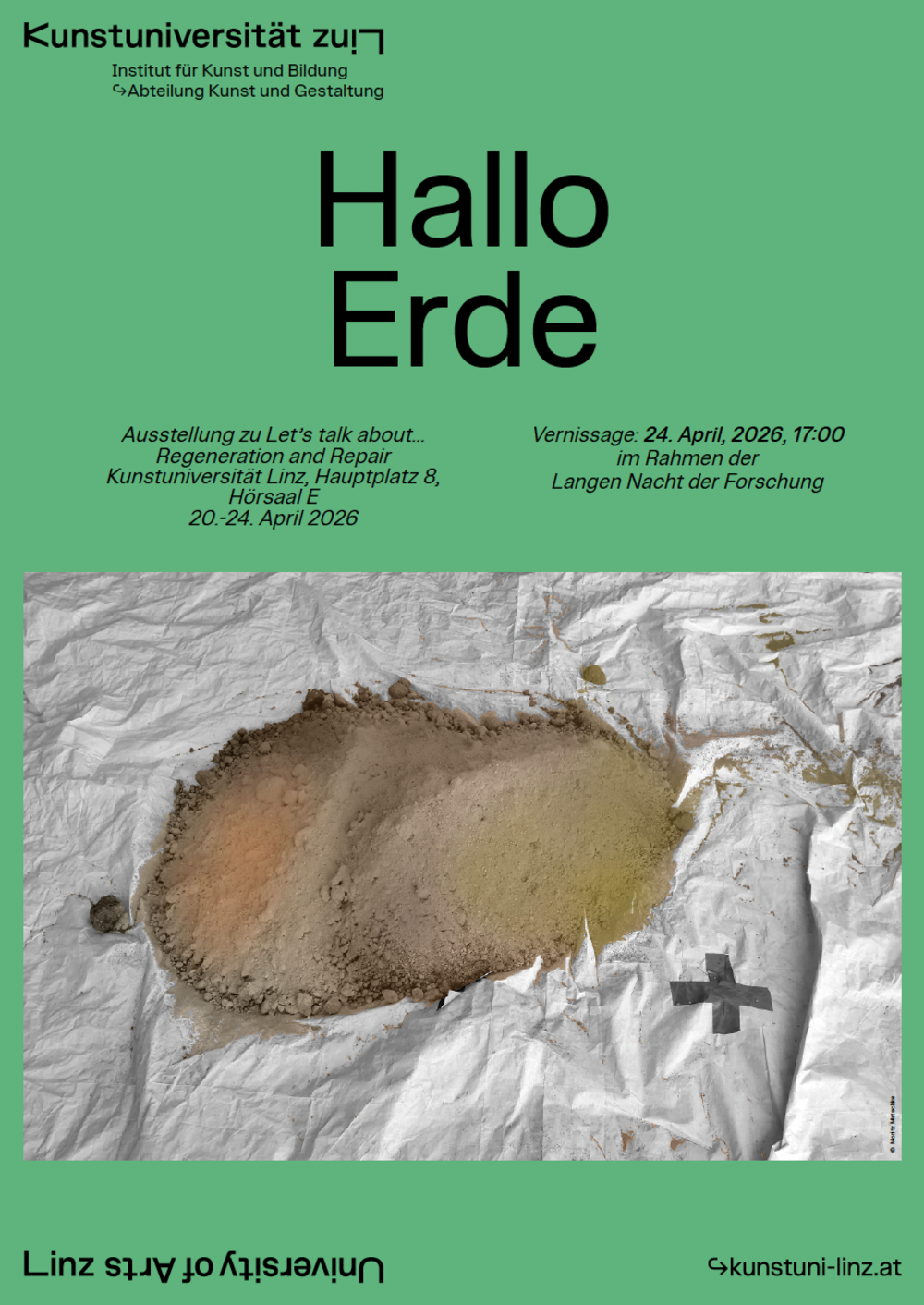
Plakat zur Ausstellung "HALLO ERDE"
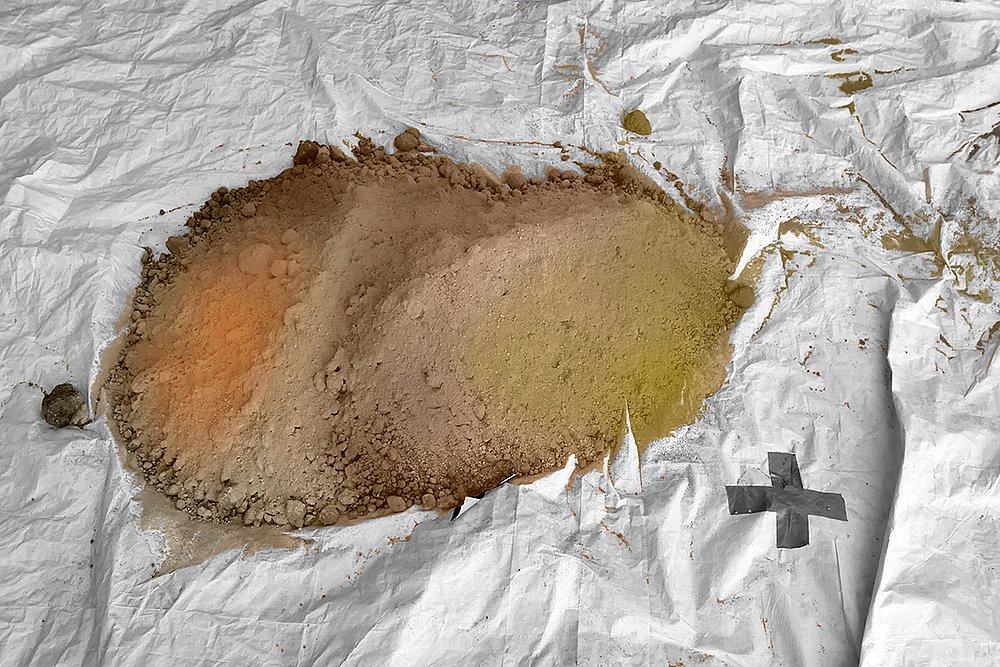
"HALLO ERDE" © Moritz Matschke