Welcome at the Interface Culture program website.
Acting as creative artists and researchers, students learn how to advance the state of the art of current interface technologies and applications. Through interdisciplinary research and team work, they also develop new aspects of interface design including its cultural and social applications. The themes elaborated under the Master's programme in relation to interactive technologies include Interactive Environments, Interactive Art, Ubiquitous Computing, game design, VR and MR environments, Sound Art, Media Art, Web-Art, Software Art, HCI research and interaction design.

The Interface Culture program at the Linz University of Arts Department of Media was founded in 2004 by Christa Sommerer and Laurent Mignonneau. The program teaches students of human-machine interaction to develop innovative interfaces that harness new interface technologies at the confluence of art, research, application and design, and to investigate the cultural and social possibilities of implementing them.
The term "interface" is omnipresent nowadays. Basically, it describes an intersection or linkage between different computer systems that makes use of hardware components and software programs to enable the exchange and transmission of digital information via communications protocols.
However, an interface also describes the hook-up between human and machine, whereby the human qua user undertakes interaction as a means of operating and influencing the software and hardware components of a digital system. An interface thus enables human beings to communicate with digital technologies as well as to generate, receive and exchange data. Examples of interfaces in very widespread use are the mouse-keyboard interface and graphical user interfaces (i.e. desktop metaphors). In recent years, though, we have witnessed rapid developments in the direction of more intuitive and more seamless interface designs; the fields of research that have emerged include ubiquitous computing, intelligent environments, tangible user interfaces, auditory interfaces, VR-based and MR-based interaction, multi-modal interaction (camera-based interaction, voice-driven interaction, gesture-based interaction), robotic interfaces, natural interfaces and artistic and metaphoric interfaces.
Artists in the field of interactive art have been conducting research on human-machine interaction for a number of years now. By means of artistic, intuitive, conceptual, social and critical forms of interaction design, they have shown how digital processes can become essential elements of the artistic process.
Ars Electronica and in particular the Prix Ars Electronica's Interactive Art category launched in 1991 has had a powerful impact on this dialog and played an active role in promoting ongoing development in this field of research.
The Interface Cultures program is based upon this know-how. It is an artistic-scientific course of study to give budding media artists and media theoreticians solid training in creative and innovative interface design. Artistic design in these areas includes interactive art, netart, software art, robotic art, soundart, noiseart, games & storytelling and mobile art, as well as new hybrid fields like genetic art, bioart, spaceart and nanoart.
It is precisely this combination of technical know-how, interdisciplinary research and a creative artistic-scientific approach to a task that makes it possible to develop new, creative interfaces that engender progressive and innovative artistic-creative applications for media art, media design, media research and communication.
Kunstgespräch "Memento Mori - Kunst in der Fastenzeit"
25. März 2026, 18.00 Uhr Kunstuniversität Linz, Domgasse 1, Expostmusik, 4020 Linz
Die Künstler*innen, Heribert Friedl und Magdalena Berger, der Ausstellung von "Memento Mori - Kunst in der Fastenzeit" stehen für ein Kunstgespräch zur Verfügung und führen durch die Ausstellung die in Zusammenarbeit der Diözese Linz und der Abteilung Plastische Konzeptionen / Keramik entstanden ist.
Magdalena Berger
Untitled (loop)
Motor, Metallkonstruktion, Textilobjekt
Krypta
2026
Im ehemaligen Aufbahrungsraum der Krypta der Ursulinenkirche sind fünf Motoren an der Wand montiert. An diesen sind weiße Stofftaschentücher aus Leinen befestigt, die sich im Kreis drehen und dabei kontinuierlich über die Wand streichen. Jedes einzelne Stofftaschentuch ist mit einem Wort bestickt: distance, love, closeness, touch, yours
Heribert Friedl
Es wird sein Nachleuchten sein, das alles überstrahlen wird
Soundinstallation im Kirchenraum
2021 / 2026
Dauer: 15 min
Der barocke Kirchenraum entführt die Besucherinnen und Besucher in eine andere Zeit. Die Fülle und Pracht der Ausstattung sollten den Menschen damals einen Vorgeschmack auf das Paradies als Zustand himmlischer Freuden und ewiger Sorglosigkeit vermitteln. Heribert Friedl fügt diesem barocken Gesamtkunstwerk jedoch keine zusätzlichen visuellen Elemente hinzu. Vielmehr nutzt er die spezifische Atmosphäre dieses Raumes, um eine neue Sinneserfahrung zu erzeugen: eine Klanginstallation, die sechsmal am Tag die Stille unterbricht. Die Klanginstallation besteht formal aus wenigen Elementen: dem Ticken einer Uhr, einem sich immer wieder verändernden Orgelton, den Flageolett-Tönen einer Gitarre und dem „Atmen“ eines Blasebalgs.
Maria Nalbantova
Disposable Care
Installation
Porzellan, Metallrohre
Krypta
2025
An der Stirnwand der Krypta hängen vier skulpturale Objekte, am Boden neben den Stützen, die das Gewölbe tragen, befinden sich zwei weitere. Die Werke der Reihe „Disposable Care“ sind skulpturale Objekte aus Porzellan. Sie haben die Form weißer Handtücher. Ihre scheinbare Weichheit ist verfestigt und bewahrt die subtile Spur eines Körpers. Sie offenbaren eine Spannung zwischen Gebrauch und Reinheit, Intimität und Anonymität. Indem sie einen flüchtigen Moment der Berührung fixieren, machen die Arbeiten sichtbar, was sonst übersehen wird: den fragilen, oft unsichtbaren Akt der Fürsorge, der in Vertrauen und Unterstützung eingebettet ist.
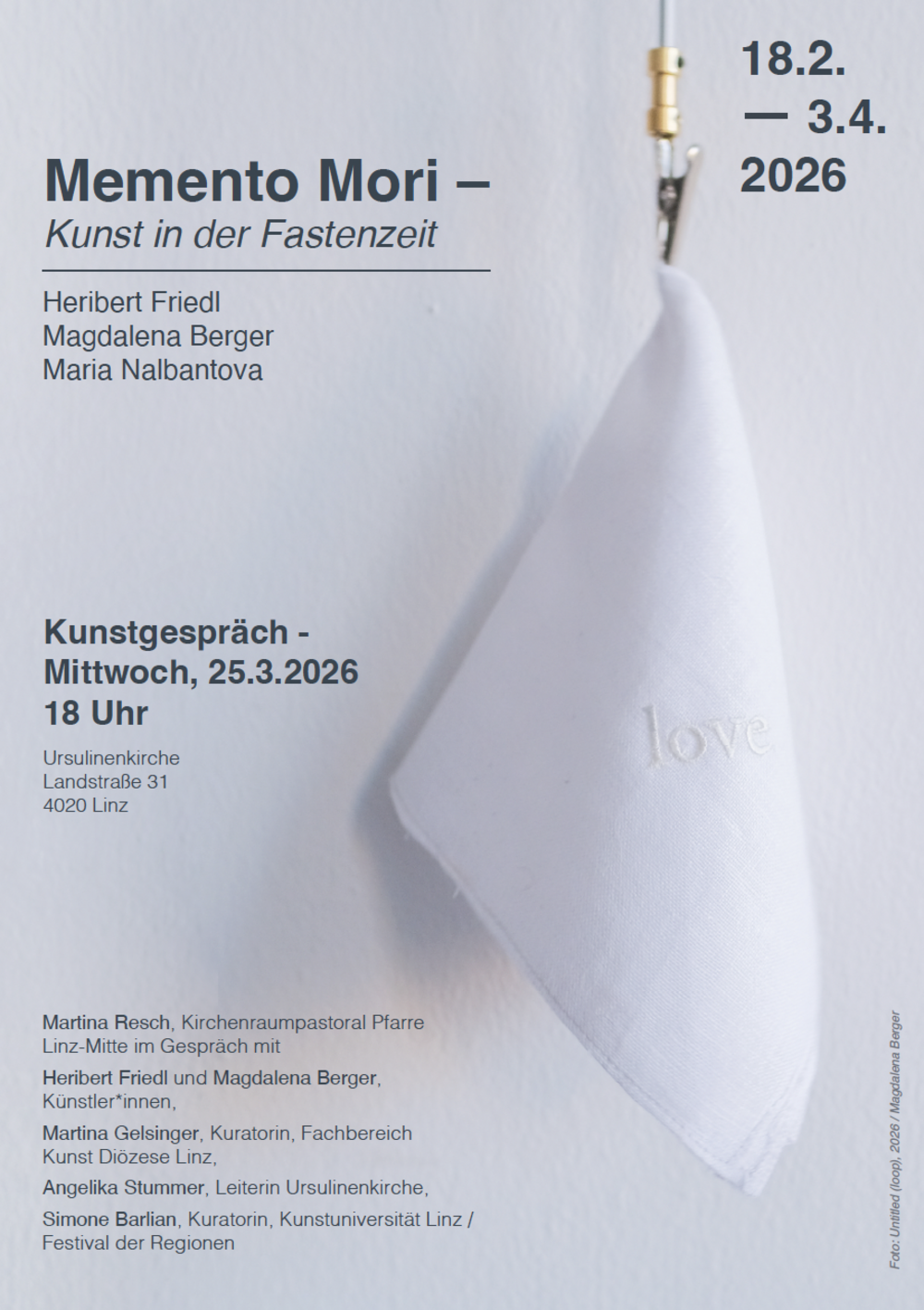
Foto: Untitled (loop), 2026 / Magdalena Berger