Welcome at the Interface Culture program website.
Acting as creative artists and researchers, students learn how to advance the state of the art of current interface technologies and applications. Through interdisciplinary research and team work, they also develop new aspects of interface design including its cultural and social applications. The themes elaborated under the Master's programme in relation to interactive technologies include Interactive Environments, Interactive Art, Ubiquitous Computing, game design, VR and MR environments, Sound Art, Media Art, Web-Art, Software Art, HCI research and interaction design.

The Interface Culture program at the Linz University of Arts Department of Media was founded in 2004 by Christa Sommerer and Laurent Mignonneau. The program teaches students of human-machine interaction to develop innovative interfaces that harness new interface technologies at the confluence of art, research, application and design, and to investigate the cultural and social possibilities of implementing them.
The term "interface" is omnipresent nowadays. Basically, it describes an intersection or linkage between different computer systems that makes use of hardware components and software programs to enable the exchange and transmission of digital information via communications protocols.
However, an interface also describes the hook-up between human and machine, whereby the human qua user undertakes interaction as a means of operating and influencing the software and hardware components of a digital system. An interface thus enables human beings to communicate with digital technologies as well as to generate, receive and exchange data. Examples of interfaces in very widespread use are the mouse-keyboard interface and graphical user interfaces (i.e. desktop metaphors). In recent years, though, we have witnessed rapid developments in the direction of more intuitive and more seamless interface designs; the fields of research that have emerged include ubiquitous computing, intelligent environments, tangible user interfaces, auditory interfaces, VR-based and MR-based interaction, multi-modal interaction (camera-based interaction, voice-driven interaction, gesture-based interaction), robotic interfaces, natural interfaces and artistic and metaphoric interfaces.
Artists in the field of interactive art have been conducting research on human-machine interaction for a number of years now. By means of artistic, intuitive, conceptual, social and critical forms of interaction design, they have shown how digital processes can become essential elements of the artistic process.
Ars Electronica and in particular the Prix Ars Electronica's Interactive Art category launched in 1991 has had a powerful impact on this dialog and played an active role in promoting ongoing development in this field of research.
The Interface Cultures program is based upon this know-how. It is an artistic-scientific course of study to give budding media artists and media theoreticians solid training in creative and innovative interface design. Artistic design in these areas includes interactive art, netart, software art, robotic art, soundart, noiseart, games & storytelling and mobile art, as well as new hybrid fields like genetic art, bioart, spaceart and nanoart.
It is precisely this combination of technical know-how, interdisciplinary research and a creative artistic-scientific approach to a task that makes it possible to develop new, creative interfaces that engender progressive and innovative artistic-creative applications for media art, media design, media research and communication.
AMRO26: Art Meets Radical Openness
13. bis 16. Mai 2026 diverse Standorte in Linz
Festival dedicated to Art, Hacktivism and Open Culture
servus.at lädt in Kooperation mit den Abteilungen Zeitbasierte Medien und Visuelle Kommunikation, der Kunstuniversität Linz zum Festival.
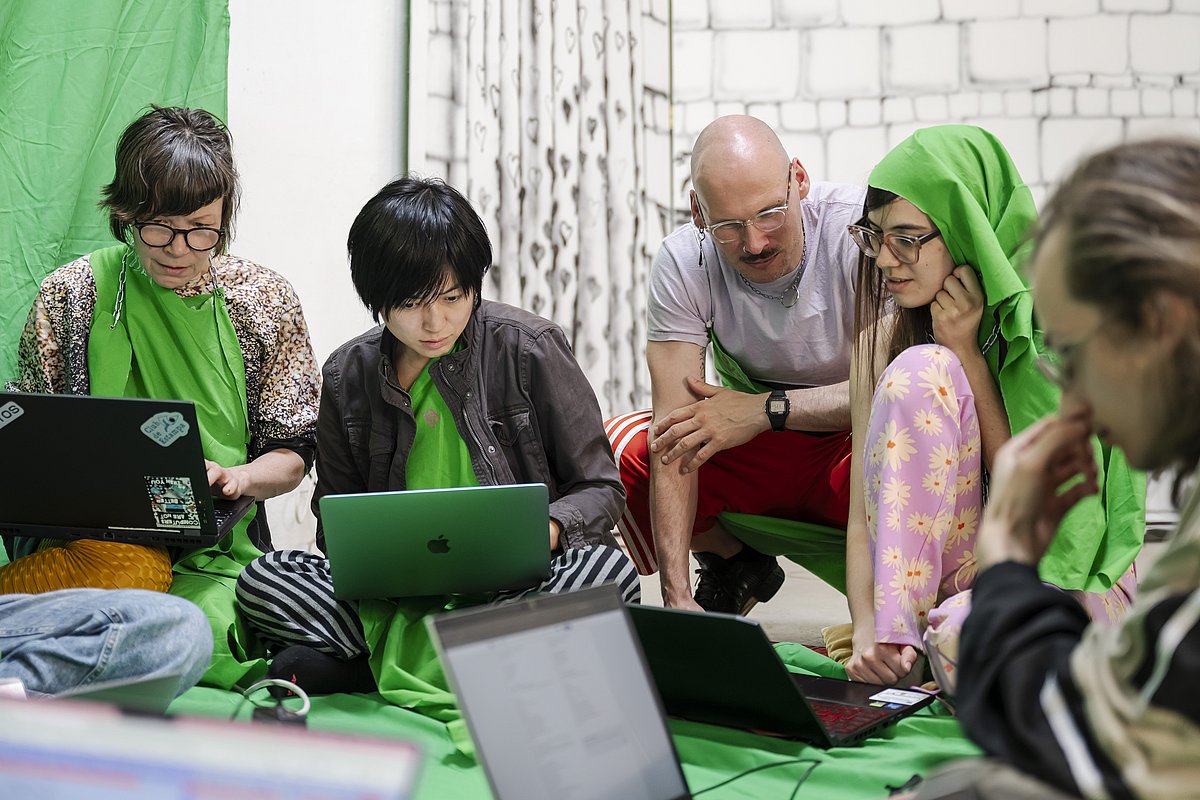
Art Meets Radical Openness (AMRO) is a biennial community festival for art, hacktivism and open cultures. It provides a space for discussion and resistance against technological monoculture, and for sharing and learning together on contemporary issues of our networked times.
#AMRO26: „Becoming Unreadable“
For its 2026 edition, titled „Becoming Unreadable“, AMRO invites its community to reflect on and engage with invisibility, unreadability, ungovernability, and uncomputability as strategies for resistance. AMRO26 aims at challenging the common understanding of AI, networks and computers, and through its programme, explores approaches that offer real change: low-tech, feminist and community IT, computing within limits, up to even more radical ideas around de-computing, de-networking, de-scaling and de-platforming ourselves. Becoming unreadable involves evading surveillance by oligarchic tech corporations, operate under the radar, and refuse to comply to the total AI cloud. Non-commercial community infrastructures are fundamental tools in this process, but even more importantly we need to develop new ways of understanding each others and being together as humans. Art Meets Radical Openness wants to be a space dedicated to that.
Programme overview
May 12, 2026 - Pre-opening
18.30 Uhr / splace am Hauptplatz / Kunstuniversität Linz / Hauptplatz 6
May 13, 2026 - Opening & Keynotes
18.00 Uhr / Exhibition: From the Ashes of the Burnout Machines / Galerie MAERZ / Eisenbahngasse 20
19.00 Uhr / afo – architekturforum oberösterreich / Herbert-Bayer-Platz 1
May 13 to 16,2026 from 10.00 to 00+
Lectures, concerts, workshops, exhibitions.
May16, 2026 – Closing event – Night-line
21.00 to 02.00 Uhr / STWST / Kirchengasse 4
The research labs
In-between the festival editions, AMRO becomes a platform for artistic research, organized in series of laboratories deepening punctual topics of current networked times.
Past research labs dealt with several topics: the emergence of social bots as tools to manipulate opinions; the very low tech processes behind the smart world; the environmental impact of digital technologies; conversational AIs and experimental programming languages; labor and exploitation in platforms and servers; permacomputing; fluidics; big tech and the politics of isolation.
Participants
Adel Faure & Rémi Georges, Arnica Montana, Lil Data, map(h), Mitsitron, MSHR, Orangetronic, Pasta Gang
Alumni: Jens Vetter, Sofia Braga, Davide Bevilacqua, Aimilia Liontou, Gabriela Gordillo, Ushi Reiter, Maria Orciuoli, Giacomo Piazzi, Antonio Zingaro, Florian Köfler, Lina Pulido Barragan
Departments & Current Students: Marianne Lechner, Nina Wenhart, Joseph Knierzinger (Professor), Martina Pizzigoni, Alessia Fallica, Christina Gruber (Professor), Gorka Egino & Sule Suarez, Hess Jeon (Phd Candidate)
Full programme on: radical-openness.org
Tickets :AMRO26 events are free of charge, but you can support the festival by purchasing a supporter ticket kupfticket.com/en/events/amro26-supporter-ticket

© AMRO26, Design by Hanna Priemetzhofer