Welcome at the Interface Culture program website.
Acting as creative artists and researchers, students learn how to advance the state of the art of current interface technologies and applications. Through interdisciplinary research and team work, they also develop new aspects of interface design including its cultural and social applications. The themes elaborated under the Master's programme in relation to interactive technologies include Interactive Environments, Interactive Art, Ubiquitous Computing, game design, VR and MR environments, Sound Art, Media Art, Web-Art, Software Art, HCI research and interaction design.

The Interface Culture program at the Linz University of Arts Department of Media was founded in 2004 by Christa Sommerer and Laurent Mignonneau. The program teaches students of human-machine interaction to develop innovative interfaces that harness new interface technologies at the confluence of art, research, application and design, and to investigate the cultural and social possibilities of implementing them.
The term "interface" is omnipresent nowadays. Basically, it describes an intersection or linkage between different computer systems that makes use of hardware components and software programs to enable the exchange and transmission of digital information via communications protocols.
However, an interface also describes the hook-up between human and machine, whereby the human qua user undertakes interaction as a means of operating and influencing the software and hardware components of a digital system. An interface thus enables human beings to communicate with digital technologies as well as to generate, receive and exchange data. Examples of interfaces in very widespread use are the mouse-keyboard interface and graphical user interfaces (i.e. desktop metaphors). In recent years, though, we have witnessed rapid developments in the direction of more intuitive and more seamless interface designs; the fields of research that have emerged include ubiquitous computing, intelligent environments, tangible user interfaces, auditory interfaces, VR-based and MR-based interaction, multi-modal interaction (camera-based interaction, voice-driven interaction, gesture-based interaction), robotic interfaces, natural interfaces and artistic and metaphoric interfaces.
Artists in the field of interactive art have been conducting research on human-machine interaction for a number of years now. By means of artistic, intuitive, conceptual, social and critical forms of interaction design, they have shown how digital processes can become essential elements of the artistic process.
Ars Electronica and in particular the Prix Ars Electronica's Interactive Art category launched in 1991 has had a powerful impact on this dialog and played an active role in promoting ongoing development in this field of research.
The Interface Cultures program is based upon this know-how. It is an artistic-scientific course of study to give budding media artists and media theoreticians solid training in creative and innovative interface design. Artistic design in these areas includes interactive art, netart, software art, robotic art, soundart, noiseart, games & storytelling and mobile art, as well as new hybrid fields like genetic art, bioart, spaceart and nanoart.
It is precisely this combination of technical know-how, interdisciplinary research and a creative artistic-scientific approach to a task that makes it possible to develop new, creative interfaces that engender progressive and innovative artistic-creative applications for media art, media design, media research and communication.
AREYOUARE
23. März bis 11. April 2026 Johannes Kepler Universität Linz, Altenberger Straße 69, 4040 Linz
Ein Performance-Projekt in Kooperation der Abteilung Visuelle Kommunikation und SILK Fluegge/Silke Grabinger. Verantwortlich für die Konzeptentwicklung sind Studierende des Masterstudiengangs Visuelle Kommunikation der Kunstuniversität Linz.
Wie kommunizieren wir mit intelligenten Systemen? Wer bestimmt die Interaktion mit unseren Alltagshelfern und Haushaltsrobotern? Welche Modelle aus Kommunikations- und Wahrnehmungstheorien visueller Medien helfen uns, neue Umgangsformen für ein Leben mit Technologie zu finden, die das Potential einer anderen, gleichberechtigten Interaktion mit unserem “more-than-human” Gegenüber erahnen lassen?
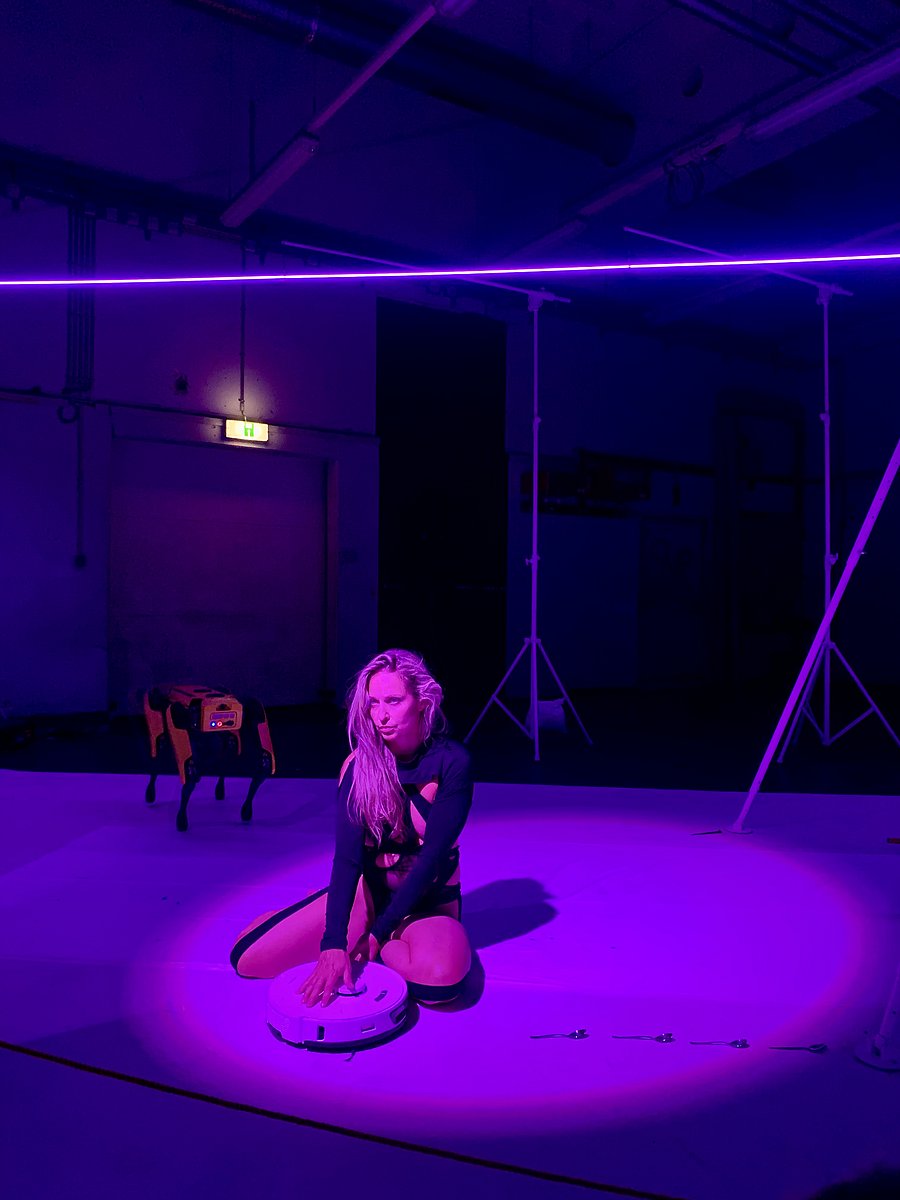
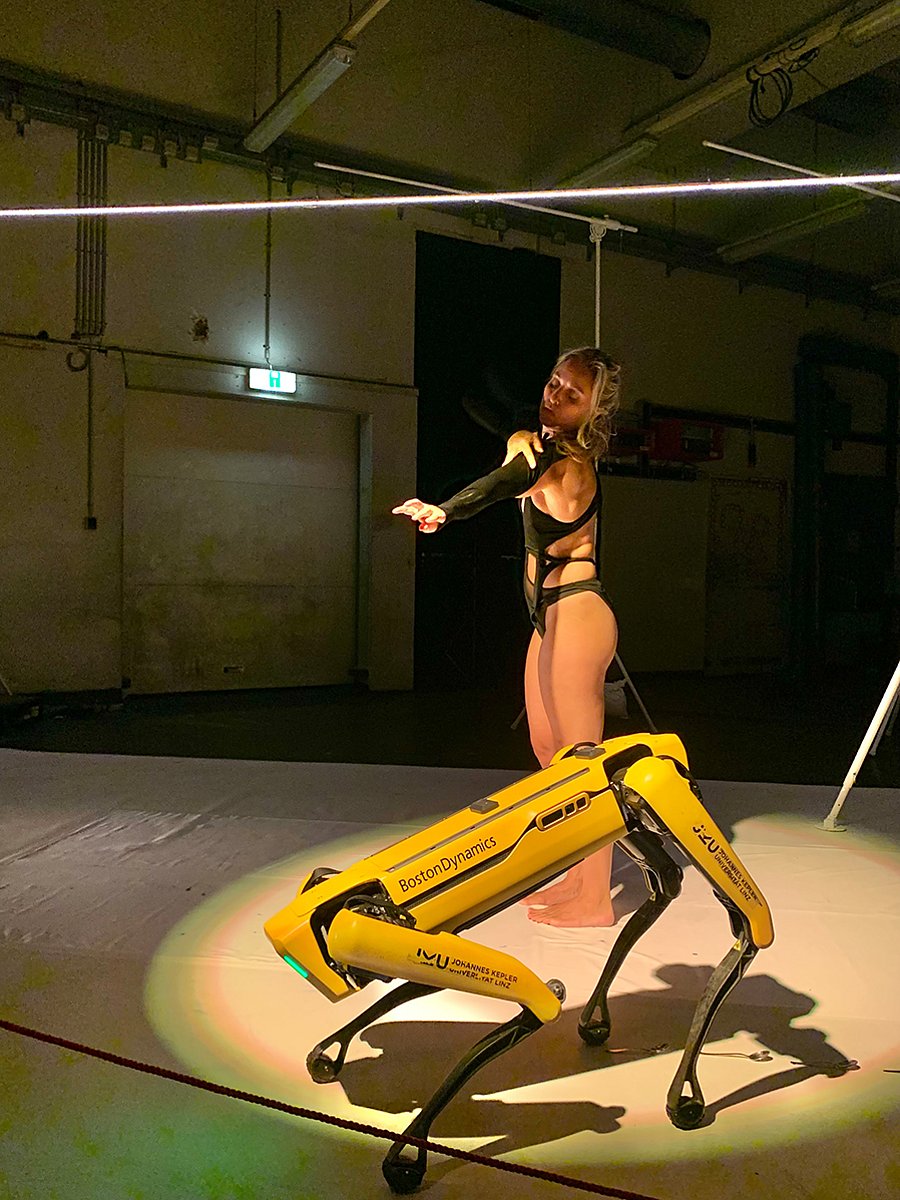
Das Performanceprojekt “AREYOUARE” der Tänzerin SILK Fluegge/Silke Grabinger untersucht verschiedene hybride Ausdrucksformen menschlicher und nicht-menschliche Akteure in einem Bewegunsparkour mit drei Saugrobotern, einem Küchenroboter und einem Roboterhund. Studierende der Abteilung Visuelle Kommunikation begleiten die Interaktion zwischen Robotern und Performerin mit Fragestellungen visueller Wahrnehmung und kommunizieren diese über subtile visuelle Eingriffe als Kommunikations-Partituren.
Teil eins dieser Zusammenarbeit wurde von 3. bis 7. September 2025 beim Ars Festival 2025 getestet.
Weitere Termine:
Vorstellungen für Schulen und Gruppen
Auch Einzelpersonen – insbesondere Mitarbeiter*innen und Studierende der JKU – können sich gerne anmelden.
Montag, 23.03.2026 | 10.00 bis 11.00 Uhr
Dienstag, 24.03.2026 | 10. 00 bis 11.00 Uhr
Mittwoch, 25.03. 2026 | 10.00 bis 11.00 Uhr
Donnerstag, 26.03.2026 | 10.00 bis 11.00 Uhr
Freitag, 27.03.2026 | 10. 00 bis 11.00 Uhr
Donnerstag, 09.04.2026 | 10.00 bis 11.00 Uhr
Freitag, 10.04.2026 | 10.00 bis 11.00 Uhr
zur Anmeldung
Öffentliche Vorstellungen
Samstag, 28.03.2026 | 16.00 bis 17.00 Uhr (Premiere) - Aufführung in Kooperation mit Verein Campus 4.0
zur Anmeldung
Mittwoch, 08.04.2026 | 15.00 bis 16.00 Uhr
zur Anmeldung
Samstag, 11.04.2026 | 16.00 bis 17.00 Uhr
zur Anmeldung
Die Interaktion mit Robotern und “lebendigen” Maschinen ist immer auch aufgeladen mit den Ansprüchen, Bedürfnissen, Wünschen, aber auch Ängsten und Wertvorstellungen ihrer Entwickler*innen und künftigen Nutzer*innen. Spekulative Designnarrationen können diese sichtbar machen und so in Frage stellen. Visuelle Kommunikation macht dadurch abstrakte Modelle sichtbar und kommuniziert Entwicklungsmöglichkeiten in der Gestaltung von Interaktion mit Haushaltsrobotern und intelligenten Maschinen.
Projektleitung Künstlerische Forschung: Barbara VON RECHBACH
(Kommunikations- und Wahrnehmungstheorien)
Künstler*innen Teil 01 - AREYOUARE:
Sofia.REITELBACH-VILLAVERDE
Zere VALEYEVA
Euk Kung YOO
alle: Abteilung für Visuelle Kommunikation
AREYOUARE
Pre-Showing
SILK Fluegge
ars.electronica.art/panic/de/view/areyouare