Welcome at the Interface Culture program website.
Acting as creative artists and researchers, students learn how to advance the state of the art of current interface technologies and applications. Through interdisciplinary research and team work, they also develop new aspects of interface design including its cultural and social applications. The themes elaborated under the Master's programme in relation to interactive technologies include Interactive Environments, Interactive Art, Ubiquitous Computing, game design, VR and MR environments, Sound Art, Media Art, Web-Art, Software Art, HCI research and interaction design.

The Interface Culture program at the Linz University of Arts Department of Media was founded in 2004 by Christa Sommerer and Laurent Mignonneau. The program teaches students of human-machine interaction to develop innovative interfaces that harness new interface technologies at the confluence of art, research, application and design, and to investigate the cultural and social possibilities of implementing them.
The term "interface" is omnipresent nowadays. Basically, it describes an intersection or linkage between different computer systems that makes use of hardware components and software programs to enable the exchange and transmission of digital information via communications protocols.
However, an interface also describes the hook-up between human and machine, whereby the human qua user undertakes interaction as a means of operating and influencing the software and hardware components of a digital system. An interface thus enables human beings to communicate with digital technologies as well as to generate, receive and exchange data. Examples of interfaces in very widespread use are the mouse-keyboard interface and graphical user interfaces (i.e. desktop metaphors). In recent years, though, we have witnessed rapid developments in the direction of more intuitive and more seamless interface designs; the fields of research that have emerged include ubiquitous computing, intelligent environments, tangible user interfaces, auditory interfaces, VR-based and MR-based interaction, multi-modal interaction (camera-based interaction, voice-driven interaction, gesture-based interaction), robotic interfaces, natural interfaces and artistic and metaphoric interfaces.
Artists in the field of interactive art have been conducting research on human-machine interaction for a number of years now. By means of artistic, intuitive, conceptual, social and critical forms of interaction design, they have shown how digital processes can become essential elements of the artistic process.
Ars Electronica and in particular the Prix Ars Electronica's Interactive Art category launched in 1991 has had a powerful impact on this dialog and played an active role in promoting ongoing development in this field of research.
The Interface Cultures program is based upon this know-how. It is an artistic-scientific course of study to give budding media artists and media theoreticians solid training in creative and innovative interface design. Artistic design in these areas includes interactive art, netart, software art, robotic art, soundart, noiseart, games & storytelling and mobile art, as well as new hybrid fields like genetic art, bioart, spaceart and nanoart.
It is precisely this combination of technical know-how, interdisciplinary research and a creative artistic-scientific approach to a task that makes it possible to develop new, creative interfaces that engender progressive and innovative artistic-creative applications for media art, media design, media research and communication.
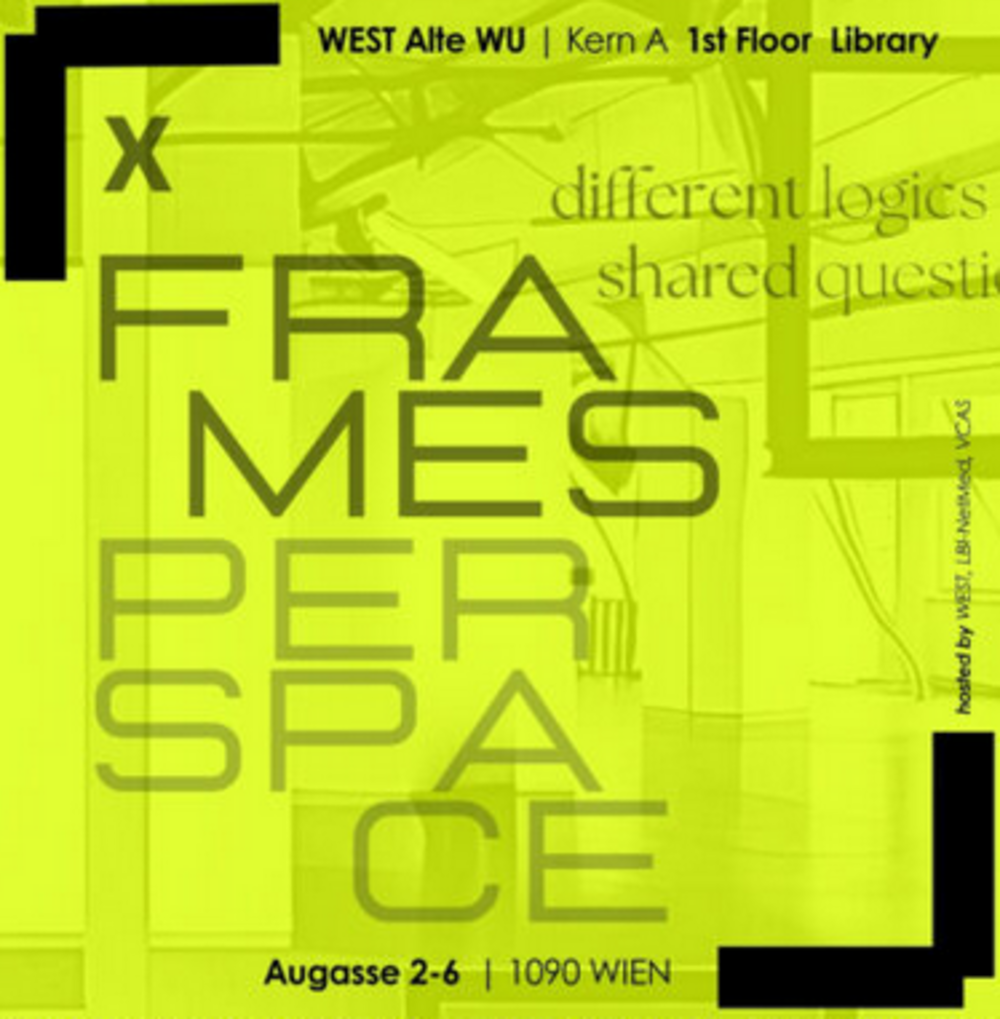
X frames per space - Different logics, shared questions
Vernissage: 8. November 2025, 18.00 Uhr; bis 14. November 2025 WEST space, Alte WU Bibliothek, Augasse 2-6, 1090 Wien
Beitrag von Daniela Trinkl
In today’s flood of images, we often overlook the frame that determines what becomes visible.
X FRAMES PER SPACE • DIFFERENT LOGICS – SHARED QUESTIONS explores these framings as a fundamental basis for our perception of the world and creates an open space where art and science intersect and unfold. 70 artistic and scientific positions illuminate complex relationships: they ask how scientific data inspire artistic creation and how art engages with contemporary scientific inquiries. It is driven by the interfaces between science, art, technology, data visualization, social imagination, and processes of exploration and transformation. It investigates how different modes of thinking can lead to similar questions - or, conversely, how different questions can yield comparable outcomes. In the multi-logical interplay of Virtual Reality, Artificial Intelligence, robotics, video, installation, painting, and drawing, new spaces for thought emerge beyond established categories. By experiencing diverse perspectives, the exhibition invites visitors to question the apparent self-evidence of our worldview and to move beyond the frame to discover new paths.
Kurator*innen: Melina Steiner, Sebastian Pfeifhofer, Annette Tesarek
VCAS – Artists:
Manuel Bachinger, Danijela Bagarić, Mina Banabak, Ziegi Boss, Tomiris Dmitrievskikh, Annika Eschmann, Jonas Fliedl, Lisa Glonti, Maria Gvardeitseva, Julia Hahnl, OU Jiun-You, June Kitho, Anthony Kroytor, Sanja Lasić, Nadine Lemke, Meike Legler, Oliver R. Meschnig, Peter Moosgaard, freakygreenfish, Sebastian Pfeifhofer, Laurie Schram, Melina Steiner, Sarah Steiner, Daniela Trinkl, Sarah Wilhelmy, Aga Zagraba, Q_plus_I
LBI-NetMed – Scientists and Artists:
Angela Andorrer, Die Aschenbrecher, Albert-László Barabási, R. Friedrich Bliem, Katy Börner, Patryck Chan, descent, ECHTZEITKUNSTWELT, Thomas Feuerstein, Funkyfiona, Dominik Grünbühel, Begi Guggenheim, Felice Gotthardt, Christiane Hütter, Julian Jankovic, Martin Krammer, T(n)C, LBI-NetMed, LBG OIS Center, Monica LoCascio, Mary Maggic, Rica Fuentes Martinez, Daniel Mazanik, Vanessa Mazanik, Ernst Miesgang, Stella Mondin, Oskerhase, Monika Pietrzak-Franger, projectvime & Te En Chen, Sebastian Pirch, Luca Ruzsics, Chris Schratt, Bettina Schülke, Clemens Stecher, STUDIO 101010, Annette Tesarek, The Meaningful Noise Collective, Norbert Unfug, Oleg Ustinov, Ana Vollwesen, Alexander Zaloopin
Organisiert von:
WEST / LBI-NetMed / VCAS
im Rahmen der Vienna Art Week
Plakat
a-tesarek.com/2025/10/26/x-frames-per-space