Welcome at the Interface Culture program website.
Acting as creative artists and researchers, students learn how to advance the state of the art of current interface technologies and applications. Through interdisciplinary research and team work, they also develop new aspects of interface design including its cultural and social applications. The themes elaborated under the Master's programme in relation to interactive technologies include Interactive Environments, Interactive Art, Ubiquitous Computing, game design, VR and MR environments, Sound Art, Media Art, Web-Art, Software Art, HCI research and interaction design.

The Interface Culture program at the Linz University of Arts Department of Media was founded in 2004 by Christa Sommerer and Laurent Mignonneau. The program teaches students of human-machine interaction to develop innovative interfaces that harness new interface technologies at the confluence of art, research, application and design, and to investigate the cultural and social possibilities of implementing them.
The term "interface" is omnipresent nowadays. Basically, it describes an intersection or linkage between different computer systems that makes use of hardware components and software programs to enable the exchange and transmission of digital information via communications protocols.
However, an interface also describes the hook-up between human and machine, whereby the human qua user undertakes interaction as a means of operating and influencing the software and hardware components of a digital system. An interface thus enables human beings to communicate with digital technologies as well as to generate, receive and exchange data. Examples of interfaces in very widespread use are the mouse-keyboard interface and graphical user interfaces (i.e. desktop metaphors). In recent years, though, we have witnessed rapid developments in the direction of more intuitive and more seamless interface designs; the fields of research that have emerged include ubiquitous computing, intelligent environments, tangible user interfaces, auditory interfaces, VR-based and MR-based interaction, multi-modal interaction (camera-based interaction, voice-driven interaction, gesture-based interaction), robotic interfaces, natural interfaces and artistic and metaphoric interfaces.
Artists in the field of interactive art have been conducting research on human-machine interaction for a number of years now. By means of artistic, intuitive, conceptual, social and critical forms of interaction design, they have shown how digital processes can become essential elements of the artistic process.
Ars Electronica and in particular the Prix Ars Electronica's Interactive Art category launched in 1991 has had a powerful impact on this dialog and played an active role in promoting ongoing development in this field of research.
The Interface Cultures program is based upon this know-how. It is an artistic-scientific course of study to give budding media artists and media theoreticians solid training in creative and innovative interface design. Artistic design in these areas includes interactive art, netart, software art, robotic art, soundart, noiseart, games & storytelling and mobile art, as well as new hybrid fields like genetic art, bioart, spaceart and nanoart.
It is precisely this combination of technical know-how, interdisciplinary research and a creative artistic-scientific approach to a task that makes it possible to develop new, creative interfaces that engender progressive and innovative artistic-creative applications for media art, media design, media research and communication.
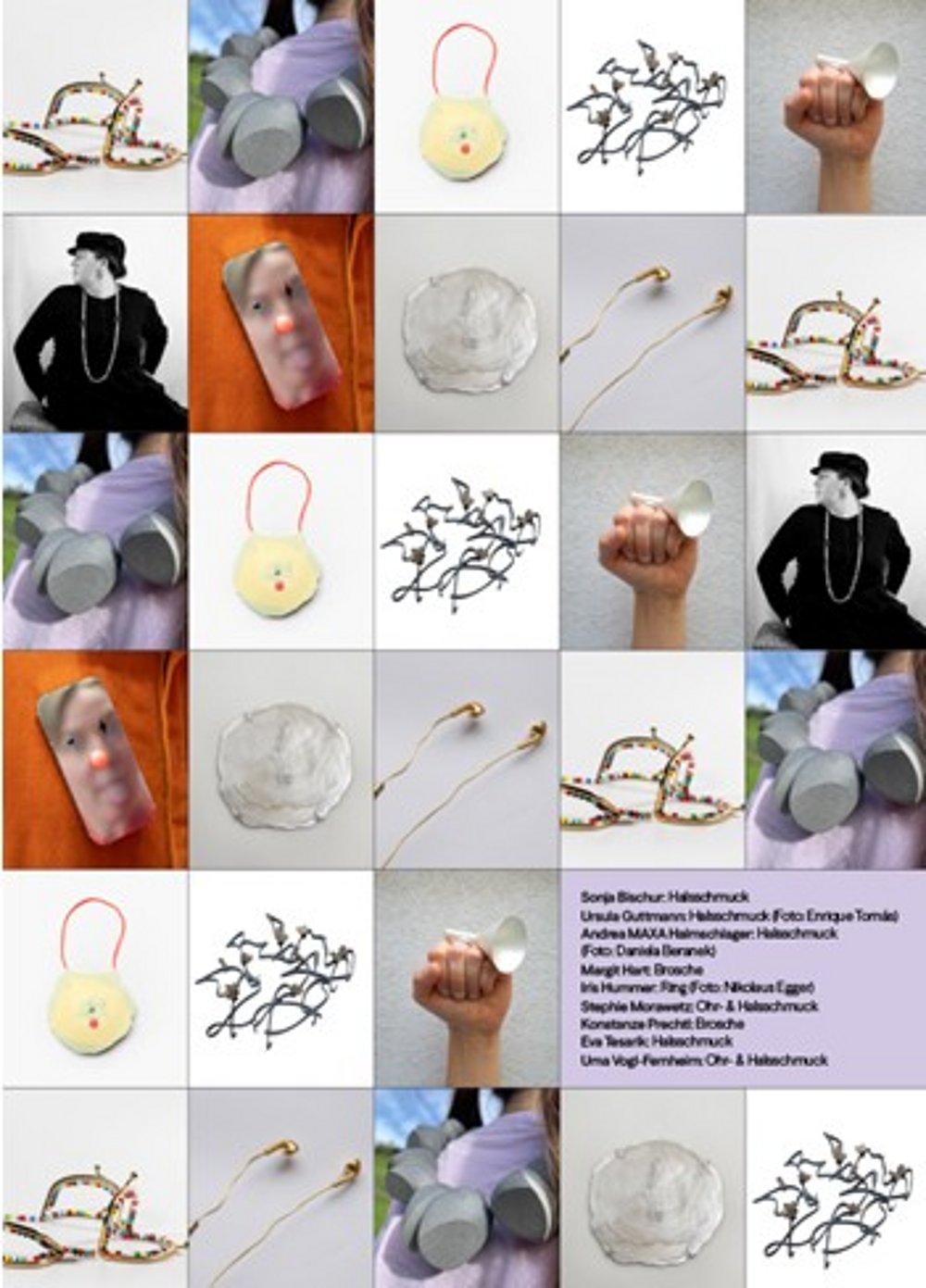
Eligius Schmuckpreis 2025
Ausstellung bis 13. Dezember 2025 Traklhaus, Waagplatz 1A, 5020 Salzburg
mit u.a. Ursula Guttmann
Seit 2005, also genau seit 20 Jahren ehrt das Land Salzburg mit dem Eligius-Schmuckpreis die lebendige und innovative Bedeutung der zeitgenössischen österreichischen Schmuckkunst. Heuer hat das Land Salzburg diesen, mit € 8.000,- dotierten Kunstpreis, zum achten Mal österreichweit ausgeschrieben. Bewerben konnten sich Künstler*innen, die in Österreich geboren sind oder seit fünf Jahren ihren Hauptwohnsitz in Österreich haben. Durch den Namen des Preises wird auf die Tradition der Goldschmiedekunst in Salzburg hingewiesen, bezugnehmend auf die Familie Scheibl, deren Söhne jeweils nach dem Schutzheiligen der Goldschmiede – Eligius getauft wurden.
Im Zentrum dieses Wettbewerbes steht der Autorenschmuck, ein Begriff, der die einzigartige Handschrift der Künstlerinnen und Künstler beschreibt. Autorenschmuck ist weit mehr als Schmuck an sich, er ist ein künstlerisches Statement, das die Grenzen zwischen Kunst, Design und Tragbarkeit neu definiert. Wobei auch Tragbarkeit kein Kriterium für Autorenschmuck ist. Alle gezeigten Schmuck-Arbeiten sind Kunstwerke und Ergebnis einer intensiven Auseinandersetzung. Die Künstler*innen hinterfragen intensiv ihr eigenes Medium und loten unter anderem auch alle möglichen und unmöglichen bzw. edlen/unedlen Materialien aus. Die Arbeiten werden immer vielfältiger – auch in Größe und Form. Edelsteine werden gleichwertig mit Gebrauchsmaterial verwendet. Der „Schmuckbegriff“ wird immer mehr hinterfragt – Themen wie Ethik, Ökologie und Mehrwert sind Teil der Gestaltung. Die künstlerischen Ansätze sind überaus vielfältig.
Jury:
Ulrike Johannsen, Schmuckkünstlerin und Lehrende im Bereich Autorenschmuck
Anne-Katrin Rossberg, Kustodin der MAK-Sammlung Metall und Wiener Werkstätte Archiv
Katharina Schniebs, Initiatorin Schmuckstammtisch Wien
Für den Salzburger Schmuckpreis lagen insgesamt 39 Einreichungen vor. Davon wurden in einer ersten Jurysitzung Sonja Bischur, Ursula Guttmann, Andrea MAXA Halmschlager, Margit Hart, Iris Hummer, Stephie Morawetz, Konstanze Prechtl, Eva Tesarik und Uma Vogl-Fernheim ausgewählt, die eingeladen wurden, ihre Arbeiten in einer Anwärterinnen-Ausstellung in Salzburg und in Wien zu zeigen.
Einladung
www.traklhaus.at/archiv/traklhaus/eligius-schmuckpreis-2025