Austauschprogramm:
Erasmus+ Personalmobilität zu Fortbildungszwecken
Mobilität durchgeführt an folgender Universität / Institution | Mobility carried out at the following university / institution:
University Munster Technological University (MTU)
Zeitraum | Duration of stay:
10. bis 14. November 2025 (8. bis 15. November mit An- und Abreise)
Abteilung an der Kunstuniversität | Department at the University of Arts Linz:
Institut Kunst und Bildung
(Design und Technik und KinderJugendKreativUni)
My specific focus at Erasmus+ Job-Shadowing in Cork was to get an Overview, how the Sustainable Development Goals (SDG) and AI-Technologies are implemented in academic and administrative tasks at the Munster Technological University (MTU) in the programm Master of Education (Art and Design) with the partner institution UCC as the First Green Flag University. I get a great insight in it and want to share my experiences. SDG Examples like Sustainability Citizenship, Climate Action, Health and Wellbeing and Landscape, Heritage and Natural Resources and more are implemented in the study and daily work life. By following examples, I want to show the opportunities to consider a wide range of wellbeing aspects and demonstrate how SDG´s can help to generate new ideas for improving teamwork and job satisfaction, as well as having an impact on society and the world. To make the implementation of the SDGs visible in different areas of everyday life, I found them at MTU and UCC as informational material in public places, visible as wall stickers, on posters, folders, and information sheets.
Sunday
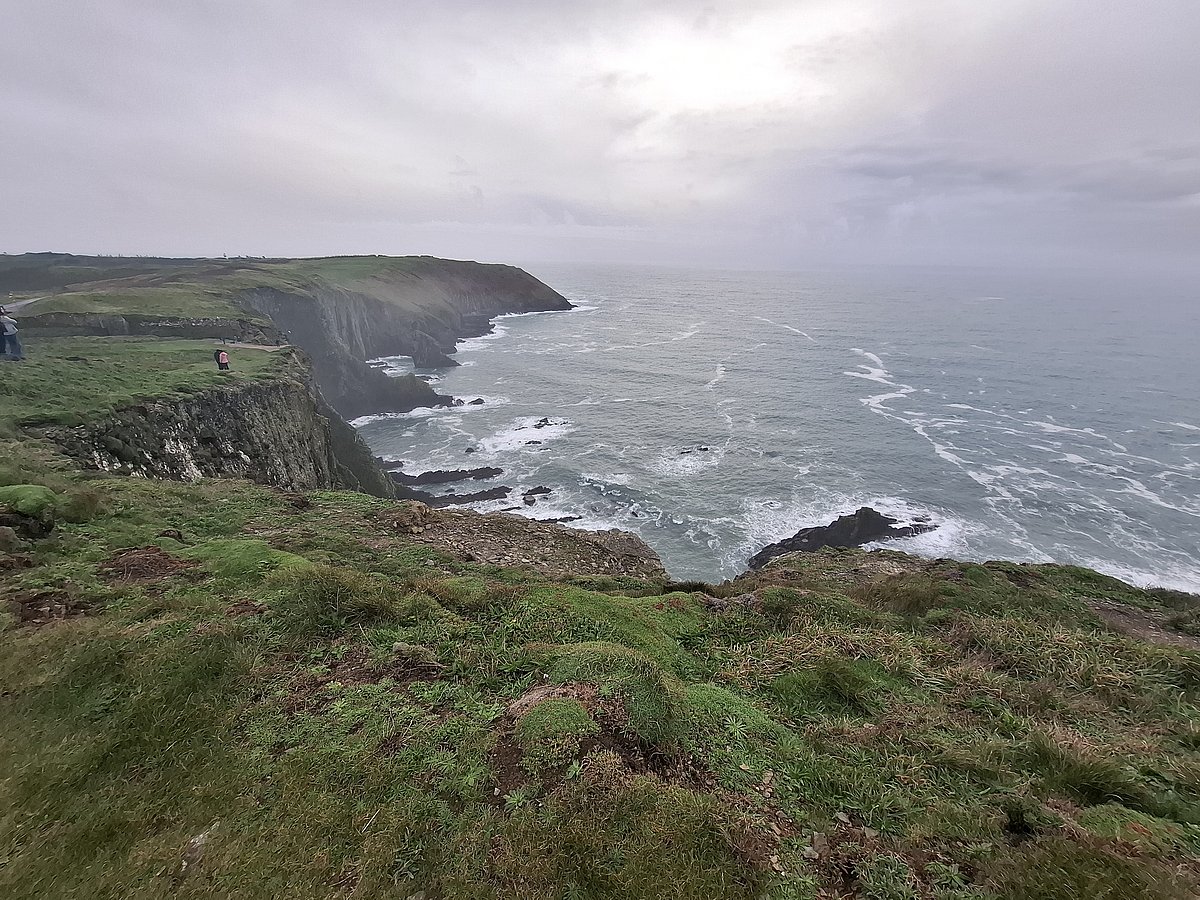
On my first day I explored the rural areas and countryside around Cork. After a flight lasting several hours over Holland, I was able to stretch my legs on Sunday before my week-long Erasmus+ work placement by taking a trip to the coast and spending a few hours surrounded by green nature. After visiting the port town of Kinsale, I fortified myself in an Irish cottage pub with the typical local fare of fish & chips, cider, Irish coffee, and chocolate cake, and reflected on the culture, art, and nature of the country. On this rainy afternoon, sitting in front of the cozy, warming fireplace under the fishing net, old sailor stories came to mind.


Monday
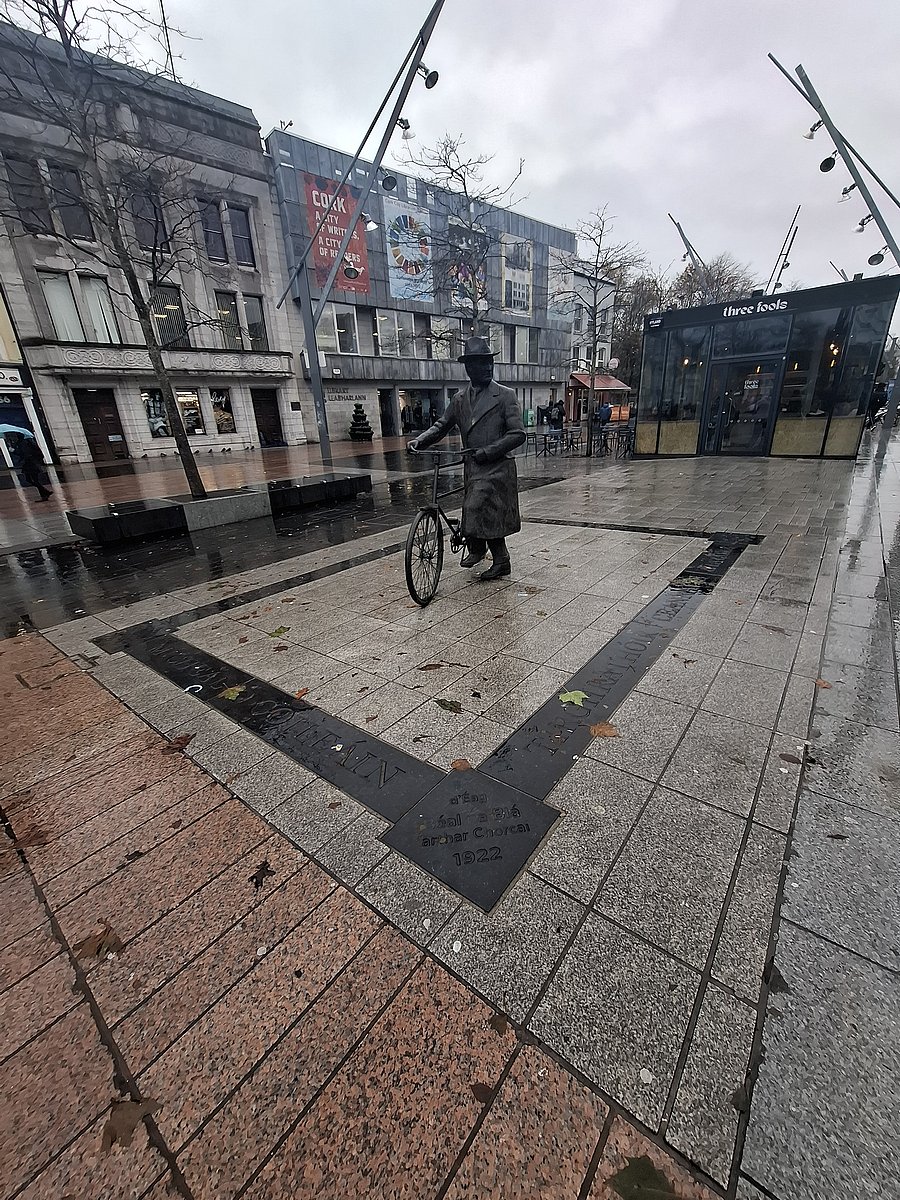
On Monday morning I started at the Munster Technological University (MTU), Grand Parade, in the center of the City Cork with meeting Louise Foott the Head of Department in “Arts in Health & Education“, the office manager and staff members to arrange meetings with colleagues and finalise the timetable at MTU and UCC. I was given a tour of the studios, gallery and offices to familiarise myself with the university, and the team allowed me to use desks in the co-working space and meeting room, as well as their kitchen. I felt openly welcomed and integrated into the university's work life.
Classroom observation: Reflective Artist Teacher Sketchbook
Inspiring success and admirable qualities in others. In the discussions, hopes and failures were seen as opportunities and topics of conversation.This means that successes at work should be highlighted and fears and weaknesses should also be discussed. This strengthens in wellbeing, the self-confidence of teachers as artists and employees in the teaching profession and thus also encourages students and pupils to achieve more. The PME-Students talked about their stories and developments that each person had experienced in creating their own artistic and pedagogical portfolio sketchbook, and what had happened in this process. They discussed what they should or shouldn't have done, shared their wishes, and presented their reasons for planning school lessons visually in the form of hardback and digital sketchbooks.


Tuesday

Crawford Supported Studio
The Cultural Institution „The Crawford Art Gallery“ and the MTU provide in cooperation, artists with a specific health or social need. spaces, materials and assistance for long-term studio facilitators in the “Crawford Supported Studios” crawfordsupportedstudios.com. Susanna Broderick is one of the supporters that development professional trainings with the Artists, so that they can work in Artistic Fields like paintings, prints, drawings, sculptures and installations. During the workshop observation, I was able to watch and help the participating artists producing Zines (self-folded and self-designed paper brochures) on that day. The active preparation and teaching of this artistic technique was carried out by two guest lecturers, including Annie Mar Forrester, co-organizer of the Cork Zine Fest. Broderick, who had organized the workshop, was busy at the beginning preparing the workspaces, providing food, and gathering materials. She was assisted by two American exchange students studying art therapy and me. In this workshop, she also had to sort, store, and archive the works that had been produced. In addition, she acted active in communication with the artists. Through her weekly studio work, she is very familiar with the artist’s work and preferences. She shows solidarity, supports and motivates the artists individually in the application of artistic techniques, and thus helps them to realize their ideas. In every group, there are people with special concerns, and it is important to the teachers that everyone involved feels comfortable.
The Supported Studio offers excellent opportunities: working materials are subsidized, there are exhibition and sales opportunities, good guidance from external trainers and experts, support with physical or mental issues, and motivation and reminders to complete work and preparatory tasks. Learning and acquiring new techniques is also supported. The classrooms are equipped with mobile furniture (folding tables, stackable chairs, mobile material and art storage trolleys) so that the space can be adapted to individual artistic work. Breaks take place in the university's public areas, allowing Students of the Professional Master of Education (PME) to interact with the artists. Participants enjoy showing their working methods and presenting their work.
In the same studio, PME-students practice their teaching concepts and create artistic works. For them, it is crucial to enjoy their work, to grow from successes and failures, to collaborate, and to exchange ideas. All this and much more is learned at the university along the way. The interests, wishes, and suggestions of the students are important to the teachers. Intergenerational needs and individual working methods are reflected upon in order to develop teaching concepts and provide insight into different walks of life.
Art and Design Pedagogy: Studio Workshop Wellbeing
Following the visit to the STEAM Award Exhibition: EARTH, some students participated in a workshop led by Avril O'Brien focusing on wellbeing. The workshop began with an introduction to automatic drawing using natural materials, such as tracing a moving shell with a pencil on paper. The students expressed their joy and talked about their own educational concepts, revealing personal feelings and views from their school experience. They reflected on their role as teachers in practice and how important they consider the student-teacher bond and artistic development is, as well as being aware of the pupils social situations.
Wednesday
Creative Wellbeing Journal
Jessica Marbe from Eco Arts gave me an insight into the Creative Wellbeing Journal, a print journal and digital tool for self-reflection and awareness in daily life. It combines prompts with goals such as 'Connect', 'Be active', 'Take notice', 'Keep learning' and 'Give', while also allowing space for own thoughts to help improve mental health. Take a look at this project in its early stages: trello.com/b/uEIwSznG/well-being-creative-toolkit.
Digital Wellbeing receives the same attention at UCC, where they aim to prevent digital overload among staff and students by facilitating digital breaks, coordinating assignment due personal talks, using announcements instead of emails and holding digital office hours.


STEAM Award Exhibition: EARTH - Main Campus MTU Bishopstown
In the Exhibition „Arts Office STEAM Award: EARTH“ exhibition a series of selected works by BA Hons in Fine Art & Visual Communication Students where showed, most of which were made while Studiotime at MTU. The focus here was on intervention and response to bringing MA Students together (refers to the educational approach to integrate creativity, critical thinking, and problem-solving in Science, Technology, Engineering, Arts and Mathematics). The central work of the exhibition was a poetic new-media installation made of natural material and sound.
Art in nature surrounding us and change our view on reality and resonate with the different people that live in the city, like an MTU Art Project on the other side of the river next to Grand Parade.


Trough Talks I experiences Art Projects in and outside MTU, from Arts & Engagement, Arts & Wellbeing, Cultural Citizenship, ECO Arts or Creativity & Change, in different Studios and Hallways and I explored moments in which social agreement and the need to express oneself in a Sustainable and Inclusive Envirement is important for the Futures. Take a Look into the MTU Inclusive Curriculum Framework and Sustainability Policy.
Thursday
Meeting and Classroom observation: The Language Centre UCC
Learning professional English is a key to self-improvement when studying abroad. Communicative exercises can supplement and the core of English learning is important for understanding a study subject like teacher training and in work of interdisciplinary teams and in the cross-cultural context of the EU.
The meeting with David Moran and Sally Orren in the O’Rahilly Building at UCC showed me a wide range of organisation structures, from multifunctional classroom furniture to digital resources used to organise the trainee programmes for staff and students. The class observation provided an enjoyable insight in English teaching using digital education resources, where text inputs were projected and short writing lessons and conversations with the students provided great insight into language practice and grammar vocabulary development.
Experiencing and preserving with care, and connecting everything with meaning through prevention, is omnipresent. I want to mention a co-working space with service areas on the University College Cork “The HUB” (An Mol)” is a central campus space that brings together Students, Employees and Visitors. The Atrium is an active Learning and Information Space and on the four floors are Open Offices, bookable Group- and Study Rooms, Kitchen Facilities and Lockers, the Student Support- and Service-offices are located there. At the Entry of the Hub the visual perception of SDG is seen.


Friday
Discoveries, inventions and digital learning UCC and MTU
On Thursday, I walked around the green campus of UCC and saw the HUB and the historic building. In two of the hallways, there is a permanent exhibition of Ogham stones, which feature the earliest form of writing in Ireland and the ancient Irish alphabet. This lovely experience made me realise the historical value of languages and the importance of passing on knowledge through the generations. I was also fascinated to discover that the famous mathematician George Boole (1815–1864) was one of the first professors of mathematics at Queen's College Cork (1849–1864). He obtained this position despite lacking a university degree, and he was largely self-taught in developing Boolean algebra, a framework for logic gates and digital circuits. Boole was a key figure for the development of later inventions in the information age. This made me realise how important the contributions of university members and alumni are, and led me to my next talks about AI in work, learning and teaching at Irish universities.
Drawing on my knowledge of programming history and the modern application of AI technologies and SDGs, I found myself taking part in an online discussion with Clíodhna O'Callaghan from the Centre for Digital Education. The aim was to gain a better understanding of how digital learning and AI technologies are implemented at UCC. I discussed AI toolkits in education, as well as the ethical use of generative AI and artificial intelligence in Irish higher education. Take a look at these topics and compare my approaches to understand how e-learning and AI usage produce a carbon footprint. So, how can we reduce internet traffic, data production and storage in a useful way?
In relation to this question, an SDG aspect was UCC's first Digital Cleanup Day, which took place this year. It aimed to raise awareness among faculty members and provide practical workshops on how to achieve "Inbox Zero" (no unread emails), as well as offering guidance on digital decluttering.
In the MTU Generative AI Webinar Series, we can change our perspective on future topics and find out what others are saying. Dr Jeremiah Spillane (Dr Diarmuid Ó Spealáin) an E-Learning Technical Officer in the Department of Technology Enhanced Learning at MTU, mentions Online Talks, a series of lectures exploring the intersection between ongoing developments in AI-Technologies, Learning and Teaching. He also mention an GenAI-Report from the “The National Digital Leadership Network (NDLN)” and “Technology Enhanced Learning Department” at MTU and informed about Reusable Learning Resources (RLR), which supports the improvment of media-rich resources. Spillane references also to the „Digital Competence Framework for Educators (DigCompEdu)“
In summary, the digital video calls with O'Callaghan and Spillane allowed me to discuss a wide range of topics, e.g. E-Learning, Academic Data, Cloud, and Content Management Systems (CMS), and the support of the universities in dealing with data cluttering and the usage of AI in writing, sound- and video production. A key aspect of the openness of these technologies and pedagogical methods is a fair contract between teacher and student, ensuring real-time feedback and face-to-face presentations to determine whether students are using AI in assignments.
Reflecting the Erasmus+ Job Shadowing and back to work at the University of Arts Linz.
The Power of the people of the City Cork is, that you feel everywhere the love that is in the detail, with openness in soul and heart they were speaking, teaching and showing me examples how you can implement SDGS in their daily work for the university and the students. I thank all the people that i had the chance to meet there and it would be great when we could stay in engaged and participate the art and academic European community in improving our wellbeing in the society. The Erasmus+ Job Shadowing Inspired me with love for the work and I hope to integrate as much the Sustainability Goals as remarkable.
An Erasmus+ job shadowing in an English-speaking country is an exciting opportunity for further education and training, and it encourages reflection on one's own work in the community. For me, it was another step towards professionalising my work at the Institute of Art and Education and showed me another direction for intermedia and international collaboration at the university. It highlighted thoughts on history, pedagogy, methods of observation and experience, a hands-on mentality, and the well-being promotion of health in the society. The opportunities to get knowledge and support others in their activities, as well as to exchange ideas with colleagues through sociability and interpersonal skills, a broadened my perspective. I would like to thank everyone who supported me on this personal and professional journey and helped me to show my inner light in optimism and awareness to share with others in this world my inner self.
