Welcome at the Interface Culture program website.
Acting as creative artists and researchers, students learn how to advance the state of the art of current interface technologies and applications. Through interdisciplinary research and team work, they also develop new aspects of interface design including its cultural and social applications. The themes elaborated under the Master's programme in relation to interactive technologies include Interactive Environments, Interactive Art, Ubiquitous Computing, game design, VR and MR environments, Sound Art, Media Art, Web-Art, Software Art, HCI research and interaction design.

The Interface Culture program at the Linz University of Arts Department of Media was founded in 2004 by Christa Sommerer and Laurent Mignonneau. The program teaches students of human-machine interaction to develop innovative interfaces that harness new interface technologies at the confluence of art, research, application and design, and to investigate the cultural and social possibilities of implementing them.
The term "interface" is omnipresent nowadays. Basically, it describes an intersection or linkage between different computer systems that makes use of hardware components and software programs to enable the exchange and transmission of digital information via communications protocols.
However, an interface also describes the hook-up between human and machine, whereby the human qua user undertakes interaction as a means of operating and influencing the software and hardware components of a digital system. An interface thus enables human beings to communicate with digital technologies as well as to generate, receive and exchange data. Examples of interfaces in very widespread use are the mouse-keyboard interface and graphical user interfaces (i.e. desktop metaphors). In recent years, though, we have witnessed rapid developments in the direction of more intuitive and more seamless interface designs; the fields of research that have emerged include ubiquitous computing, intelligent environments, tangible user interfaces, auditory interfaces, VR-based and MR-based interaction, multi-modal interaction (camera-based interaction, voice-driven interaction, gesture-based interaction), robotic interfaces, natural interfaces and artistic and metaphoric interfaces.
Artists in the field of interactive art have been conducting research on human-machine interaction for a number of years now. By means of artistic, intuitive, conceptual, social and critical forms of interaction design, they have shown how digital processes can become essential elements of the artistic process.
Ars Electronica and in particular the Prix Ars Electronica's Interactive Art category launched in 1991 has had a powerful impact on this dialog and played an active role in promoting ongoing development in this field of research.
The Interface Cultures program is based upon this know-how. It is an artistic-scientific course of study to give budding media artists and media theoreticians solid training in creative and innovative interface design. Artistic design in these areas includes interactive art, netart, software art, robotic art, soundart, noiseart, games & storytelling and mobile art, as well as new hybrid fields like genetic art, bioart, spaceart and nanoart.
It is precisely this combination of technical know-how, interdisciplinary research and a creative artistic-scientific approach to a task that makes it possible to develop new, creative interfaces that engender progressive and innovative artistic-creative applications for media art, media design, media research and communication.
Mental Load und unsichtbare Arbeit
Eröffnung in Venedig: 9. Mai 2026, 10.00Uhr; bis 22. Nov. 2026, Palazzo Mora, Venedig; zu sehen auch in Bad Ischl und Wien
Beteiligung von: Elke Punkt Fleisch, Gertraude Stüger, Elisa Treml
Wie prägt die unsichtbare Last des Organisierens, Planens und Sorgens unser Leben, unsere Beziehungen und unsere Gesellschaft? Welche Geschichten können darüber erzählt werden, und wie können künstlerische Ausdrucksformen das Unsichtbare sichtbar machen?
Die Ausstellung Mental Load und unsichtbare Arbeit versammelt rund um diese Fragestellungen 34 künstlerische Positionen, die im Rahmen eines internationalen Open Calls ausgewählt wurden. Im Zentrum steht der Begriff des „Mental Load", der jene häufig unbeachtete Verantwortung beschreibt, für die Organisation und das Funktionieren des Alltagslebens zu sorgen. Diese Verantwortung betrifft überproportional Frauen und marginalisierte Gruppen .
Als Form der Arbeit bleibt sie häufig unbemerkt, ungesehen und unbezahlt – und doch ist sie essenziell. Die Ausstellung will diese Arbeit sichtbar machen, aufklären, reflektieren und einen Raum für Dialog schaffen.
Die vertretenen Arbeiten stammen aus unterschiedlichen Disziplinen – wie Malerei, Skulptur und Fotografie über Performance, Video und digitale Kunst bis hin zu Design, Literatur und interdisziplinären Ansätzen.
Mit Arbeiten von:
Die 4 Grazien feat. Christiane Spatt, Filipa Santos Antunes, Amanda Bravo, Robert Cambrinus, David Carol Fedders, Elke Punkt Fleisch, Klemens Hegen, Paul Iby / Johanna Winklhofer, Edo Amelie Katavic, Sarah Kretschmer, Marlene Lerperger, Ina Loitzl, Lena Mayringer, Susanne Meerwald-Stadler, Veronika Merklein, Wolfgang Miksits, Markus Moser, Paula Peters, Pia Plankensteiner, Petra Radel, Anouk Rehorek, Lena Reutenauer, Jonas Rottmann, Angelo Roventa, Alexandra Rusz, Karoline Sams, Gabriele Schuller, Julia Schulz, Christiane Spatt, Astrid Starrermayr, Max Steinacker, Gertraude Stüger, Elisa Treml, Golnaz Walamotamed
Termine
Ausstellungdauer in Bad Ischl bis 16. Mai 2026,
Trinkhalle, Auböckplatz 5, 4820 Bad Ischl
Ausstellungseröffnung bei der Biennale di Venezia
9. Mai 2026, 10.00; zu sehen bis 22. November 2026
Palazzo Mora, Cannaregio, Strada Nova 3659, Venezia
Ausstellungsdauer im Rahmen des Angewandte Festival 2026
1. bis 4. Juli 2026
Universität für angewandte Kunst Wien, Oskar-Kokoschka-Platz 2, 1010 Wien
Eine Ausstellung des Zentrum Didaktik für Kunst und interdisziplinären Unterricht der Universität für angewandte Kunst Wien. Die Ausstellung ist in Bad Ischl, bei der Biennale di Venezia 2026 und im Rahmen des Angewandte Festival 2026 zu sehen.
Einladung.pdf
www.dieangewandte.at/aktuell/ausstellungen/ausstellungen_detail
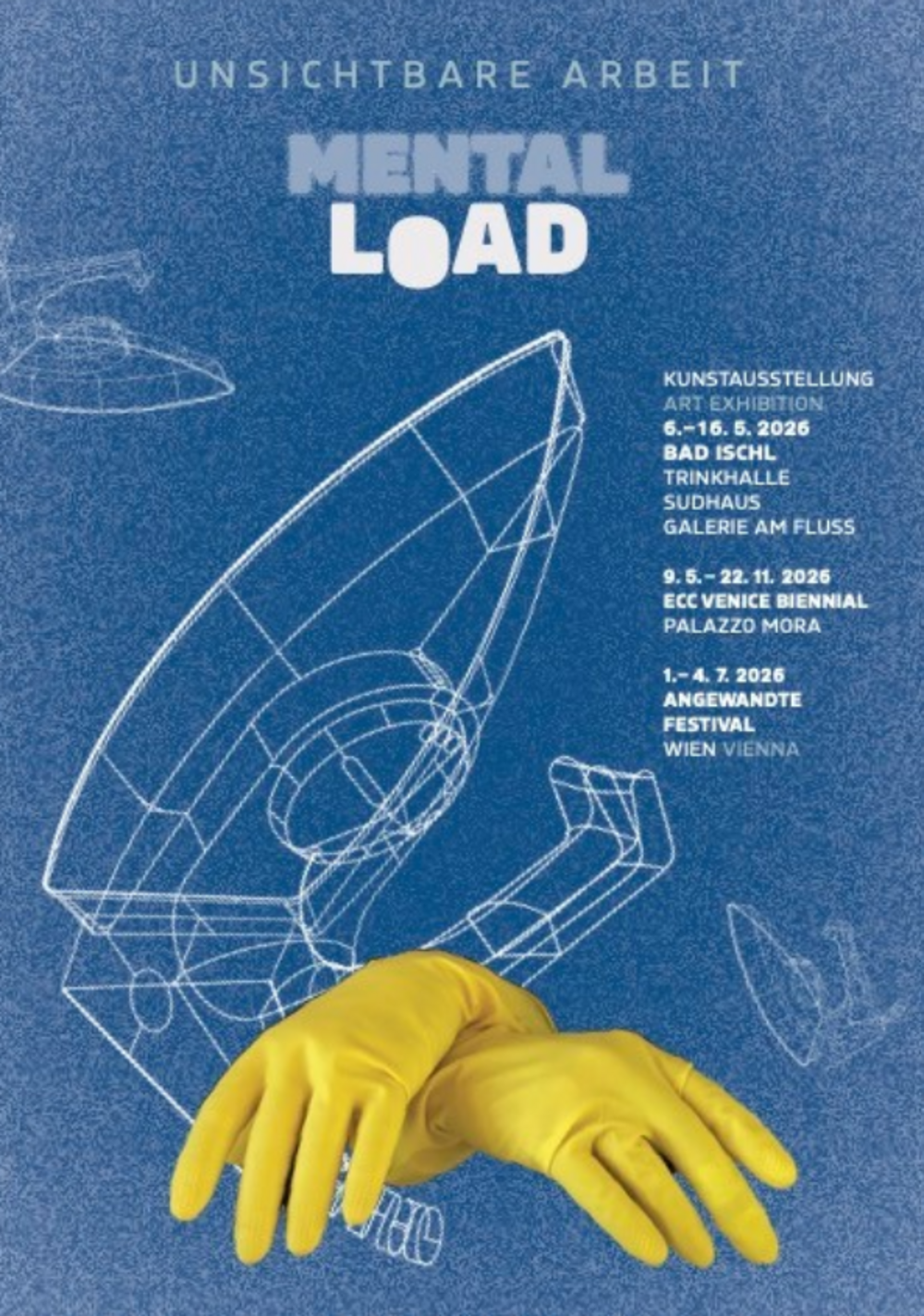
Visuals: © Markus Moser, © Robert Cambrinus; Design: Anita Kern