Welcome at the Interface Culture program website.
Acting as creative artists and researchers, students learn how to advance the state of the art of current interface technologies and applications. Through interdisciplinary research and team work, they also develop new aspects of interface design including its cultural and social applications. The themes elaborated under the Master's programme in relation to interactive technologies include Interactive Environments, Interactive Art, Ubiquitous Computing, game design, VR and MR environments, Sound Art, Media Art, Web-Art, Software Art, HCI research and interaction design.

The Interface Culture program at the Linz University of Arts Department of Media was founded in 2004 by Christa Sommerer and Laurent Mignonneau. The program teaches students of human-machine interaction to develop innovative interfaces that harness new interface technologies at the confluence of art, research, application and design, and to investigate the cultural and social possibilities of implementing them.
The term "interface" is omnipresent nowadays. Basically, it describes an intersection or linkage between different computer systems that makes use of hardware components and software programs to enable the exchange and transmission of digital information via communications protocols.
However, an interface also describes the hook-up between human and machine, whereby the human qua user undertakes interaction as a means of operating and influencing the software and hardware components of a digital system. An interface thus enables human beings to communicate with digital technologies as well as to generate, receive and exchange data. Examples of interfaces in very widespread use are the mouse-keyboard interface and graphical user interfaces (i.e. desktop metaphors). In recent years, though, we have witnessed rapid developments in the direction of more intuitive and more seamless interface designs; the fields of research that have emerged include ubiquitous computing, intelligent environments, tangible user interfaces, auditory interfaces, VR-based and MR-based interaction, multi-modal interaction (camera-based interaction, voice-driven interaction, gesture-based interaction), robotic interfaces, natural interfaces and artistic and metaphoric interfaces.
Artists in the field of interactive art have been conducting research on human-machine interaction for a number of years now. By means of artistic, intuitive, conceptual, social and critical forms of interaction design, they have shown how digital processes can become essential elements of the artistic process.
Ars Electronica and in particular the Prix Ars Electronica's Interactive Art category launched in 1991 has had a powerful impact on this dialog and played an active role in promoting ongoing development in this field of research.
The Interface Cultures program is based upon this know-how. It is an artistic-scientific course of study to give budding media artists and media theoreticians solid training in creative and innovative interface design. Artistic design in these areas includes interactive art, netart, software art, robotic art, soundart, noiseart, games & storytelling and mobile art, as well as new hybrid fields like genetic art, bioart, spaceart and nanoart.
It is precisely this combination of technical know-how, interdisciplinary research and a creative artistic-scientific approach to a task that makes it possible to develop new, creative interfaces that engender progressive and innovative artistic-creative applications for media art, media design, media research and communication.
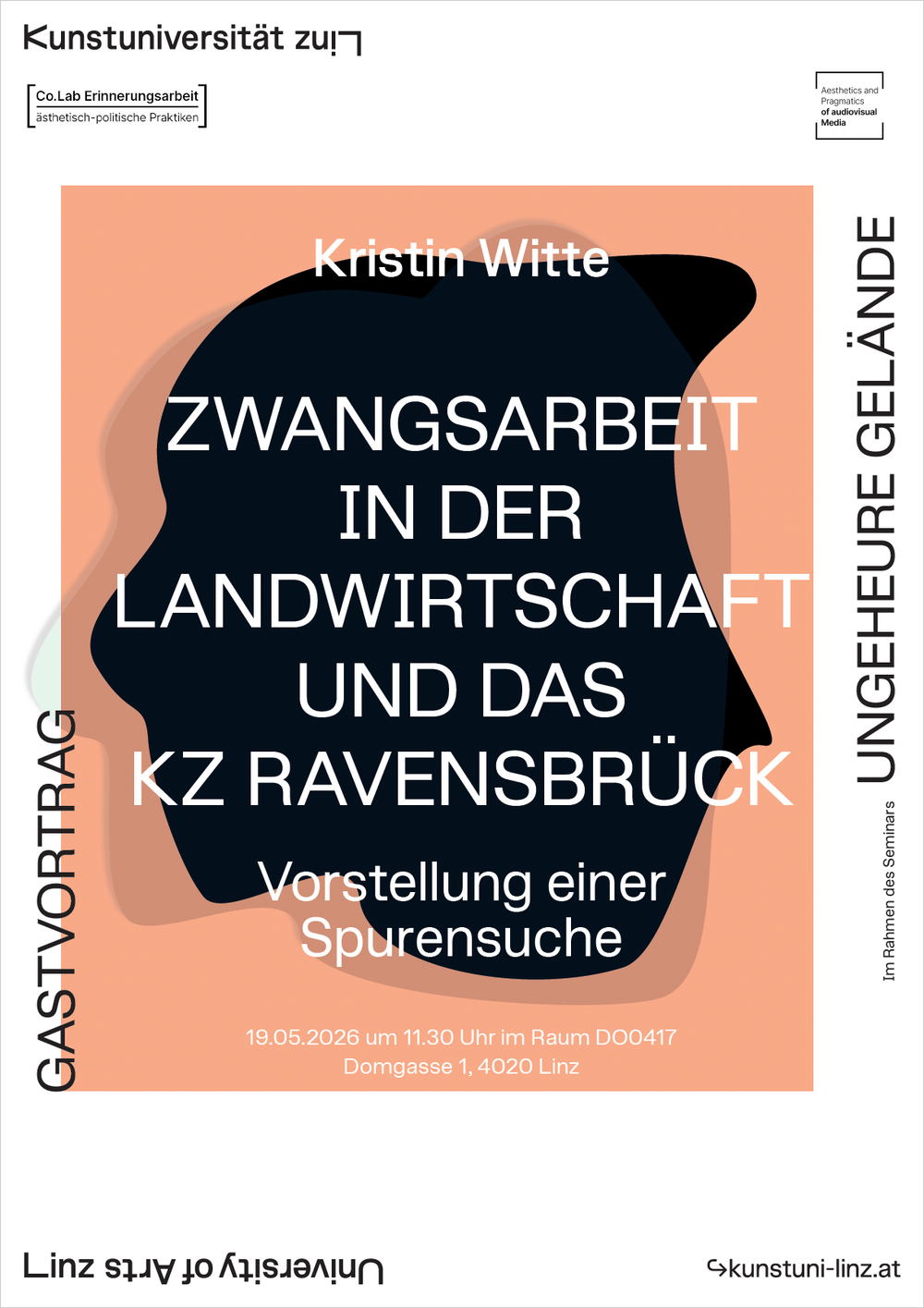
Zwangsarbeit in der Landwirtschaft und das KZ Ravensbrück.
19. Mai 2026 um 11.30 Uhr Kunstuniversität Linz, Domgasse 1, Raum DO0417, 4020 Linz
Vorstellung einer Spurensuche.
Das Co.Lab Erinnerungsarbeit · ästhetisch-politische Strategien und die Abteilung für Ästhetik und Pragmatik audiovisueller Medien laden zum Gastvortrag Zwangsarbeit in der Landwirtschaft und das KZ Ravensbrück. Vorstellung einer Spurensuche von Kristin Witte ein. Der Vortrag findet im Rahmen des Seminars Ungeheure Gelände – NS-Zwangsarbeit in Linz und Umgebung statt.
Die Historikerin Kristin Witte weist im Vortrag darauf hin, dass sich im Umfeld des Frauen-Konzentrationslagers Ravensbrück nicht nur eine lagereigene Gärtnerei und diverse Tierställe befanden, sondern auch ein landwirtschaftliches Versuchsgut der „Deutschen Versuchsanstalt für Ernährung und Verpflegung GmbH“. Häftlinge des Konzentrationslagers mussten dort verschiedene Arten von Zwangsarbeit leisten.
Kristin Witte stellt vor, wie sie sich in ihrer Forschung diesen Orten und der Geschichte angenähert hat, welche Quellen sie nutzte und wie ein quellenkritischer Umgang insbesondere mit Fotografien aussehen kann.
Kristin Witte, M.A. hat in Berlin und Seattle Gender Studies sowie Neuere/Neueste Geschichte und in Frankfurt (Oder) „Schutz europäischer Kulturgüter“ studiert. Von 2015 bis Ende 2019 arbeitete sie zunächst als wissenschaftliche Volontärin und anschließend als wissenschaftliche Mitarbeiterin in der Gedenkstätte Ravensbrück. Daneben hat sie 2019 zusammen mit dem Institut für angewandte Geschichte e.V. den digitalen Rundgang „Unbekannte Orte. Ravensbrück“ entwickelt. Seit März 2021 arbeitet sie als kuratorische Projektleitung und stellvertretende Leitung im Museum Pankow in Berlin.
Veröffentlichungen u.a.:
Der Schweine- und Pferdestall des Frauen-Konzentrationslagers Ravensbrück. Eine Bestandsaufnahme, in: Brandenburgische Denkmalpflege 6 (2020) 2, S. 73-82 (mit Magda-Lena Eppinger).
DVA-Versuchsgüter im Umfeld des KZ Ravensbrück, in: Jens Ebert, Tanja Kinzel, Meggi Pieschel, Kristin Witte: Die Versuchsanstalt. Landwirtschaftliche Forschung und Praxis der SS in Konzentrationslagern und eroberten Gebieten, Berlin 2021, S. 198-265.