Welcome at the Interface Culture program website.
Acting as creative artists and researchers, students learn how to advance the state of the art of current interface technologies and applications. Through interdisciplinary research and team work, they also develop new aspects of interface design including its cultural and social applications. The themes elaborated under the Master's programme in relation to interactive technologies include Interactive Environments, Interactive Art, Ubiquitous Computing, game design, VR and MR environments, Sound Art, Media Art, Web-Art, Software Art, HCI research and interaction design.

The Interface Culture program at the Linz University of Arts Department of Media was founded in 2004 by Christa Sommerer and Laurent Mignonneau. The program teaches students of human-machine interaction to develop innovative interfaces that harness new interface technologies at the confluence of art, research, application and design, and to investigate the cultural and social possibilities of implementing them.
The term "interface" is omnipresent nowadays. Basically, it describes an intersection or linkage between different computer systems that makes use of hardware components and software programs to enable the exchange and transmission of digital information via communications protocols.
However, an interface also describes the hook-up between human and machine, whereby the human qua user undertakes interaction as a means of operating and influencing the software and hardware components of a digital system. An interface thus enables human beings to communicate with digital technologies as well as to generate, receive and exchange data. Examples of interfaces in very widespread use are the mouse-keyboard interface and graphical user interfaces (i.e. desktop metaphors). In recent years, though, we have witnessed rapid developments in the direction of more intuitive and more seamless interface designs; the fields of research that have emerged include ubiquitous computing, intelligent environments, tangible user interfaces, auditory interfaces, VR-based and MR-based interaction, multi-modal interaction (camera-based interaction, voice-driven interaction, gesture-based interaction), robotic interfaces, natural interfaces and artistic and metaphoric interfaces.
Artists in the field of interactive art have been conducting research on human-machine interaction for a number of years now. By means of artistic, intuitive, conceptual, social and critical forms of interaction design, they have shown how digital processes can become essential elements of the artistic process.
Ars Electronica and in particular the Prix Ars Electronica's Interactive Art category launched in 1991 has had a powerful impact on this dialog and played an active role in promoting ongoing development in this field of research.
The Interface Cultures program is based upon this know-how. It is an artistic-scientific course of study to give budding media artists and media theoreticians solid training in creative and innovative interface design. Artistic design in these areas includes interactive art, netart, software art, robotic art, soundart, noiseart, games & storytelling and mobile art, as well as new hybrid fields like genetic art, bioart, spaceart and nanoart.
It is precisely this combination of technical know-how, interdisciplinary research and a creative artistic-scientific approach to a task that makes it possible to develop new, creative interfaces that engender progressive and innovative artistic-creative applications for media art, media design, media research and communication.
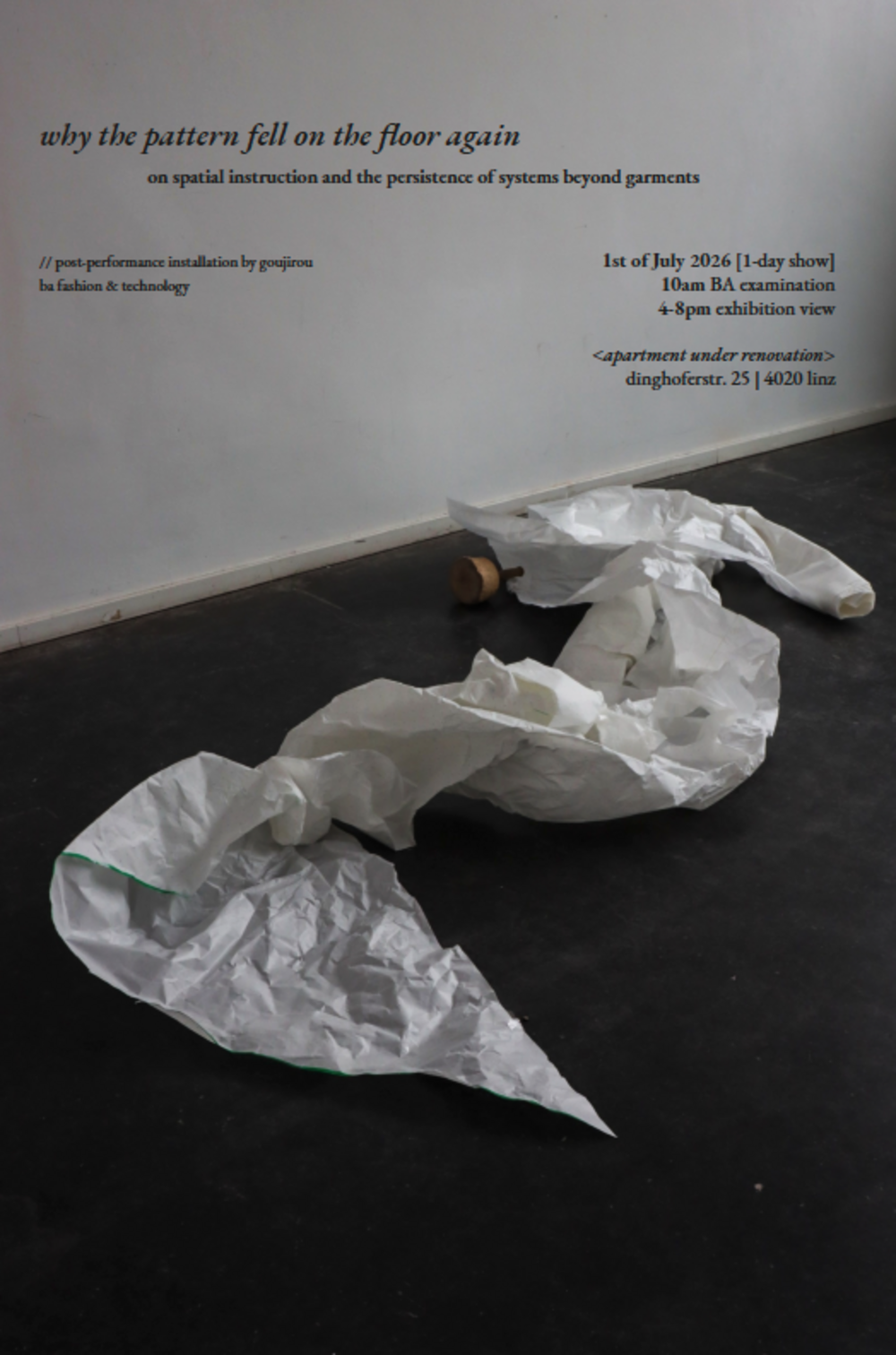
why the pattern fell on the floor again
1. Juli um 10.00 Uhr (BA Prüfung), Ausstellung 16.00 bis 20.00 Uhr <apartment under renovation>, Dinghoferstr. 25, 4020 Linz
Mert Özdemir (goujirou), Studierender der Bildhauerei - transmedialer Raum, stellt aus.
why the pattern fell on the floor again ist eine Post-Performance Installation, die Mode nicht als Kleidungsstück, sondern als System räumlicher Anweisungen versteht. Ausgehend von überdimensional vergrößerten Schnittmustern werden Operationen der Schnittkonstruktion in den Raum übertragen und ihrer üblichen Funktion entzogen. Der Installation geht eine mehrtägige Ausdauerperformance voraus. Mit Schnittpapier, Werkzeugen und dem eigenen Körper betritt der Künstler den Raum und verlässt ihn erst, wenn eine Fortsetzung aufgrund physischer und/oder mentaler Erschöpfung nicht mehr möglich ist. Ein nachträgliches Arrangieren der entstandenen Situation findet nicht statt. Die ausgestellte Installation verbleibt als Spur dieses Prozesses. Sie untersucht, was von Mode übrig bleibt, wenn das Kleidungsstück verschwindet, die zugrunde liegenden Strukturen jedoch weiterwirken.
goujirou (mert oezdemir) arbeitet zwischen Skulptur, Installation, Performance und Mode. Ausgehend von aussortierten Materialien, residualen Objekten und Systemen der Anweisung untersucht seine Arbeit, was bleibt, wenn Funktion, Gebrauch oder Auflösung ausbleiben. Zu seinen jüngeren Projekten zählen Skulpturen aus menschlichem Haar, bronzene Sicherungsetikette, vergrößerte Schnittmuster und Ausdauerperformance. Geprägt wird seine Praxis durch das Studium Fashion & Technology sowie Bildhauerei an der Kunstuniversität Linz und Bildhauerei an der Städelschule in Frankfurt am Main.
why the pattern fell on the floor again
on spatial instruction and the persistence of systems beyond garments
"what remains of fashion when it no longer resolves into garments?"
// post-performance installation by goujirou
Ausstellung am 1. Juli 2026 [Ein-Tages-Show]
Um 10.00 Uhr findet die BA Prüfung statt. Die Ausstellung ist von 16.00 bis 20.00 Uhr zu sehen (auch früher nach Vereinbarung).
Ort: <apartment under renovation>, Dinghoferstr. 25, 4020 Linz
Instagram: www.instagram.com/_goujirou/