Welcome at the Interface Culture program website.
Acting as creative artists and researchers, students learn how to advance the state of the art of current interface technologies and applications. Through interdisciplinary research and team work, they also develop new aspects of interface design including its cultural and social applications. The themes elaborated under the Master's programme in relation to interactive technologies include Interactive Environments, Interactive Art, Ubiquitous Computing, game design, VR and MR environments, Sound Art, Media Art, Web-Art, Software Art, HCI research and interaction design.

The Interface Culture program at the Linz University of Arts Department of Media was founded in 2004 by Christa Sommerer and Laurent Mignonneau. The program teaches students of human-machine interaction to develop innovative interfaces that harness new interface technologies at the confluence of art, research, application and design, and to investigate the cultural and social possibilities of implementing them.
The term "interface" is omnipresent nowadays. Basically, it describes an intersection or linkage between different computer systems that makes use of hardware components and software programs to enable the exchange and transmission of digital information via communications protocols.
However, an interface also describes the hook-up between human and machine, whereby the human qua user undertakes interaction as a means of operating and influencing the software and hardware components of a digital system. An interface thus enables human beings to communicate with digital technologies as well as to generate, receive and exchange data. Examples of interfaces in very widespread use are the mouse-keyboard interface and graphical user interfaces (i.e. desktop metaphors). In recent years, though, we have witnessed rapid developments in the direction of more intuitive and more seamless interface designs; the fields of research that have emerged include ubiquitous computing, intelligent environments, tangible user interfaces, auditory interfaces, VR-based and MR-based interaction, multi-modal interaction (camera-based interaction, voice-driven interaction, gesture-based interaction), robotic interfaces, natural interfaces and artistic and metaphoric interfaces.
Artists in the field of interactive art have been conducting research on human-machine interaction for a number of years now. By means of artistic, intuitive, conceptual, social and critical forms of interaction design, they have shown how digital processes can become essential elements of the artistic process.
Ars Electronica and in particular the Prix Ars Electronica's Interactive Art category launched in 1991 has had a powerful impact on this dialog and played an active role in promoting ongoing development in this field of research.
The Interface Cultures program is based upon this know-how. It is an artistic-scientific course of study to give budding media artists and media theoreticians solid training in creative and innovative interface design. Artistic design in these areas includes interactive art, netart, software art, robotic art, soundart, noiseart, games & storytelling and mobile art, as well as new hybrid fields like genetic art, bioart, spaceart and nanoart.
It is precisely this combination of technical know-how, interdisciplinary research and a creative artistic-scientific approach to a task that makes it possible to develop new, creative interfaces that engender progressive and innovative artistic-creative applications for media art, media design, media research and communication.
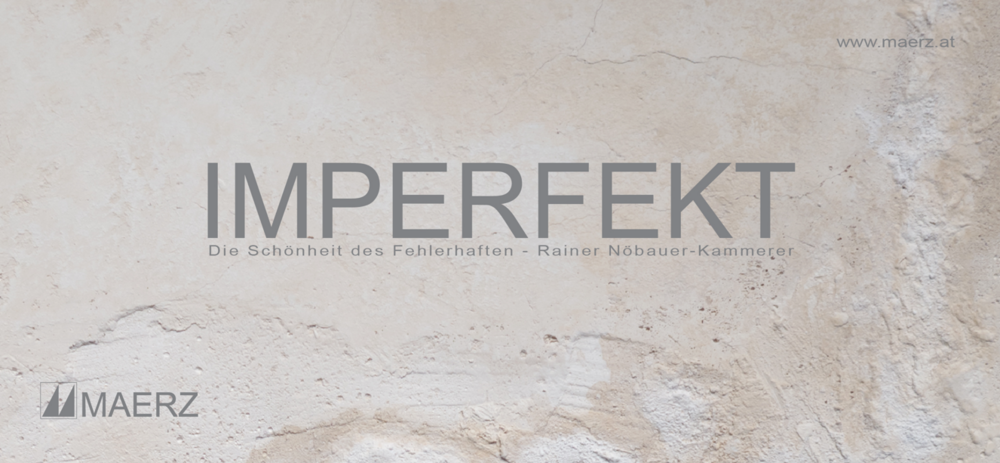
IMPERFEKT - Die Schönheit des Fehlerhaften
Eröffnung: 26. Mai 2026, 19.00 Uhr; Ausstellung bis 26. Juni 2026 Galerie MAERZ, Eisenbahngasse 20, 4020 Linz
Rainer Nöbauer-Kammerer
Begrüßung: Lisa Spalt (MAERZ)
Grußworte: Margot Nazzal (Direktorin Kultur und Gesellschaft Land Oberösterreich)
Einführung in die Ausstellung: Georg Wilbertz (Architektur- und Kunsthistoriker)
Der neue Werkzyklus des Künstlers Rainer Nöbauer-Kammerer nimmt bautechnische Mängel und den Verfall von Architekturen und Bauten des 20. und 21. Jahrhunderts als Ausgangspunkt. Die hierbei auftretenden Verfallserscheinungen, Mängel und Verletzungen werden bildnerisch und skulptural in Formate der bildenden Kunst transferiert.
IMPERFEKT überträgt die – zumeist negativ gewerteten – Formen und ästhetischen Qualitäten baulicher Mängel und Schäden bewusst in die künstlerische Gestaltung von Skulpturen und Reliefs. Ergänzt wird der Werkzyklus durch eine theoretische Auseinandersetzung in enger Zusammenarbeit mit dem Architektur- und Kunsthistoriker Georg Wilbertz.
Methodisch werden die Herstellungsprozesse bestimmter Materialien gezielt manipuliert, sodass kalkulierte Fehler und Schäden entstehen. Beispiele sind die künstliche Erzeugung von Rissen und Abplatzungen in Oberflächen durch veränderte Mischungsverhältnisse oder die gezielte Beschleunigung von Oxidationsprozessen durch den Einsatz von Zusatzstoffen und materialtechnischen Verfahren.
Aus den gesteuerten und aufwendigen Prozessen entstehen ästhetisch eigenständige Werke. Sie laden dazu ein, den künstlerischen Wert des Mangelhaften und Fehlerhaften neu zu betrachten. Das Dogma der Perfektion wird hinterfragt und eine Ästhetik des Unvollkommenen vorgestellt.
Begleitende Programmpunkte:
30.5.2026 um 16.00 Uhr
Sonderführung im Rahmen der „Architekturtage 2026“ in Kooperation mit afo - architekturforum oberösterreich
18.6.2026 um 19.00 Uhr
Podiumsdiskussion
Die folgende Expert*innenrunde nähert sich dem Thema praxisnah und erweitert die Perspektive über ästhetisch-künstlerische Aspekte hinaus:
Dipl.-Ing. Ulrich Aspetsberger (Architekt / Caramel – architekten), Dipl.-Ing.in Brigitte Kumpfmiller
(Bundesdenkmalamt, Landeskonservatorat für Oberösterreich), MMag. art. Rainer Nöbauer-Kammerer (Künstler) und Dr. Georg Wilbertz (Architektur- und Kunsthistoriker)
26.6.2026 von 15.00 bis 18.00 Uhr
Finissage
der Künstler ist anwesend
Einladung
maerz.at/imperfekt-die-schoenheit-des-fehlerhaften-rainer-noebauer-kammerer