Welcome at the Interface Culture program website.
Acting as creative artists and researchers, students learn how to advance the state of the art of current interface technologies and applications. Through interdisciplinary research and team work, they also develop new aspects of interface design including its cultural and social applications. The themes elaborated under the Master's programme in relation to interactive technologies include Interactive Environments, Interactive Art, Ubiquitous Computing, game design, VR and MR environments, Sound Art, Media Art, Web-Art, Software Art, HCI research and interaction design.

The Interface Culture program at the Linz University of Arts Department of Media was founded in 2004 by Christa Sommerer and Laurent Mignonneau. The program teaches students of human-machine interaction to develop innovative interfaces that harness new interface technologies at the confluence of art, research, application and design, and to investigate the cultural and social possibilities of implementing them.
The term "interface" is omnipresent nowadays. Basically, it describes an intersection or linkage between different computer systems that makes use of hardware components and software programs to enable the exchange and transmission of digital information via communications protocols.
However, an interface also describes the hook-up between human and machine, whereby the human qua user undertakes interaction as a means of operating and influencing the software and hardware components of a digital system. An interface thus enables human beings to communicate with digital technologies as well as to generate, receive and exchange data. Examples of interfaces in very widespread use are the mouse-keyboard interface and graphical user interfaces (i.e. desktop metaphors). In recent years, though, we have witnessed rapid developments in the direction of more intuitive and more seamless interface designs; the fields of research that have emerged include ubiquitous computing, intelligent environments, tangible user interfaces, auditory interfaces, VR-based and MR-based interaction, multi-modal interaction (camera-based interaction, voice-driven interaction, gesture-based interaction), robotic interfaces, natural interfaces and artistic and metaphoric interfaces.
Artists in the field of interactive art have been conducting research on human-machine interaction for a number of years now. By means of artistic, intuitive, conceptual, social and critical forms of interaction design, they have shown how digital processes can become essential elements of the artistic process.
Ars Electronica and in particular the Prix Ars Electronica's Interactive Art category launched in 1991 has had a powerful impact on this dialog and played an active role in promoting ongoing development in this field of research.
The Interface Cultures program is based upon this know-how. It is an artistic-scientific course of study to give budding media artists and media theoreticians solid training in creative and innovative interface design. Artistic design in these areas includes interactive art, netart, software art, robotic art, soundart, noiseart, games & storytelling and mobile art, as well as new hybrid fields like genetic art, bioart, spaceart and nanoart.
It is precisely this combination of technical know-how, interdisciplinary research and a creative artistic-scientific approach to a task that makes it possible to develop new, creative interfaces that engender progressive and innovative artistic-creative applications for media art, media design, media research and communication.
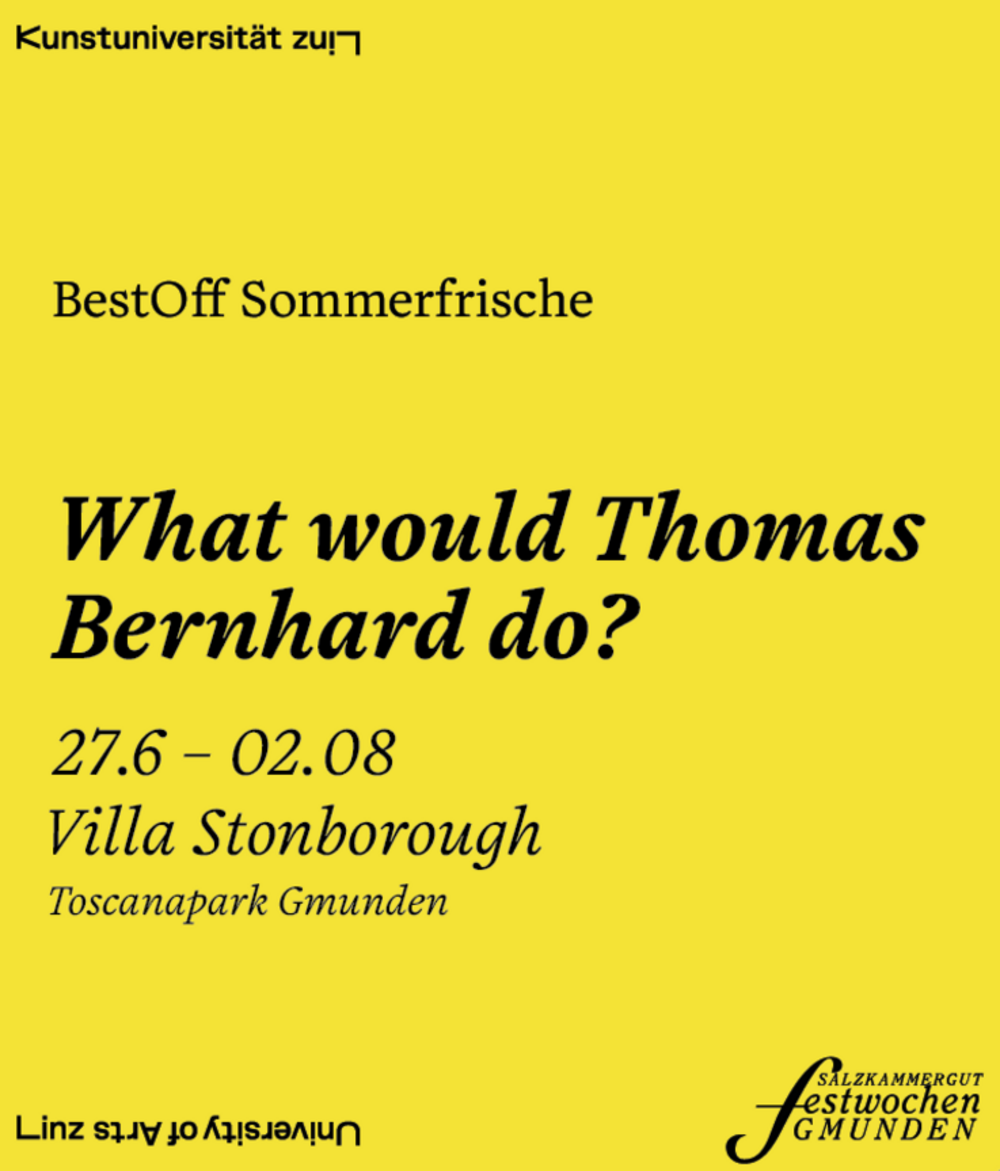
What would Thomas Bernhard do?
Pressemitteilung vom 19. Juni 2026
Kunstuni Linz lädt zur BestOff Sommerfrische ins ehemalige Thomas-Bernhard-Archiv in Gmunden.
Die Kunstuni Linz begibt sich von 28. Juni bis 2. August erneut auf Sommerfrische und diesmal wird es philosophisch. Die sechste Auflage im Rahmen der Salzkammergut Festwochen Gmunden positioniert sich als zeitgenössisches Ausstellungs- und Forschungsformat an der Schnittstelle von Kunst, Philosophie und öffentlichem Raum.
Im Toscanapark sowie im angrenzenden ehemaligen Thomas-Bernhard-Archiv entstehen mit dem von der Kunsthalle Wien ausgeborgten Ausstellungstitel „WWTBD – WHAT WOULD THOMAS BERNHARD DO“ künstlerische Arbeiten, die Sprache, Raum und gesellschaftliche Verantwortung reflektieren. Der Titel referenziert auf das Ausstellungsprojekt, welches vor 13 Jahren unter der künstlerischen Leitung von Nicolaus Schafhausen in der Kunsthalle Wien stattgefunden hat. Studierende und Alumni der Kunstuniversität Linz zeigen in Gmunden nun ihre Positionen, die sich zwischen Kunst, Philosophie und Gesellschaft bewegen – offen, experimentell und oft unkonventionell.
Im Toscanapark und der umliegenden Landschaft entsteht damit für einige Wochen ein temporärer Ort für künstlerisches Arbeiten, Denken und Austauschen. Mit skulpturalen oder installativen Arbeiten im Freien, mit performativen Formaten, Interventionen oder auch mit konzeptuellen Ansätzen, die sich mit Raum, Sprache und Öffentlichkeit beschäftigen. Ebenso präsentiert werden textbasierte und theoretische Beiträge, die sich auf unterschiedliche Weise mit Kunst & Philosophie auseinandersetzen – ob als Essay, Fragment, poetische Arbeit oder diskursiver Impuls.
Das Format setzt kulturelle Landmarks, stärkt Gmunden als lebendigen Ort zeitgenössischer Kunst und wirkt über die Traunsee-Region hinaus in den internationalen Diskurs, so Kuratorin Simone Barlian: „Einmal mehr beweisen die Kunstuniversität Linz und die Salzkammergut Festwochen Gmunden ihre Vielfalt und fördern den internationalen Austausch auch in ländlicheren Regionen Oberösterreichs.“
Rektorin Brigitte Hütter: „Zum sechsten Mal präsentiert die Kunstuniversität Linz heuer die BestOff Sommerfrische mit tatkräftiger Unterstützung der Salzkammergut Festwochen in Gmunden – und diesmal freuen wir uns besonders, dass die jungen Künstler*innen ihre Werke nicht nur im Toscanapark, sondern auch im angrenzenden ehemaligen Thomas-Bernhard-Archiv präsentieren dürfen. An diesem besonderen und sehr unterschiedlich wahrgenommenen Ort können unsere Studierenden in regen Austausch mit den Besucher*innen treten und so werden Begegnungen und Kontakte im wunderschönen landschaftlichen Rahmen jenseits bekannter Touristenattraktionen möglich.“
Johanna Mitterbauer, Kaufmännische Geschäftsführerin der Salzkammergut Festwochen Gmunden: „Die BestOff Sommerfrische der Kunstuniversität Linz ist für die Salzkammergut Festwochen Gmunden seit vielen Jahren weit mehr als eine Ausstellung: Sie ist ein lebendiger Denkraum, in dem junge Kunst auf Landschaft, Öffentlichkeit und Diskurs trifft. Dass sich heuer auch das ehemalige Thomas-Bernhard-Archiv als Resonanzraum öffnet, verleiht diesem besonderen Format eine zusätzliche Tiefe zwischen Sprache, Erinnerung und Gegenwartskunst. Die Zusammenarbeit mit der Kunstuniversität Linz eröffnet für uns jedes Jahr einen inspirierenden Dialog, der Gmunden jeden Sommer aufs Neue mit zeitgenössischer Kunst, neuen Perspektiven und offenen Begegnungen bereichert.“
PS: Freuen Sie sich jedes Wochenende auf performative Aktionen und halten Sie Ausschau nach der Thomas Bernhard Zeitung!
What would Thomas Bernhard do?
Ausstellungseröffnung
Samstag, 27. Juni um 18:00
Mit Brigitte Hütter, Rektorin Kunstuniversität Linz
und Andre Zogholy, Vizerektor für Forschung Kunstuniversität Linz
Ausstellungsdauer
28.Juni bis 2. August
Öffnungszeiten
MI – SO jeweils 11:00 – 19:00 Uhr
Villa Stonborough
Toscanapark Gmunden
Kuratiert von Simone Barlian. In Kooperation mit den Salzkammergut Festwochen Gmunden.
Anfrage für Führungen für Medienvertreter*innen & Kontakt für Rückfragen: Simone Barlian, simone.barlian@kunstuni-linz.at, 0699 12 79 38 68
Weitere Infos unter: www.kunstuni-linz.at