Welcome at the Interface Culture program website.
Acting as creative artists and researchers, students learn how to advance the state of the art of current interface technologies and applications. Through interdisciplinary research and team work, they also develop new aspects of interface design including its cultural and social applications. The themes elaborated under the Master's programme in relation to interactive technologies include Interactive Environments, Interactive Art, Ubiquitous Computing, game design, VR and MR environments, Sound Art, Media Art, Web-Art, Software Art, HCI research and interaction design.

The Interface Culture program at the Linz University of Arts Department of Media was founded in 2004 by Christa Sommerer and Laurent Mignonneau. The program teaches students of human-machine interaction to develop innovative interfaces that harness new interface technologies at the confluence of art, research, application and design, and to investigate the cultural and social possibilities of implementing them.
The term "interface" is omnipresent nowadays. Basically, it describes an intersection or linkage between different computer systems that makes use of hardware components and software programs to enable the exchange and transmission of digital information via communications protocols.
However, an interface also describes the hook-up between human and machine, whereby the human qua user undertakes interaction as a means of operating and influencing the software and hardware components of a digital system. An interface thus enables human beings to communicate with digital technologies as well as to generate, receive and exchange data. Examples of interfaces in very widespread use are the mouse-keyboard interface and graphical user interfaces (i.e. desktop metaphors). In recent years, though, we have witnessed rapid developments in the direction of more intuitive and more seamless interface designs; the fields of research that have emerged include ubiquitous computing, intelligent environments, tangible user interfaces, auditory interfaces, VR-based and MR-based interaction, multi-modal interaction (camera-based interaction, voice-driven interaction, gesture-based interaction), robotic interfaces, natural interfaces and artistic and metaphoric interfaces.
Artists in the field of interactive art have been conducting research on human-machine interaction for a number of years now. By means of artistic, intuitive, conceptual, social and critical forms of interaction design, they have shown how digital processes can become essential elements of the artistic process.
Ars Electronica and in particular the Prix Ars Electronica's Interactive Art category launched in 1991 has had a powerful impact on this dialog and played an active role in promoting ongoing development in this field of research.
The Interface Cultures program is based upon this know-how. It is an artistic-scientific course of study to give budding media artists and media theoreticians solid training in creative and innovative interface design. Artistic design in these areas includes interactive art, netart, software art, robotic art, soundart, noiseart, games & storytelling and mobile art, as well as new hybrid fields like genetic art, bioart, spaceart and nanoart.
It is precisely this combination of technical know-how, interdisciplinary research and a creative artistic-scientific approach to a task that makes it possible to develop new, creative interfaces that engender progressive and innovative artistic-creative applications for media art, media design, media research and communication.
TIME OUT.14
Ausstellung bis 19. Juli 2026 Deep Space 8K, Ars Electronica Center Linz
TIME OUT .14 präsentiert vierzehn neue Arbeiten von Studierenden des Bachelorstudienganges Zeitbasierte und Interaktive Medienkunst, der Kunstuniversität Linz.
Seit 2013 ermöglicht das Ausstellungsformat TIME OUT jungen Medienkünstler*innen, die an der Kunstuniversität Linz studieren, ausgewählte Werke im Ars Electronica Center zu präsentieren. Auch in der 14. Edition wird die Vielfalt der Studienrichtung "Zeitbasierte und Interaktive Medienkunst" sichtbar: Die 14 neuen Arbeiten von Künstler*innen aus 8 Ländern, spannen einen Bogen von Klangkunst über unkonventionelle Videoformate und interaktive Installationen bis hin zu anspruchsvollen Performances, die bei der Eröffnung am 2. Juni im Deep Space 8K gezeigt werden.
Ein besonderes Alleinstellungsmerkmal der hinter diesem Format stehenden Abteilung an der Kunstuniversität liegt in den Möglichkeiten und Freiräumen, die den Studierenden angeboten werden: Neben dem Zugang zu High-End-Technologien, Studios, Werkstätten und Infrastrukturen und den entsprechenden Arbeitsmethoden, dürfen die jungen Medienkünstler*innen die Themen und Inhalte mit denen sie sich beschäftigen möchten, individuell selbst wählen und auch selbst entscheiden, mit welchen Technologien und Medien und in welchen Formaten sie mit dem Publikum kommunizieren wollen.
Dies ermöglicht und unterstützt die Beschäftigung mit persönlichen Themen und die Auseinandersetzung mit sehr aktuellen Fragestellungen mit oft hoher gesellschaftlicher Relevanz, aber auch spielerische Experimente, die häufig zu erstaunlichen Ergebnissen führen.
Die Möglichkeit in diesem renommierten Haus ausstellen zu können und der Austausch mit den Besucher*innen im AEC sind wertvolle Bereicherungen für die Studierenden und bieten dem Publikum Einblicke in aktuelles Kunstschaffen.

Performances zur Ausstellungseröffnung
Love Letters (in a Deep Space) || Ariathney Coyne
Keeping The Light On, An Anti-Capitalistic Performance || Remo Stuflesser
Ausgestellte Arbeiten
LARVA || Pauline Hübner (AT)
Transcendental Strings || Maxemilian van der Meer (DE)
City Soundscape || Anja Stiftinger (AT)
Who is jumping, Jack? || Nathalie Kronberger (AT
Comments || Jingwen Luo (CN)
We’re in this tub together || Elena Jäger (DE)
SoundsLike Joy – The Happy Memory Archive || Remo Stuflesser
shards of a looking glass || Egemen Karaaslan
HEAST // Francisca Friedrich und Lena Isabella Deisenberger
Paket ist unterwegs || Elizaveta Belkevich (RU)
METALLY MEADOWS || Daniel Hans Walter (AT)
The Gallery of Context Lost || Daryna Stohnii (UA)
zu den Arbeiten
Kuratiert wird die Schau von Ars Electronica und Studiengangsleiter Joachim Smetschka.
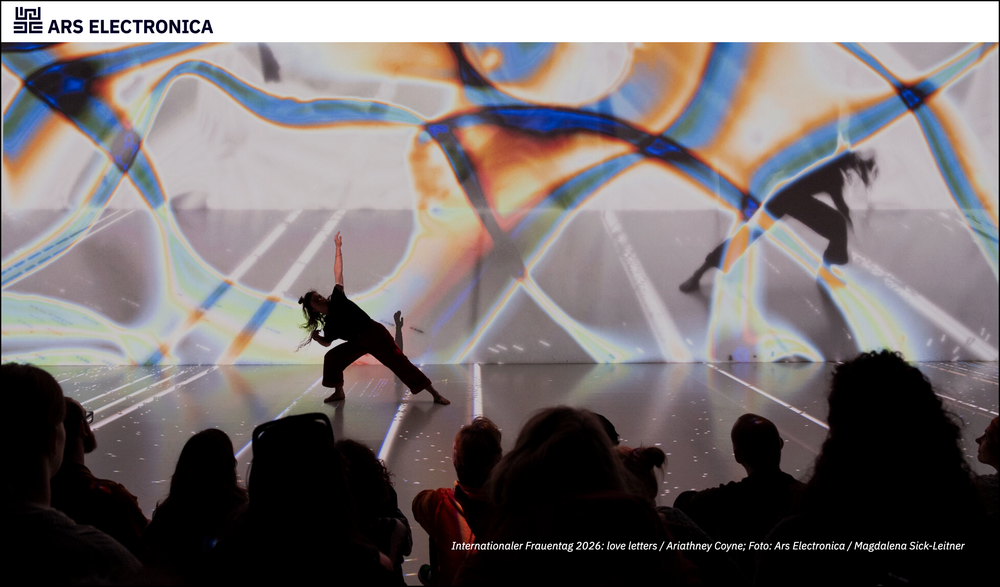
Internationaler Frauentag 2026: love letters / Ariathney Coyne; Foto: Ars Electronica / Magdalena Sick-Leitner