Welcome at the Interface Culture program website.
Acting as creative artists and researchers, students learn how to advance the state of the art of current interface technologies and applications. Through interdisciplinary research and team work, they also develop new aspects of interface design including its cultural and social applications. The themes elaborated under the Master's programme in relation to interactive technologies include Interactive Environments, Interactive Art, Ubiquitous Computing, game design, VR and MR environments, Sound Art, Media Art, Web-Art, Software Art, HCI research and interaction design.

The Interface Culture program at the Linz University of Arts Department of Media was founded in 2004 by Christa Sommerer and Laurent Mignonneau. The program teaches students of human-machine interaction to develop innovative interfaces that harness new interface technologies at the confluence of art, research, application and design, and to investigate the cultural and social possibilities of implementing them.
The term "interface" is omnipresent nowadays. Basically, it describes an intersection or linkage between different computer systems that makes use of hardware components and software programs to enable the exchange and transmission of digital information via communications protocols.
However, an interface also describes the hook-up between human and machine, whereby the human qua user undertakes interaction as a means of operating and influencing the software and hardware components of a digital system. An interface thus enables human beings to communicate with digital technologies as well as to generate, receive and exchange data. Examples of interfaces in very widespread use are the mouse-keyboard interface and graphical user interfaces (i.e. desktop metaphors). In recent years, though, we have witnessed rapid developments in the direction of more intuitive and more seamless interface designs; the fields of research that have emerged include ubiquitous computing, intelligent environments, tangible user interfaces, auditory interfaces, VR-based and MR-based interaction, multi-modal interaction (camera-based interaction, voice-driven interaction, gesture-based interaction), robotic interfaces, natural interfaces and artistic and metaphoric interfaces.
Artists in the field of interactive art have been conducting research on human-machine interaction for a number of years now. By means of artistic, intuitive, conceptual, social and critical forms of interaction design, they have shown how digital processes can become essential elements of the artistic process.
Ars Electronica and in particular the Prix Ars Electronica's Interactive Art category launched in 1991 has had a powerful impact on this dialog and played an active role in promoting ongoing development in this field of research.
The Interface Cultures program is based upon this know-how. It is an artistic-scientific course of study to give budding media artists and media theoreticians solid training in creative and innovative interface design. Artistic design in these areas includes interactive art, netart, software art, robotic art, soundart, noiseart, games & storytelling and mobile art, as well as new hybrid fields like genetic art, bioart, spaceart and nanoart.
It is precisely this combination of technical know-how, interdisciplinary research and a creative artistic-scientific approach to a task that makes it possible to develop new, creative interfaces that engender progressive and innovative artistic-creative applications for media art, media design, media research and communication.
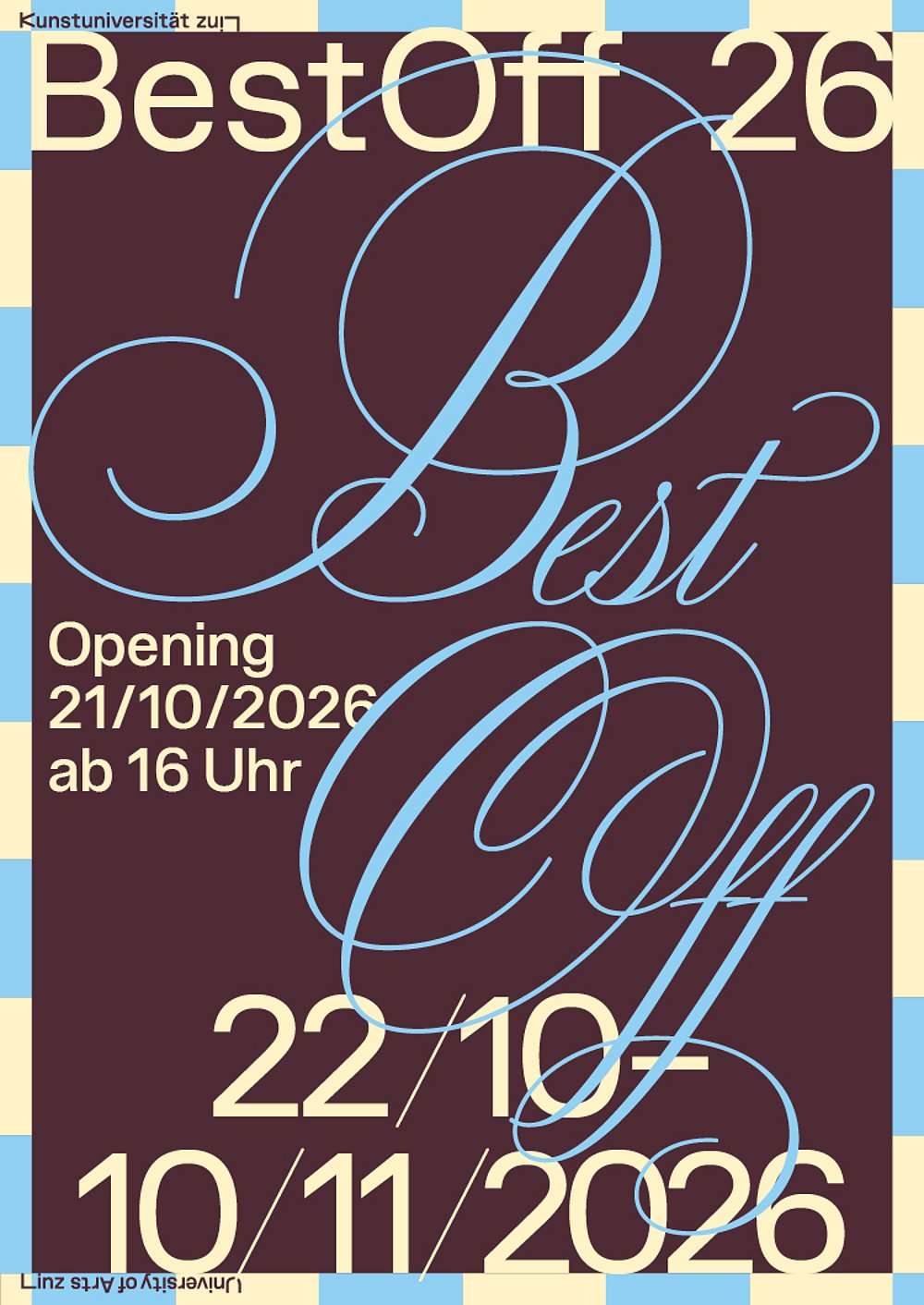
BestOff 2026
Eröffnung: 21. Oktober 2026, 16.00 Uhr; Ausstellung bis 10. Nov. 2026 Kunstuni Linz, Hauptplatz 6, splace am Hauptplatz, Paramentenwerkstatt
Ausstellung mit Arbeiten von Studierenden und Absolvent*innen der Kunstuniversität Linz
Wir laden Sie herzlich zur diesjährigen BestOff der Kunstuniversität Linz ein. Das jährliche Ausstellungsformat präsentiert Arbeiten von Studierenden und Absolvent*innen. Dieses Jahr werden 44 Kunstprojekte zu sehen sein, aufgeteilt auf die Räumlichkeiten von Hauptplatz 6, splace am Hauptplatz und der Paramentenwerkstatt in der Seilerstätte 1.
Das Team der BestOff hat sich mit der Geschichte des Gebäudes Hauptplatz 6 beschäftigt, insbesondere mit dem ehemaligen Lokal Stadtkeller, dessen Spuren im Untergeschoß des Gebäudes zu finden sind. Der Stadtkeller bildet den kuratorischen und gestalterischen Rahmen für die Ausstellung und fließt durch kuratorische Interventionen in die Räumlichkeiten ein.
Der Eröffnungstag beginnt mit einem soft opening aller Ausstellungsräume ab 16.00 Uhr. Gleichzeitig beginnt die Clay Dinner Masterclass der Künstlerin Tetiana Shtykalo, bei der im Kollektiv Fisch zubereitet wird. Anmeldungen zur Masterclass sind per E-Mail möglich.
Ab 18.00 Uhr finden performative Arbeiten von Ariathney Coyne und Lukas Kuhl statt. Das Eröffnungsprogramm wird vom Ned D’accord Chor musikalisch begleitet.
Wie kein anderes Ausstellungsformat, vermag die BestOff die künstlerische Vielfalt an der Kunstuniversität Linz zu illustrieren. Studierende und Absolvent*innen laden dazu ein, in ihre Gedankenwelten einzutauchen.
Erstmals während der BestOff finden Artistic Research Roundtables statt. Studierende, die einen wissenschaftlich basierten Zugang zu ihren Werken haben, treten miteinander in Austausch und präsentieren ihre Recherchen. Diese öffentlichen Veranstaltungen finden am 27.10. und 3.11., jeweils ab 19.00 Uhr im Festsaal des Nordico Stadtmuseums statt.
Während der Ausstellungsdauer werden Performances von Studierenden, sowohl in den Ausstellungsräumen als auch in der Linzer Innenstadt stattfinden. Halten Sie die Augen offen!
Auf Ihr Kommen freuen sich,
Das Team der BestOff
Barbara Seyerl, Laura Weiss, Ayal Semrik und Sharon Mary Nesyt
Öffnungszeiten:
MI bis FR: 14.00 bis 18.00 Uhr
SA 12.00 bis 16.00 Uhr