Welcome at the Interface Culture program website.
Acting as creative artists and researchers, students learn how to advance the state of the art of current interface technologies and applications. Through interdisciplinary research and team work, they also develop new aspects of interface design including its cultural and social applications. The themes elaborated under the Master's programme in relation to interactive technologies include Interactive Environments, Interactive Art, Ubiquitous Computing, game design, VR and MR environments, Sound Art, Media Art, Web-Art, Software Art, HCI research and interaction design.

The Interface Culture program at the Linz University of Arts Department of Media was founded in 2004 by Christa Sommerer and Laurent Mignonneau. The program teaches students of human-machine interaction to develop innovative interfaces that harness new interface technologies at the confluence of art, research, application and design, and to investigate the cultural and social possibilities of implementing them.
The term "interface" is omnipresent nowadays. Basically, it describes an intersection or linkage between different computer systems that makes use of hardware components and software programs to enable the exchange and transmission of digital information via communications protocols.
However, an interface also describes the hook-up between human and machine, whereby the human qua user undertakes interaction as a means of operating and influencing the software and hardware components of a digital system. An interface thus enables human beings to communicate with digital technologies as well as to generate, receive and exchange data. Examples of interfaces in very widespread use are the mouse-keyboard interface and graphical user interfaces (i.e. desktop metaphors). In recent years, though, we have witnessed rapid developments in the direction of more intuitive and more seamless interface designs; the fields of research that have emerged include ubiquitous computing, intelligent environments, tangible user interfaces, auditory interfaces, VR-based and MR-based interaction, multi-modal interaction (camera-based interaction, voice-driven interaction, gesture-based interaction), robotic interfaces, natural interfaces and artistic and metaphoric interfaces.
Artists in the field of interactive art have been conducting research on human-machine interaction for a number of years now. By means of artistic, intuitive, conceptual, social and critical forms of interaction design, they have shown how digital processes can become essential elements of the artistic process.
Ars Electronica and in particular the Prix Ars Electronica's Interactive Art category launched in 1991 has had a powerful impact on this dialog and played an active role in promoting ongoing development in this field of research.
The Interface Cultures program is based upon this know-how. It is an artistic-scientific course of study to give budding media artists and media theoreticians solid training in creative and innovative interface design. Artistic design in these areas includes interactive art, netart, software art, robotic art, soundart, noiseart, games & storytelling and mobile art, as well as new hybrid fields like genetic art, bioart, spaceart and nanoart.
It is precisely this combination of technical know-how, interdisciplinary research and a creative artistic-scientific approach to a task that makes it possible to develop new, creative interfaces that engender progressive and innovative artistic-creative applications for media art, media design, media research and communication.
Habitat Hybrid – Upgrade der Schiffswerft im Pocket Park Nordwest
29. Mai 2026, 18.00 Uhr; zu sehen bis Ende August 2026 MUSEUM Nordwestbahnhof, Nordwestbahnstraße 16, 1200 Wien
Katharina Gruzei
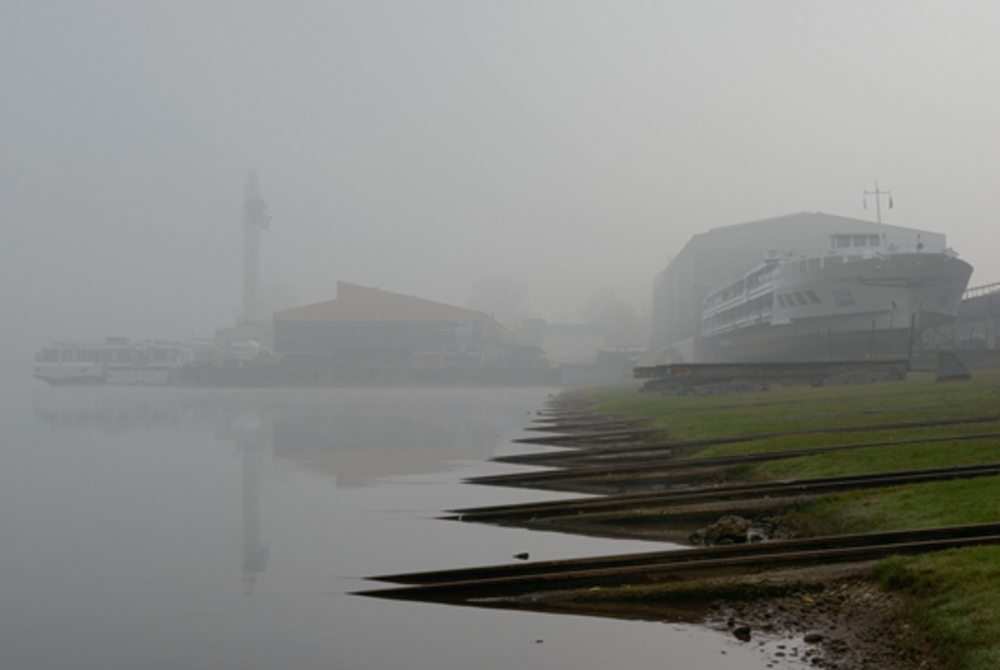
Fotos aus der Serie „Bodies of Work“, 2017 installiert im Hochregal der fiktiven Schiffswerft Nordwest
Die Auseinandersetzung mit Arbeit ist ein zentrales Thema der Künstlerin Katharina Gruzei. In der Serie „Bodies of Work“ befasst sie sich mit Österreichs letzter Donau-Schiffswerft. Dort sind hochtechnologische maschinelle Fertigung und industrielle Handarbeit eng miteinander verzahnt. Mensch und Maschine erweisen sich im industriellen Schaffensprozess als perfekt aufeinander abgestimmt. Gruzei sieht den »Arbeiterkörper« in diesem Zusammenhang als »Verhandlungsort für die stets aktuellen Diskurse um den Stellenwert und die Veränderung von Arbeit.«
Über einen Zeitraum von eineinhalb Jahren begleitete sie das Linzer Unternehmen mit ihrer Kamera und erarbeitete eine umfassende Serie, deren fotografischer Befund weit über einen dokumentarischen Ansatz hinausreicht. In ihren Bildern verwandelt Gruzei die vorgefundene Arbeitswelt in teils schwerelos wirkende oder an Science-Fiction erinnernde Szenarien und lässt damit die Nähe zur Ästhetik der Raumfahrt durchscheinen. Sie gibt Einblick in den Bau eines großen Fährschiffs und richtet ihre Kamera dabei auch auf Bereiche abseits der Arbeit. Gruzei zeigt wie die betriebliche Infrastruktur von den MitarbeiterInnen benutzt und geprägt wird und greift die lange Betriebsgeschichte des Unternehmens auf, die sich am Betriebsgelände visuell manifestiert. Außerhalb der Betriebszeiten, wenn sich die Dunkelheit über das Firmenareal legt und der Lärm der Maschinen verhallt, zeigen sich die Motive in einem anderen Licht. In Gruzeis Fotoserie erweitern fremdartig wirkende Szenarien den repräsentierten Realitätsausschnitt um neue Zeit- und Raumbezüge.
Katharina Gruzei installiert eine Auswahl aus dieser Foto-Serie im Hochregal einer von Tracing Spaces eingerichteten fiktiven Schiffswerft und verweist damit zum einen auf die Vorgeschichte des Areals als beschiffbarer Donauarm und zum anderen auf die hier nach der Stilllegung eines bedeutenden Bahnhofs und Güterumschlagplatzes bereits verschwundenen Arbeitswelt.
https://tracingspaces.net/programm/habitat-hybrid-upgrade-der-schiffswerft-im-pocket-park-nordwest/