Welcome at the Interface Culture program website.
Acting as creative artists and researchers, students learn how to advance the state of the art of current interface technologies and applications. Through interdisciplinary research and team work, they also develop new aspects of interface design including its cultural and social applications. The themes elaborated under the Master's programme in relation to interactive technologies include Interactive Environments, Interactive Art, Ubiquitous Computing, game design, VR and MR environments, Sound Art, Media Art, Web-Art, Software Art, HCI research and interaction design.

The Interface Culture program at the Linz University of Arts Department of Media was founded in 2004 by Christa Sommerer and Laurent Mignonneau. The program teaches students of human-machine interaction to develop innovative interfaces that harness new interface technologies at the confluence of art, research, application and design, and to investigate the cultural and social possibilities of implementing them.
The term "interface" is omnipresent nowadays. Basically, it describes an intersection or linkage between different computer systems that makes use of hardware components and software programs to enable the exchange and transmission of digital information via communications protocols.
However, an interface also describes the hook-up between human and machine, whereby the human qua user undertakes interaction as a means of operating and influencing the software and hardware components of a digital system. An interface thus enables human beings to communicate with digital technologies as well as to generate, receive and exchange data. Examples of interfaces in very widespread use are the mouse-keyboard interface and graphical user interfaces (i.e. desktop metaphors). In recent years, though, we have witnessed rapid developments in the direction of more intuitive and more seamless interface designs; the fields of research that have emerged include ubiquitous computing, intelligent environments, tangible user interfaces, auditory interfaces, VR-based and MR-based interaction, multi-modal interaction (camera-based interaction, voice-driven interaction, gesture-based interaction), robotic interfaces, natural interfaces and artistic and metaphoric interfaces.
Artists in the field of interactive art have been conducting research on human-machine interaction for a number of years now. By means of artistic, intuitive, conceptual, social and critical forms of interaction design, they have shown how digital processes can become essential elements of the artistic process.
Ars Electronica and in particular the Prix Ars Electronica's Interactive Art category launched in 1991 has had a powerful impact on this dialog and played an active role in promoting ongoing development in this field of research.
The Interface Cultures program is based upon this know-how. It is an artistic-scientific course of study to give budding media artists and media theoreticians solid training in creative and innovative interface design. Artistic design in these areas includes interactive art, netart, software art, robotic art, soundart, noiseart, games & storytelling and mobile art, as well as new hybrid fields like genetic art, bioart, spaceart and nanoart.
It is precisely this combination of technical know-how, interdisciplinary research and a creative artistic-scientific approach to a task that makes it possible to develop new, creative interfaces that engender progressive and innovative artistic-creative applications for media art, media design, media research and communication.
Made in Linz
Eröffnung: 26. März 2026, 19.00 Uhr; Ausstellung bis 4. Oktober 2026 Nordico, Stadtmuseum Linz, Simon-Wiesenthal-Platz 1, Linz
mit Beiträgen von u.a. Tobias Hagleitner, Katharina Gruzei, Lisa Schmidt, Reinhard Zach
Gestaltung: ANY:TIME architekten (u.a. Christoph Weidinger)
Von kleinen Einzelunternehmen bis zu Firmen mit tausenden Mitarbeiter:innen: Die Wirtschaftslandschaft von Linz ist vielfältig und stetigem Wandel unterworfen. Dieser spannt sich von frühen Industriebetrieben wie der Wollzeugfabrik des 17. Jahrhunderts bis zu den innovativen Startups der Gegenwart.
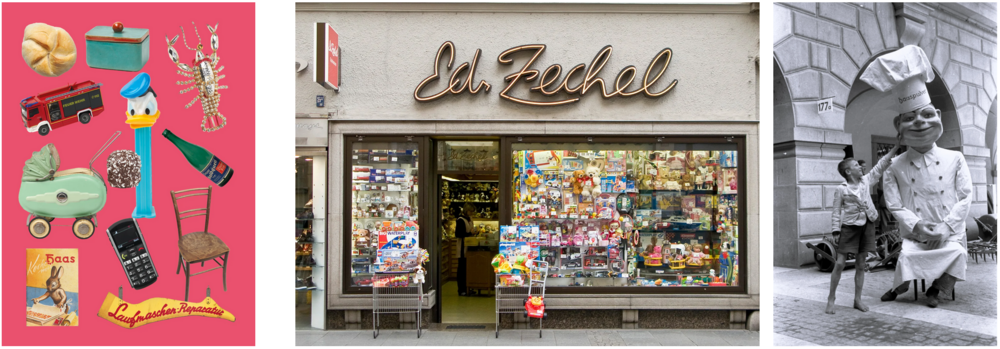
Die Ausstellung Made in Linz widmet sich ausgewählten regionalen Produkten aus Handel, Industrie und Handwerk. Die exemplarische Auswahl umfasst einen Zeitraum von mehr als 175 Jahren – von der Niemetz Schwedenbombe und der Keli Limonade bis zu international agierenden Unternehmen wie Rosenbauer oder Dynatrace. Allen gemeinsam ist ihre topografische und historische Verbindung zur Stadt Linz.
In kompakten Stationen erzählt die Schau die Geschichten prägender Betriebe und rückt zugleich die Menschen hinter den Unternehmen in den Fokus: Gründer:innen mit Pioniergeist, Familienbetriebe über Generationen hinweg und Firmen, die zu wichtigen Arbeitgebern der Stadt wurden. Eine Kolonialwarenhandlung aus Urfahr von 1913, Modelle großer Fabriksanlagen oder aktuelle Interviews veranschaulichen das Thema neben einer Fülle von Produkten.
Die Ausstellung wirft einen Blick auf den kreativen Kosmos der Stadt und zeigt ein lebendiges Bild des wirtschaftlichen Schaffens in Linz – mit dem Ziel, das Bewusstsein für die Vielfalt des heimischen Marktes zu stärken.
Kuratorinnen: Andrea Bina, Michaela Nagl
Mitarbeit: Julia Brunner, Lisa Schmidt
Ausstellungsgestaltung: ANY:TIME architekten
Grafische Gestaltung: Verena Hochleitner
Künstler:innen: Leo Adler, Karl Czap, Gregor Graf, Katharina Gruzei, Wilhelm Höhnel, Anton Kehrer, Ulrich Kehrer, Johann Matthias Krinner, Hans Lang, Franz Michalek, Alfons Ortner, Josef Pausch, Erwin Rachbauer, Christian Schepe, Alois Schwarz, Ferdinand Weeser-Krell, Eduard Wiesinger, Hans Wöhrl, Reinhard Zach
Zur Ausstellung erscheint das gleichnamige Buch Herausgegeben von Andrea Bina und Michaela Nagl.
Mit Texten von Stefan Groh, Johannes Jetschgo, Michael John, Roman Sandgruber und Anna Tratter sowie Beiträgen von Andrea Bina, Julia Brunner, Tobias Hagleitner, Klaudia Kreslehner, Michaela Nagl, Sebastian Piringer, Lisa Schmidt und Georg Wilbertz.
Grafik: Verena Hochleitner
Verlag: Anton Pustet, Salzburg
352 Seiten, € 34
Kooperation
Die Ausstellung wird unterstützt von der WKO Wirtschaftskammer Oberösterreich Linz-Stadt, dem Büro Stadtregierung | Wirtschaft, Innovation, Klimaschutz und EU und dem Kaufmannsmuseum Haslach. Das afo architekturforum oberösterreich realisiert gemeinsam mit der Kunstuniversität Linz (Studio Städtebau) die Ausstellung Linz…in Arbeit (9.4. bis 26.6.26).