Welcome at the Interface Culture program website.
Acting as creative artists and researchers, students learn how to advance the state of the art of current interface technologies and applications. Through interdisciplinary research and team work, they also develop new aspects of interface design including its cultural and social applications. The themes elaborated under the Master's programme in relation to interactive technologies include Interactive Environments, Interactive Art, Ubiquitous Computing, game design, VR and MR environments, Sound Art, Media Art, Web-Art, Software Art, HCI research and interaction design.

The Interface Culture program at the Linz University of Arts Department of Media was founded in 2004 by Christa Sommerer and Laurent Mignonneau. The program teaches students of human-machine interaction to develop innovative interfaces that harness new interface technologies at the confluence of art, research, application and design, and to investigate the cultural and social possibilities of implementing them.
The term "interface" is omnipresent nowadays. Basically, it describes an intersection or linkage between different computer systems that makes use of hardware components and software programs to enable the exchange and transmission of digital information via communications protocols.
However, an interface also describes the hook-up between human and machine, whereby the human qua user undertakes interaction as a means of operating and influencing the software and hardware components of a digital system. An interface thus enables human beings to communicate with digital technologies as well as to generate, receive and exchange data. Examples of interfaces in very widespread use are the mouse-keyboard interface and graphical user interfaces (i.e. desktop metaphors). In recent years, though, we have witnessed rapid developments in the direction of more intuitive and more seamless interface designs; the fields of research that have emerged include ubiquitous computing, intelligent environments, tangible user interfaces, auditory interfaces, VR-based and MR-based interaction, multi-modal interaction (camera-based interaction, voice-driven interaction, gesture-based interaction), robotic interfaces, natural interfaces and artistic and metaphoric interfaces.
Artists in the field of interactive art have been conducting research on human-machine interaction for a number of years now. By means of artistic, intuitive, conceptual, social and critical forms of interaction design, they have shown how digital processes can become essential elements of the artistic process.
Ars Electronica and in particular the Prix Ars Electronica's Interactive Art category launched in 1991 has had a powerful impact on this dialog and played an active role in promoting ongoing development in this field of research.
The Interface Cultures program is based upon this know-how. It is an artistic-scientific course of study to give budding media artists and media theoreticians solid training in creative and innovative interface design. Artistic design in these areas includes interactive art, netart, software art, robotic art, soundart, noiseart, games & storytelling and mobile art, as well as new hybrid fields like genetic art, bioart, spaceart and nanoart.
It is precisely this combination of technical know-how, interdisciplinary research and a creative artistic-scientific approach to a task that makes it possible to develop new, creative interfaces that engender progressive and innovative artistic-creative applications for media art, media design, media research and communication.
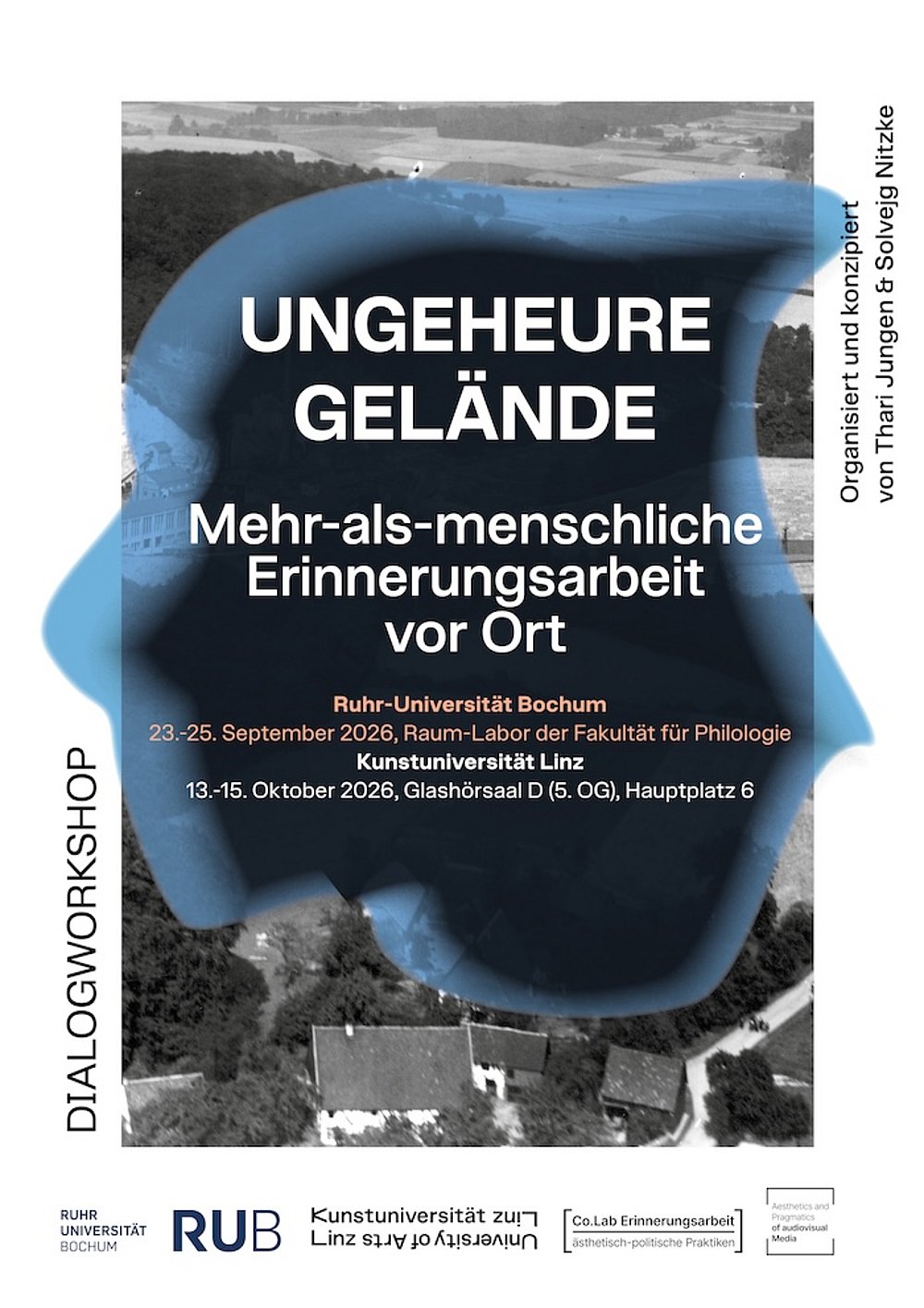
Ungeheure Gelände. Mehr-als-menschliche Erinnerungsarbeit vor Ort
23. bis 25. September und 13. bis 15. Oktober 2026 Ruhr-Universität Bochum und Kunstuniversität Linz
23. bis 25. September 2026 an der Ruhr-Universität Bochum, Raum-Labor der Fakultät für Philologie
13. bis 15. Oktober 2026 an der Kunstuniversität Linz, Glashörsaal D, 5.OG, Hauptplatz 6
Ein Dialogworkshop zwischen dem Co.Lab Erinnerungsarbeit·ästhetisch-politische Praktiken, der Abteilung für Ästhetik und Pragmatik audiovisueller Medien und der Professur für vergleichende Literaturwissenschaften der Universität Wien.
Der Workshop »Ungeheure Gelände« stellt zwei Industriestandorte in den Fokus, die auf sichtbare und unsichtbare Weise von massiven menschlichen Eingriffen geprägt sind: Die Landschaften von Linz und Bochum weisen Spuren vielfältiger Gewaltgeschichten auf. Sie lassen sich deshalb als stille, oftmals übersehene Archive vergangener Gewalt verstehen. Ausgehend von der Frage, welche materiellen Formen das Erinnern an diesen Orten (nicht) annimmt und in welchen Weisen sich das Vergessen materialisiert, wenden wir uns im Workshop u.a. den Stollen, Schlackebergen und Steinbrüchen zu, die als Zeugnisse von Zwangsarbeit fungieren, den Fluss- und Waldlandschaften in die sich Spuren von Kriegsverbrechen eingeschrieben haben oder auch den Böden, die durch die industrielle Nutzung verwüstet und verunreinigt sind.
Anhand solcher und weiterer Geländeformen möchten wir im Workshop diskutieren, inwiefern diese mehr-als-menschlichen Materialisierungen dazu beitragen, dass Vergangenheiten (nicht nur) an diesen Orten gegenwärtig bleiben, sondern auch die Zukunft beeinflussen. Die Tagung soll Gelegenheit bieten der Frage nachzugehen, ob sich solche Gelände als sedimentierte Ausdrucksformen kollektiver Erinnerungen verstehen lassen und in welcher Hinsicht sich deren Wirkung bis in gegenwärtige gesellschaftliche Aushandlungsprozesse fortsetzt. Weiters erscheint es uns relevant zu untersuchen, ob sich diese Terrains als räumliche Gedächtnisspeicher menschlicher Gewalt verstehen lassen und welche epistemischen, politischen und kulturellen Konsequenzen sich daraus ergeben. Und nicht zuletzt stellt sich die Frage, zu welchen Formaten und Praktiken des Erinnerns und Archivierens uns solche Orte herausfordern.
Um gemeinsam zu untersuchen, wie diese uns oftmals ungeheuren Gelände wahrgenommen und erzählt werden können, bringen wir in Bochum und Linz Autor*innen, Künstler*innen und Wissenschaftler*innen zusammen. Damit möchte der interdisziplinär organisierte Arbeitsworkshop zu einer Begriffs- und Konzeptdiskussion beitragen, die aktuell hinsichtlich eines mehr-als-menschlichen Archivbegriffes virulent geführt wird.
Organisation:
Solvejg Nitzke (Universität Wien)
Thari Jungen (Kunstuniversität Linz)
Kontakt: medienaesthetik@kunstuni-linz.at