Welcome at the Interface Culture program website.
Acting as creative artists and researchers, students learn how to advance the state of the art of current interface technologies and applications. Through interdisciplinary research and team work, they also develop new aspects of interface design including its cultural and social applications. The themes elaborated under the Master's programme in relation to interactive technologies include Interactive Environments, Interactive Art, Ubiquitous Computing, game design, VR and MR environments, Sound Art, Media Art, Web-Art, Software Art, HCI research and interaction design.

The Interface Culture program at the Linz University of Arts Department of Media was founded in 2004 by Christa Sommerer and Laurent Mignonneau. The program teaches students of human-machine interaction to develop innovative interfaces that harness new interface technologies at the confluence of art, research, application and design, and to investigate the cultural and social possibilities of implementing them.
The term "interface" is omnipresent nowadays. Basically, it describes an intersection or linkage between different computer systems that makes use of hardware components and software programs to enable the exchange and transmission of digital information via communications protocols.
However, an interface also describes the hook-up between human and machine, whereby the human qua user undertakes interaction as a means of operating and influencing the software and hardware components of a digital system. An interface thus enables human beings to communicate with digital technologies as well as to generate, receive and exchange data. Examples of interfaces in very widespread use are the mouse-keyboard interface and graphical user interfaces (i.e. desktop metaphors). In recent years, though, we have witnessed rapid developments in the direction of more intuitive and more seamless interface designs; the fields of research that have emerged include ubiquitous computing, intelligent environments, tangible user interfaces, auditory interfaces, VR-based and MR-based interaction, multi-modal interaction (camera-based interaction, voice-driven interaction, gesture-based interaction), robotic interfaces, natural interfaces and artistic and metaphoric interfaces.
Artists in the field of interactive art have been conducting research on human-machine interaction for a number of years now. By means of artistic, intuitive, conceptual, social and critical forms of interaction design, they have shown how digital processes can become essential elements of the artistic process.
Ars Electronica and in particular the Prix Ars Electronica's Interactive Art category launched in 1991 has had a powerful impact on this dialog and played an active role in promoting ongoing development in this field of research.
The Interface Cultures program is based upon this know-how. It is an artistic-scientific course of study to give budding media artists and media theoreticians solid training in creative and innovative interface design. Artistic design in these areas includes interactive art, netart, software art, robotic art, soundart, noiseart, games & storytelling and mobile art, as well as new hybrid fields like genetic art, bioart, spaceart and nanoart.
It is precisely this combination of technical know-how, interdisciplinary research and a creative artistic-scientific approach to a task that makes it possible to develop new, creative interfaces that engender progressive and innovative artistic-creative applications for media art, media design, media research and communication.
Wir kommen wieder.
Eröffnung: 25.06.2026 um 18 Uhr; Ausstellung von 26.06.26 – 11.10.26 Basement Berlin, Tauentzienstr. 9-12, 10789 Berlin
Wir kommen wieder.
Vom Reisen zum Tourismus und zurück / Über Tourismus und die Destination West-Berlin
Norbert Artner, Lehrender der Malerei & Grafik, stellt im Basement Berlin aus.
Die Ausstellung „Wir kommen wieder.“ untersucht Tourismus als kulturelles und politisches Phänomen zwischen Mobilität, Erinnerung und globaler Verflechtung. Ziel ist es, die ästhetischen und gesellschaftlichen Dimensionen des Reisens sichtbar zu machen – von kolonialen Blickregimen und historischen Stadtbildern bis zu heutigen Formen digitaler Selbstverortung. Im Mittelpunkt steht die Frage, wie touristische Narrative unsere Wahrnehmung von Orten, Menschen und Geschichte prägen und welche Bilder dabei bestehen bleiben oder neu entstehen. Gerade jetzt, angesichts ökologischer Krisen und sozialer Ungleichheiten, erscheint eine künstlerische Auseinandersetzung mit dem Thema Reisen besonders dringlich.
Das Projekt entsteht in Kooperation zwischen der kommunalen Galerie Basement und dem Museum Villa Oppenheim und verbindet historische Archive mit zeitgenössischer Kunst. Eine eigens entwickelte Bustour verknüpft beide Orte und macht Bewegung selbst zum Thema.
Die beteiligten Künstler – u. a. Esther Ernst, Bärbel Praun, Marina Camargo, Norbert Artner und Flo Maak – eröffnen unterschiedliche Zugänge: von fotografischer und installativer Forschung über Archivarbeit bis hin zu performativer Praxis.
Materialien aus dem Historischen Archiv Tourismus (TU Berlin) sowie aus dem Archiv zur Stadtgeschichte Charlottenburg-Wilmersdorf bilden die Grundlage für neue Arbeiten, die historische Narrative befragen und transformieren.
Eröffnung:
Donnerstag, 25. Juni 2026, 18.00 – 21.00 Uhr
Ort:
Basement Berlin
Zugang über den Weltkugelbrunnen
Tauentzienstr. 9-12, 10789 Berlin
Eine gemeinsame Ausstellung des Museums Charlottenburg-Wilmersdorf mit dem Kunstraum Basement Berlin.
Weiterführende Informationen:
museumsportal-berlin.de/de/ausstellungen/wir-kommen-wieder/
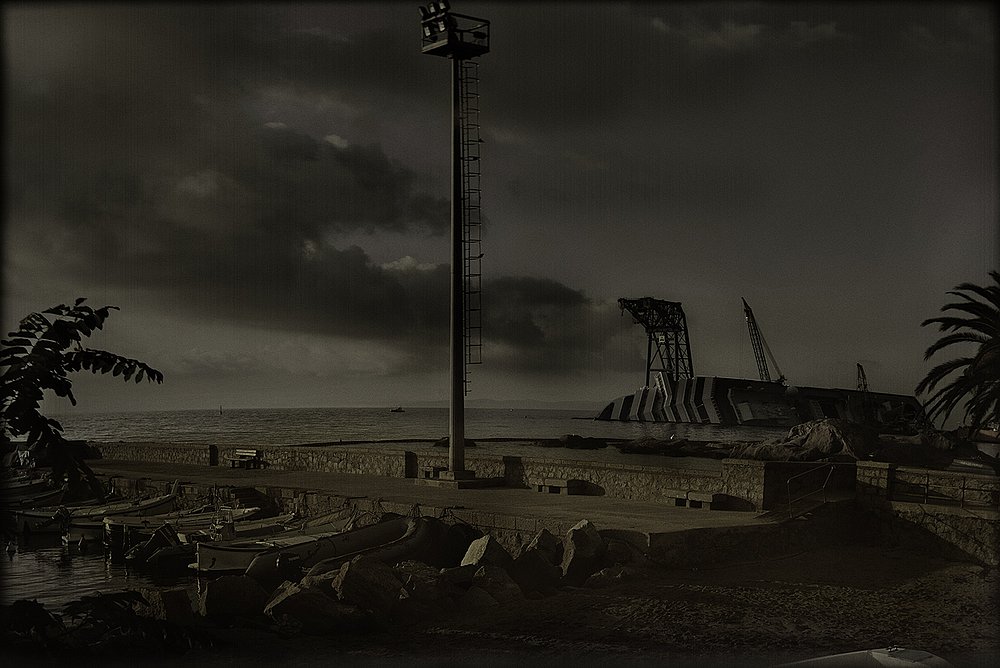
Norbert Artner, aus der Serie Dark Glass (Projekt „Costa Concordia“), © Bildrecht Wien