Welcome at the Interface Culture program website.
Acting as creative artists and researchers, students learn how to advance the state of the art of current interface technologies and applications. Through interdisciplinary research and team work, they also develop new aspects of interface design including its cultural and social applications. The themes elaborated under the Master's programme in relation to interactive technologies include Interactive Environments, Interactive Art, Ubiquitous Computing, game design, VR and MR environments, Sound Art, Media Art, Web-Art, Software Art, HCI research and interaction design.

The Interface Culture program at the Linz University of Arts Department of Media was founded in 2004 by Christa Sommerer and Laurent Mignonneau. The program teaches students of human-machine interaction to develop innovative interfaces that harness new interface technologies at the confluence of art, research, application and design, and to investigate the cultural and social possibilities of implementing them.
The term "interface" is omnipresent nowadays. Basically, it describes an intersection or linkage between different computer systems that makes use of hardware components and software programs to enable the exchange and transmission of digital information via communications protocols.
However, an interface also describes the hook-up between human and machine, whereby the human qua user undertakes interaction as a means of operating and influencing the software and hardware components of a digital system. An interface thus enables human beings to communicate with digital technologies as well as to generate, receive and exchange data. Examples of interfaces in very widespread use are the mouse-keyboard interface and graphical user interfaces (i.e. desktop metaphors). In recent years, though, we have witnessed rapid developments in the direction of more intuitive and more seamless interface designs; the fields of research that have emerged include ubiquitous computing, intelligent environments, tangible user interfaces, auditory interfaces, VR-based and MR-based interaction, multi-modal interaction (camera-based interaction, voice-driven interaction, gesture-based interaction), robotic interfaces, natural interfaces and artistic and metaphoric interfaces.
Artists in the field of interactive art have been conducting research on human-machine interaction for a number of years now. By means of artistic, intuitive, conceptual, social and critical forms of interaction design, they have shown how digital processes can become essential elements of the artistic process.
Ars Electronica and in particular the Prix Ars Electronica's Interactive Art category launched in 1991 has had a powerful impact on this dialog and played an active role in promoting ongoing development in this field of research.
The Interface Cultures program is based upon this know-how. It is an artistic-scientific course of study to give budding media artists and media theoreticians solid training in creative and innovative interface design. Artistic design in these areas includes interactive art, netart, software art, robotic art, soundart, noiseart, games & storytelling and mobile art, as well as new hybrid fields like genetic art, bioart, spaceart and nanoart.
It is precisely this combination of technical know-how, interdisciplinary research and a creative artistic-scientific approach to a task that makes it possible to develop new, creative interfaces that engender progressive and innovative artistic-creative applications for media art, media design, media research and communication.
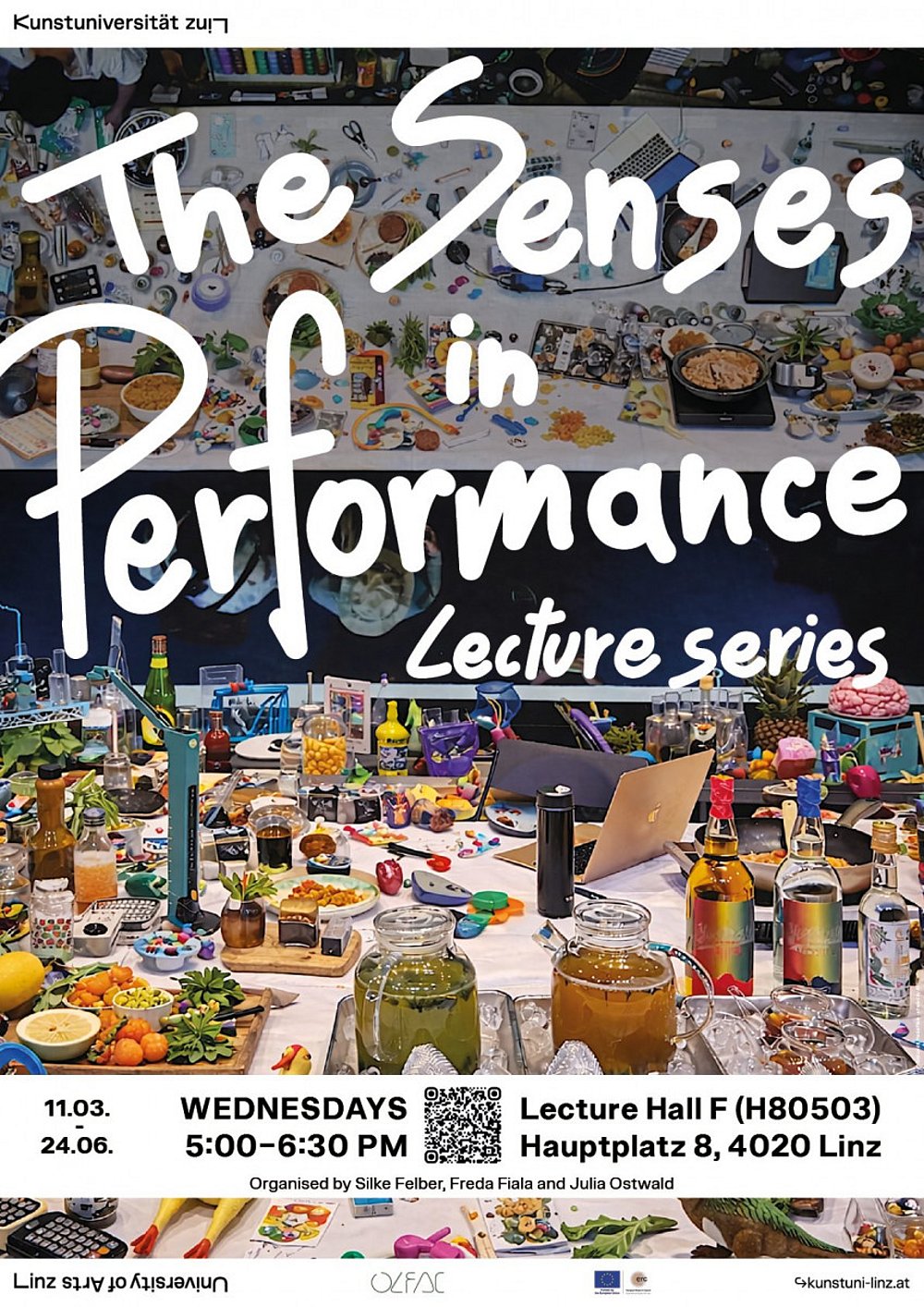
The Senses in Performance
11. März bis 24. Juni 2026, jeweils 17.00 bis 18.30 Uhr Kunstuniversität Linz, Hauptplatz 8, Hörsaal F, H8.05.03, 4020 Linz
The Chair of History of Knowledge and the ERC project OLFAC invite you to a lecture series. Co-organised and hosted by Silke Felber, Freda Fiala and Julia Ostwald
Held at the Kunstuniversität Linz (University of Arts Linz) during the summer term 2026 and co-hosted by the OLFAC team, this lecture series brings together artists, scholars and curators to explore the senses as dynamic sites of practice and inquiry.
The series approaches the senses as a stage and performance as a method of sensing. It begins from the premise that both senses and performance are not fixed domains, but active, porous and contested fields of practice. Drawing on the 2007 publication of the same name by Sally Banes and André Lepecki, The Senses in Performance reactualizes their investigation into the “critical thresholds where the corporeal meets the social, the somatic meets the historical, the cultural meets the biological, and imagination meets the flesh.“
The senses are inherently political. They organise what can be felt, seen, and known. Performance, in turn, offers a laboratory for their (re-)arrangement. From a decidedly multi- and intersensory perspective, we ask how cultural and artistic performances address the sensorium. How do the senses collaborate, compete, or fail one another?
And which hierarchies – e.g., between seeing and smelling, rationality and intuition, body and mind – do we still enact, often implicitly, when we perceive, create, or study? On a weekly basis, artists, scholars and curators discuss how to think and act through sensory methods: to approach vision, sound, touch, smell, or proprioception not as neutral channels of experience but as historically and culturally shaped knowledge regimes. Across disciplines, we ask how sensory hierarchies can be worked with, and how biases – of gender, ability, race, or technology – might be engaged productively, as material for critical invention.
The lecture series is open to the public – everyone is most welcome to attend. The introduction session is held in English, lectures are held both in English and German.
All sessions take place on Wednesdays, 5:00–6:30 pm CET
Termine
11. März 2026
Introduction by OLFAC – Silke Felber, Freda Fiala and Julia Ostwald
25. März 2026
320 GB im Rucksack – der physische Aspekt digitaler Kunst über Gletscher
Tina Frank (Visual Communication, University of Arts Linz) &
Alexis Dworsky (Media Design, University of Arts Linz)
15. April 2026
Dis_sensual – A crip choreographer’s re-distribution of the sensible
Michael Turinsky (Artist, Vienna)
22. April 2026
Performing Snakes in Modernity and Today
Nicole Haitzinger (Dance Studies, University of Salzburg) &
Christina Gillinger (Tanzquartier Vienna TQW)
29. April 2026
Tasting skin. On chilis and chills
Karin Harrasser (Cultural Studies, University of Arts Linz and Director of
ifk – International Research Center for Cultural Studies)
6. Mai 2026
Sinn für Unlösbares
bankleer – Karin Kasböck & Christoph Maria Leitner (Plastik und Environment, University of Arts Linz)
13. Mai 2026
Mimi o Sumasu – the Very Act of Listening
Miya Yoshida (Artistic Research, University of Applied Arts Vienna)
20. Mai 2026
Lingering with Bass (2024, Steve McQueen)
Ulrike Hanstein (VALIE EXPORT Center, University of Arts Linz)
27. Mai 2026
Olfactory Violence and the Freedom to Speak: Stink Bombs in Interwar Europe
William Tullett (Early Modern History, University of York)
3. Juni 2026
Sensing the Atmospheres of Painters’ Studios in Nineteenth-Century France
Erika Wicky (Olfactions, Université Grenoble Alpes)
10. Juni 2026
Hee-Hawing Democracy: Somatic Articulations Beyond the Logos
Bettina Wuttig (University of Marburg)
17. Juni 2026
Greetings from the Swamp - ABGESAGT / CANCELLED
Maria Nalbantova (Artist, Sofia)
24. Juni 2026
A loving ear – toward a poetic ecology of feeling
Brandon LaBelle (Independent Researcher, Berlin)
Es wird einen Live-Stream geben. Der Link wird den angemeldeten Teilnehmer*innen mitgeteilt.
Wenn Sie online teilnehmen möchten, melden Sie sich bitte über folgende Adresse an: office.olfac@kunstuni-linz.at