Using bacteria and robots to create new substances
December 16, 2024, 7.30 p.m. to 9 p.m. Kepler Salon, Rathausgasse 5, 4020 Linz
The Bio Fabrication Lab invites you to the Kepler Salon
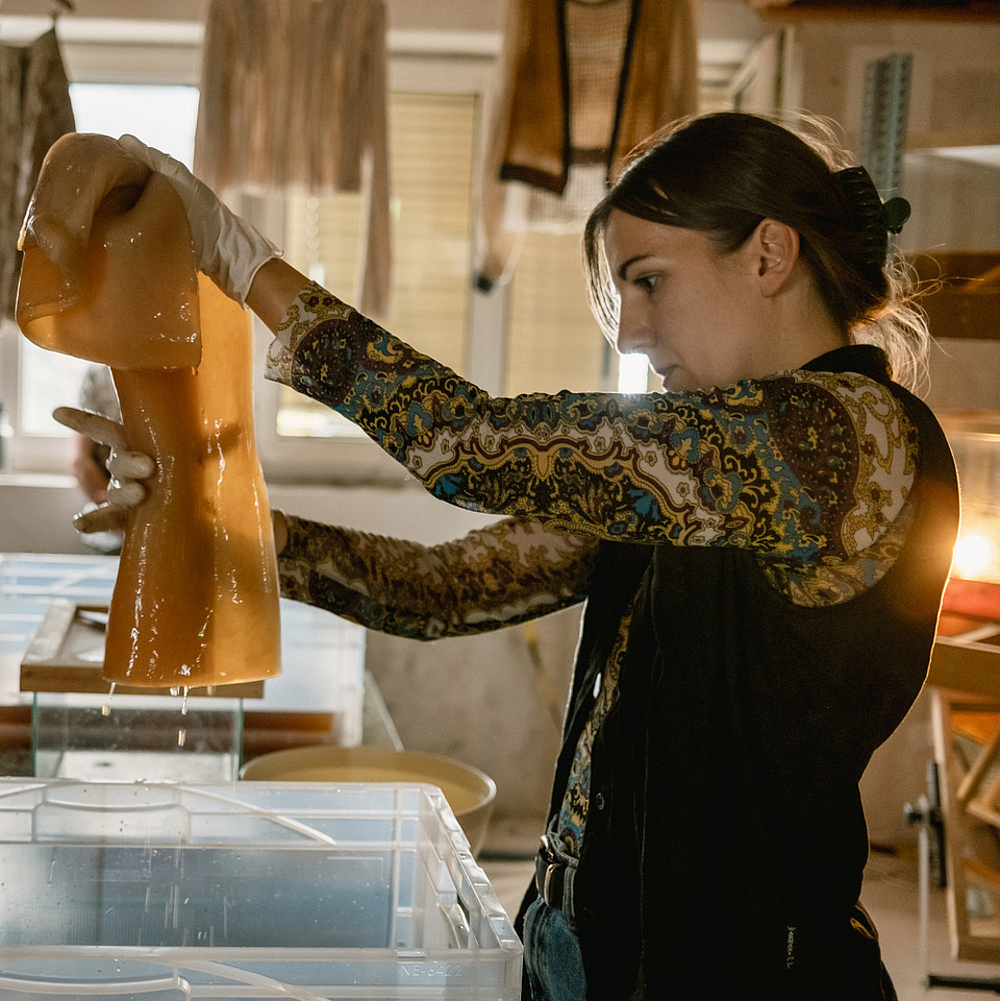
The Bio Fabrication Lab, one of the nine Co.Labs at the University of Art and Design Linz, is a transdisciplinary experimental space that works in close cooperation with the JKU Linz. Here, students, scientists and artists work together to research innovative, sustainable materials and production processes in the fields of fashion, textiles and design. The focus is on the development of new fabrics, dyeing with bacteria and the use of robots and machines to support these processes. The lab invites you to a lively discussion about forward-looking, regenerative fashion and the responsible use of resources and offers insights into the creative combination of nature, technology and design.
With Ute Ploier and Christiane Luible-Bär, Head of the Fashion & Technology program and Co.Lab Kunstuniversität Linz, as well as Peter Holzinger, Julia Moser, Johannes Heitz from the Institute of Applied Physics at Kepler University and Sandra Axinte (performance / buffet). The event will be hosted by Vice Rector Gitti Vasicek. The event is part of the new Transversale Echos series, an artistic-scientific cooperation between the JKU Linz and the University of Art and Design Linz, which aims to curb scientific skepticism and fake news.
Sandra-Laura Axinte studied Fashion & Technology at the University of Art and Design Linz, with a focus on experimental material development. In her bachelor's thesis "Culinary Turn", she creates a utopian scenario in which clothing is made from everyday ingredients, food waste and locally grown materials in the kitchen. As part of the Tangente Festival in St. Pölten, she founded the "SCOBY Lab", a production facility for Kombucha leather, in collaboration with Biennale Urbana. SCOBY, a symbiotic culture of bacteria and yeast, is created during the fermentation process of Kombucha tea and forms a sustainable cellulose material that is processed into leather-like surfaces. At the same time, Kombucha is produced as a drink, creating a link between culinary art and art.
Krassimir Kolev