Codes [ ] Rituals

Exhibition in the Domgasse 8th to 13th September 2026,
8th September – 12th September, 11 am – 8pm
13th of September, 11am – 9pm
This year’s exhibition arises from a moment marked by acceleration, fragmented attention, the constant production of information, and the endless triggering of emotional responses. In a time increasingly shaped by mediated realities and distant forms of conflict, we are compelled to ask: who constructs the narratives through which we perceive the world, and what forms can still create shared meaning? While information expands through endless accumulation, stories and rituals establish moments of temporary closure, rendering time inhabitable and creating structures of attention, repetition, and resonance through which new imaginaries and unexpected forms of coexistence unfold.
Interface Cultures students do not simply present works, but their own personal systems and situations that operate as new forms of code and ritual. Through new materialities that move within and beyond the screen, they activate new spaces of encounter, friction, and collective imagination. Their projects have become environments for trial and error, for productive misuse, for getting into trouble together, but also for practising care and play. Rather than presenting finished statements, “Codes [ ] Rituals” should be understood as a celebration of process itself –– a temporary suspension of productivity before the projects begin their life beyond the exhibition space.
Faculty:
Manuela Naveau, Laurent Mignonneau, Fabricio Lamoncha, Michaela Ortner, Gudrun Oberndorfer, Alexander Wöran
Exhibition Team Production Coordinator: Volkan Dinçer
Setup Assistant: Paul Eßer
Proofreading: Aisling Phelan
Art Direction Folder: Paul Eßer
Video Documentation: Carmen Daniela Córdoba Martínez
Video Sound Design: Hassan Wakaf
PR and Social Media Strategy: Aisling Phelan
Volkan Dinçer, Hassan Wakaf, Bilge Nefise Yardimci, Yutong Zhang, Simon Shimizu, Gustiele Fistaról, Rene Preuer, Ingrid Graz, Ling-Hsuan Hsu, Patrick Ortiz , Marta Salinas, Joann Lee, Patricia Soto Molina, Carmen Daniela Córdoba Martínez, Ahmad Aiub, Alireza Khosroabadi, Sara Karimi, Carolina Sofia Bischof, Carmen Daniela Córdoba Martínez, Vlada Oleinik, Nail Gainulla, Saumil Bhandari, Christine Haupt

Listening to Calcified
Volkan Dinçer (TR)
This project focuses on perception and memory of matter, using media-archaeological techniques that release captured information as sound waves from the scratches. It questions the subjectivity of matter based on information theory, with the
understanding that all entities are uniquely informed by their relations within their environment.
Ausstellungsort: Main Exhibtion Domgasse 1, Audimax
Phobos
Hassan Wakaf (SY/BR)
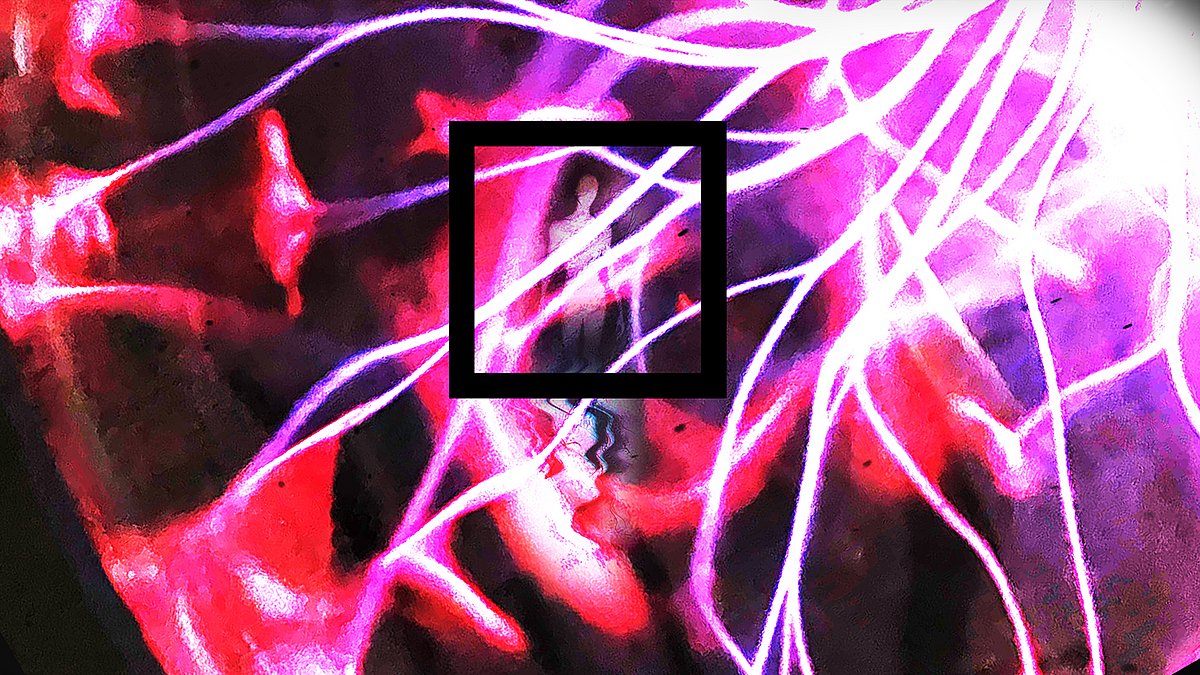
Phobos is an interactive installation that mimics inner dialogues, raising questions that challenge certainties and invite reflection. Named after the Greek personification of fear, Phobos stems from the roots of contemporary fears, uncertainties and anxieties born of conflict and war. It is built as a reflective conversational layer on top of an inverted version of the knowledge-generating combinatorial system ‘Ars Magna Generalis Ultima’, created by Ramon Llull in the 13th century.
Ausstellungsort: Main Exhibtion Domgasse 1, Audimax

Phantom Limbs - The Architecture of a Meeting Point
Bilge Nefise Yardimci (TR)
You are invited to leave the singular human perspective behind. You are stepping into a shared reality where the edges of your own body seem to dissolve. The installation does not tell you what to see or how to feel. Instead, it offers a threshold. It is a place where the gap between species and machine is finally bridged, if only for a short time. The goal is for you to carry the memory of that hybrid state with you.
Ausstellungsort: Main Exhibtion Domgasse 1, Audimax
in/affection
Sound, Mold, and Human Behavior
Yutong Zhang (CN) & Simon Shimizu (JP)
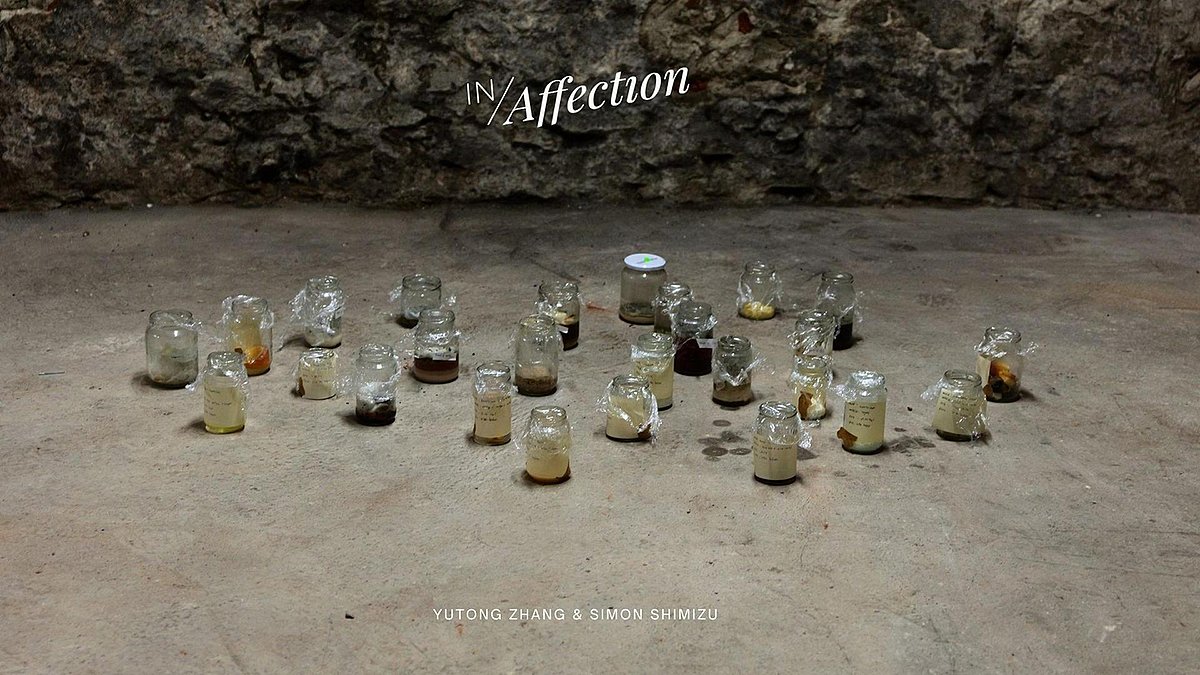
in/affection is a performance and interactive sound installation that translates the bioelectrical activity of living moulds into sound. Different species are cultivated under varying conditions and connected to a self-developed synthesiser. Fluctuations in electrical resistance are transformed in real time into evolving sonic structures. The audience interacts physically by touching cables, thereby becoming participants in a shared sonic ecosystem. How does coexistence sound when non-human life is given a voice?
Ausstellungsort: Main Exhibtion Domgasse 1, Audimax
more
BioCore
A Soft Echo of Living Heat
Rene Preuer (AT) & Ingrid Graz (AT)
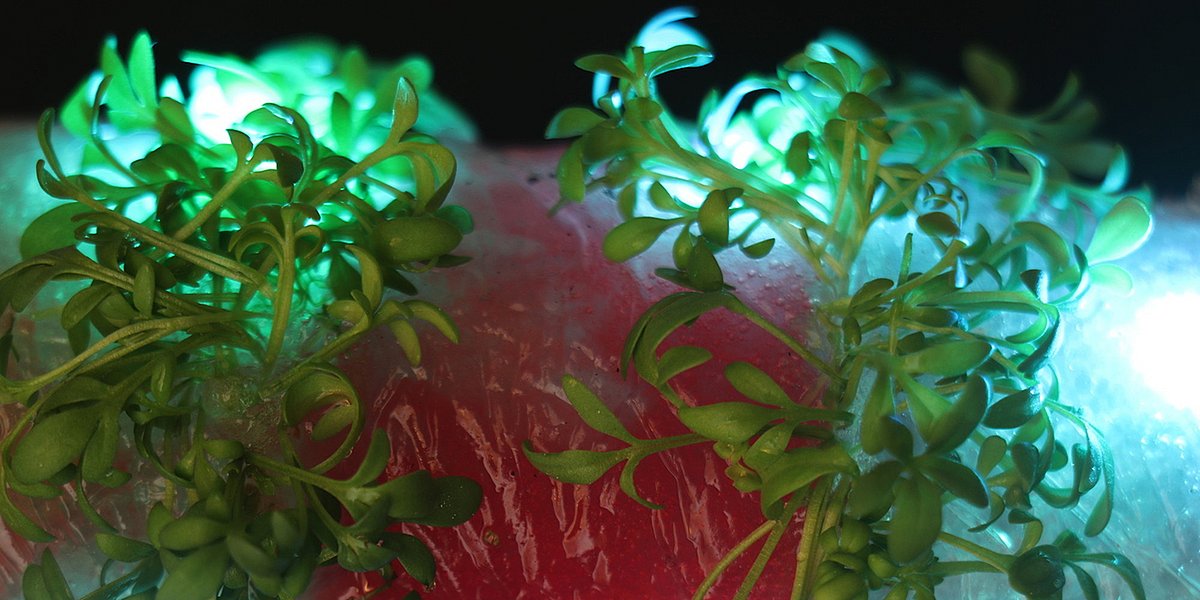
BioCore is a kinetic sculpture that bridges the living and the machine. This soft, robotic sculpture features an artificial core wrapped in living vegetation, blending nature with technology. Instead of relying on cold data, it is brought to life by the visitor’s body heat, thereby accelerating its biological decay. By highlighting the fragility of both biological and artificial existence, it serves as a reflection on the temporal nature of life and the short-lived cycle of our technology.
Ausstellungsort: Main Exhibtion Domgasse 1, Audimax
Mío##
Economies of Movement, Procedures for Displacing a Body
Patrick Ortiz (BO) & Marta Salinas (AR)
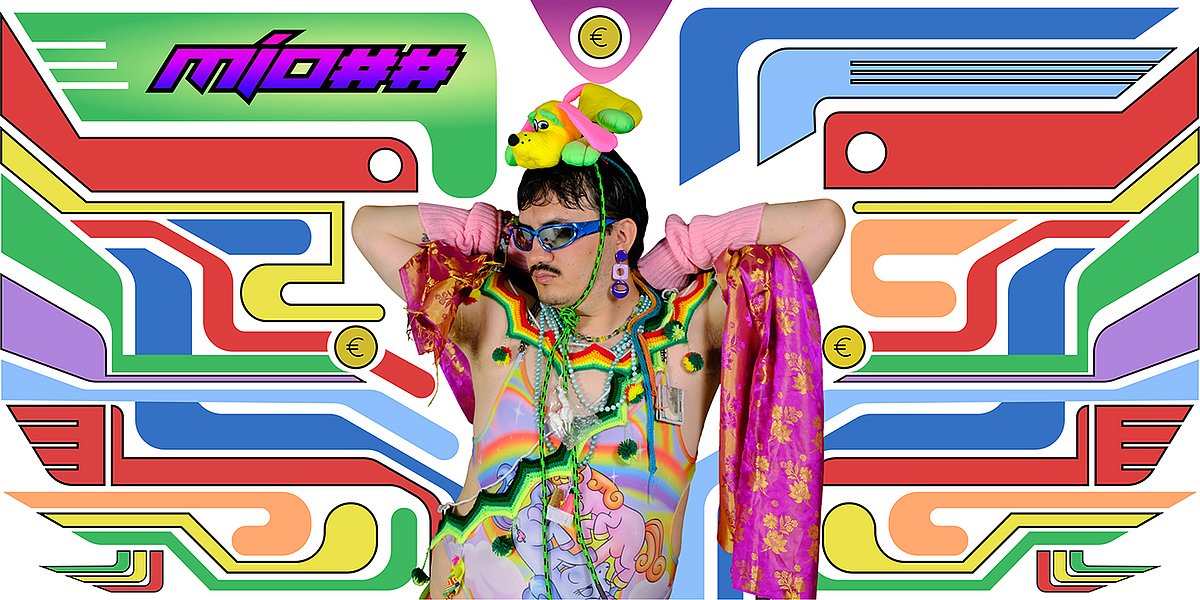
Mío## is a live stream re-imagined as a video game, where the playable character is replaced by a real person wandering through the city. Their movement is triggered by participants acting as players who control the route through payments that authorise each segment. The project proposes a choreographic framework in which the performer’s transit operates as a metaphor for migration, a journey that is conditioned, fragmented, and governed by external forces.
Performers: Alireza Khosroabadi, Patrick Ortiz, Maque Pereyra
Ausstellungsort: Main Exhibtion Domgasse 1, Audimax
sketch by the artist
SovereigntyMeter
Who owns the internet, and who will own it next?
Ahmad Aiub (EG)
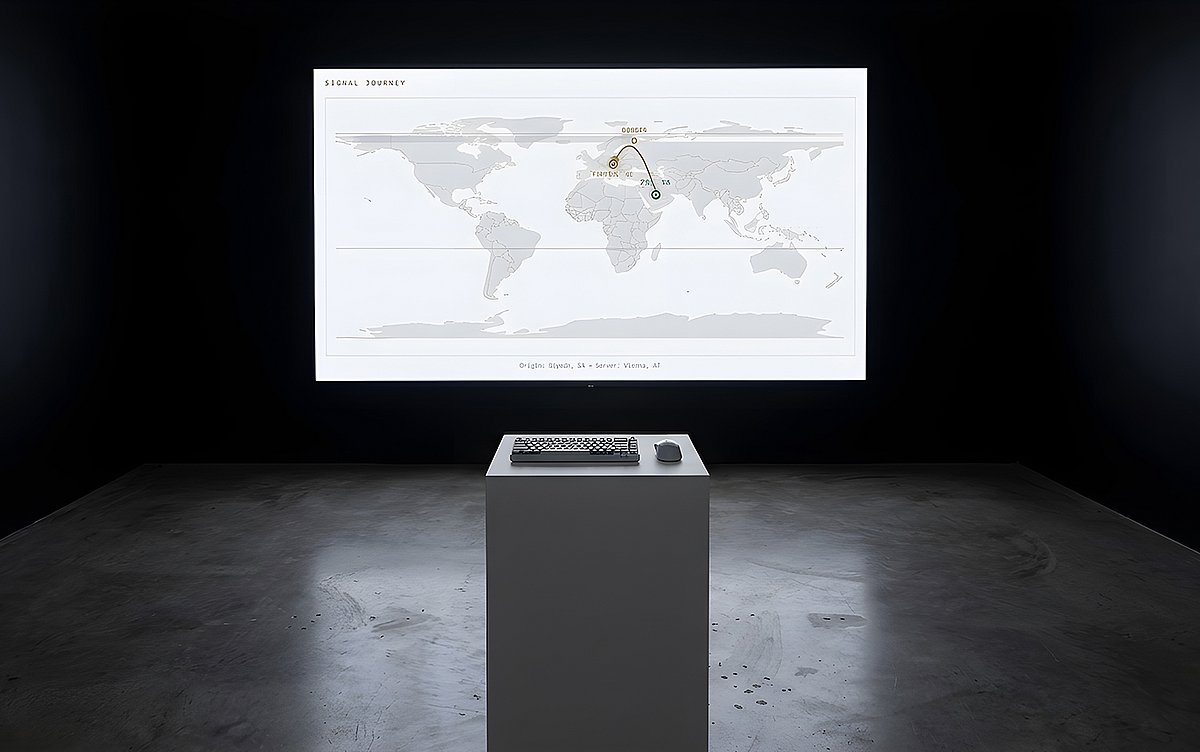
SovereigntyMeter scans any domain to visualise the political and physical geography of its infrastructure: server location, corporate ownership, routing, and undersea cable dependencies. Each scan generates a Digital Sovereignty Score measuring reliance on dominant technological powers. Grounded in data colonialism theory, scans contribute to an open-source archive documenting how internet infrastructure shifts over time—asking who owns the internet now and who will own it in ten years.
Ausstellungsort: Main Exhibtion Domgasse 1, Audimax
veronica
spilt out of the line
Ling-Hsuan Hsu (TW)
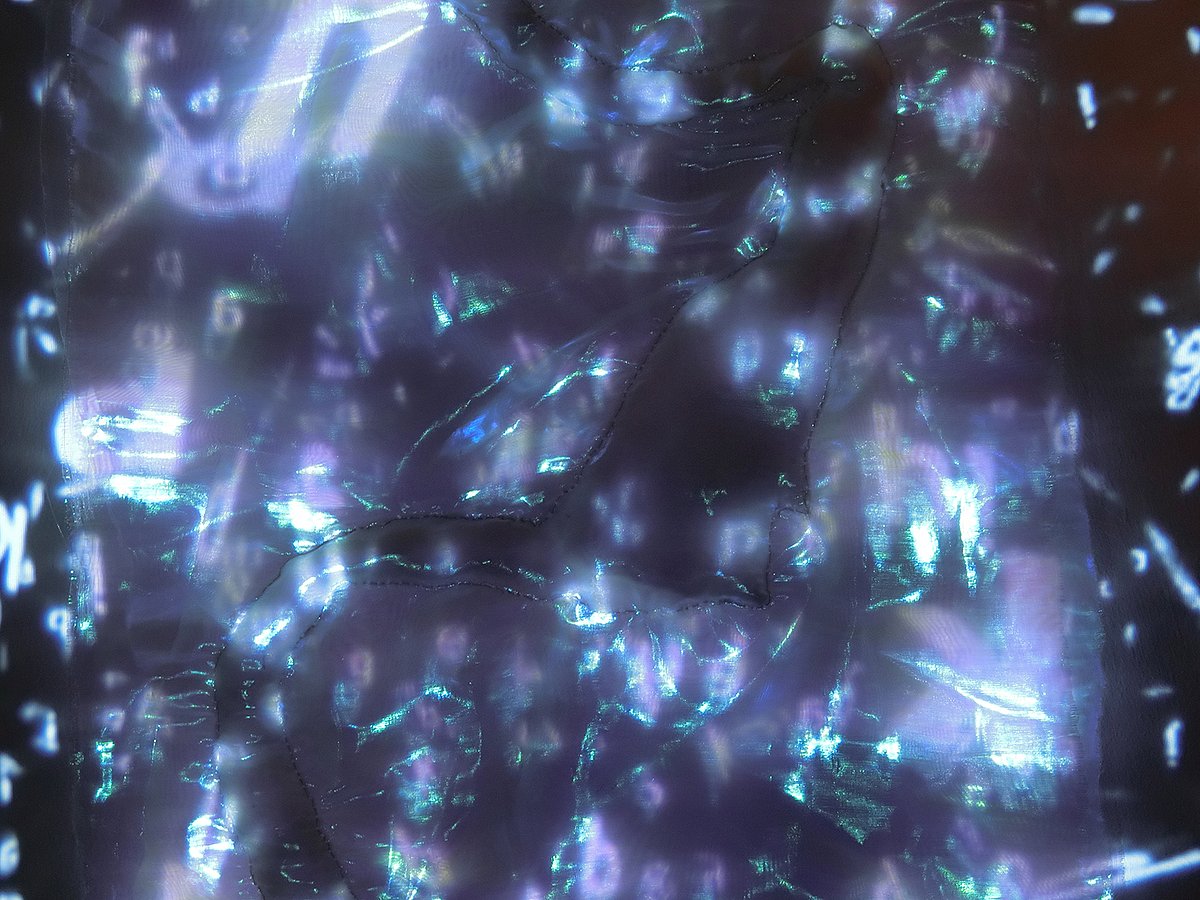
Through the cables that carry our voices, information swells into an ocean of letters. What might you receive from it? Place your hand on the silk. Touch it. The light at your fingertip gathers. A fragment surfaces - in Chinese, in English, in German. Lift your hand. It dissolves. But for a moment, someone’s private second was yours.
Ausstellungsort: Main Exhibtion Domgasse 1, Audimax
Withdraw
AR Brand Blocker
Carmen Daniela Córdoba Martínez (CO)
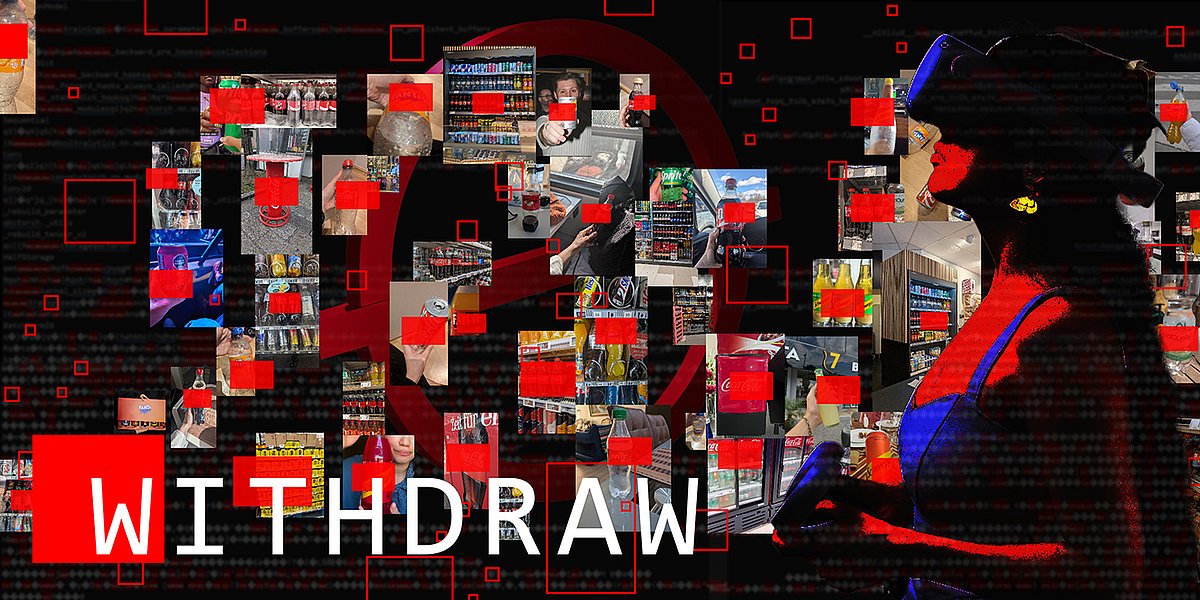
What if the consumer could decide which brand deserves their gaze? In La Calera, Colombia, Coca-Cola has been accused of building concrete structures over springs. They manipulate the resource while the community experiences water rationing. This project was born as a consumer’s answer to this situation. It speculates on controlled reality: using augmented reality glasses and a visual recognition system to detect and blocklist a brand from the wearer’s field of vision.
Ausstellungsort: Main Exhibtion Domgasse 1, Audimax
Cycle of Emotions: Composition
Joann Lee (KR)
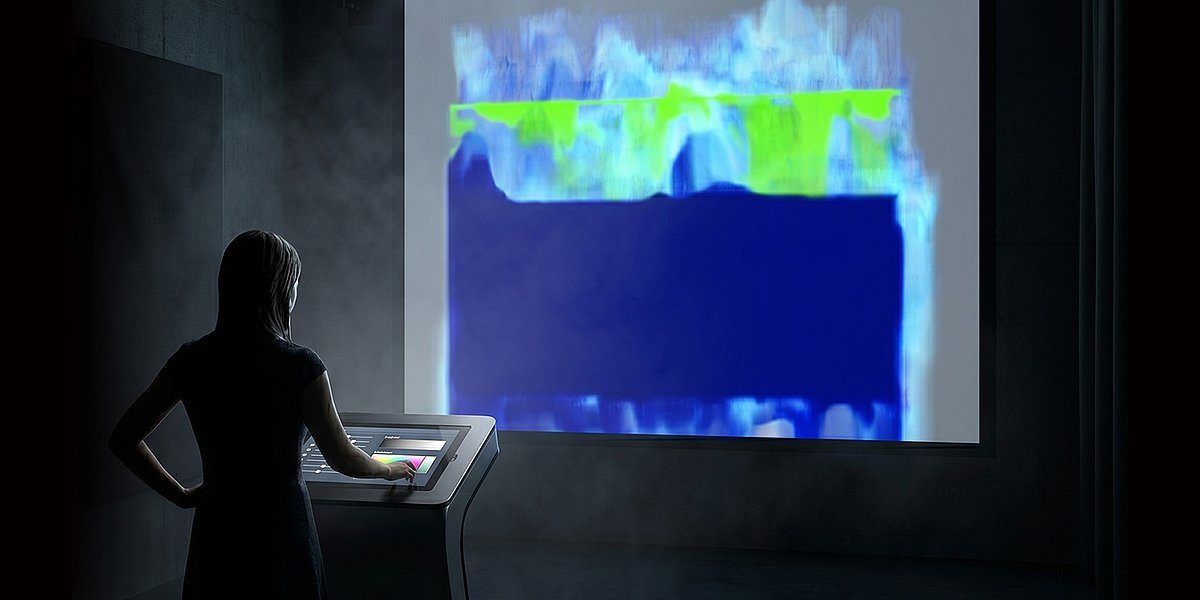
‘Composition’ continues the ‘Cycle of Emotions’ series (G.MAP Gwangju, South Korea, 2026). The user chooses an emotion and its colour on a tablet; facial expression recognition (FER) reads the face. These inputs converge into three layers of colour: the user’s choice, colours chosen by previous users in this exhibition, and traces from Gwangju users. Here, emotion data becomes abstract painting rather than information, and one user’s colour becomes part of the next viewer’s composition.
Ausstellungsort: Main Exhibtion Domgasse 1, Audimax
By the Time We Looked
Patricia Soto Molina (ES)
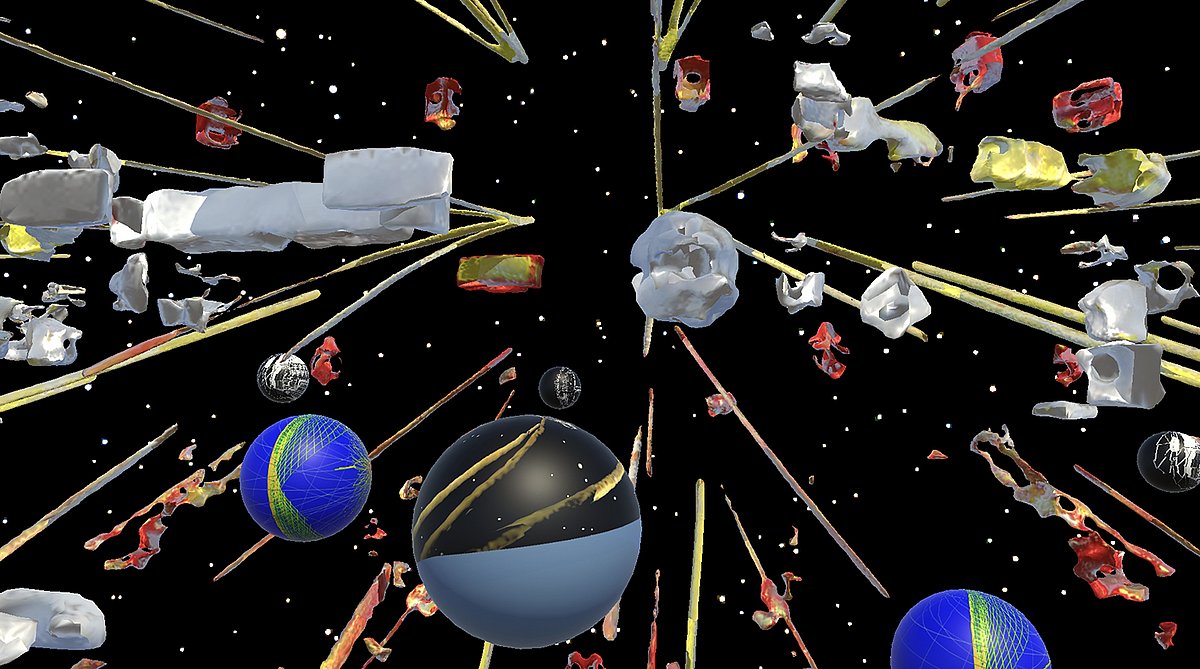
Archival installation and live audiovisual performance developed through research into the Standard Model, the Higgs boson and reconstruction methodologies at CERN. The piece approaches reconstruction as a condition through which we access reality. In particle physics, collisions are never directly observed but are reconstructed from traces and delayed signals, providing access to both the event and the underlying structures that describe microscopic interactions.
Ausstellungsort: Main Exhibtion Domgasse 1, Audimax
Spectral Roots
Gustiele Fistaról (BR)
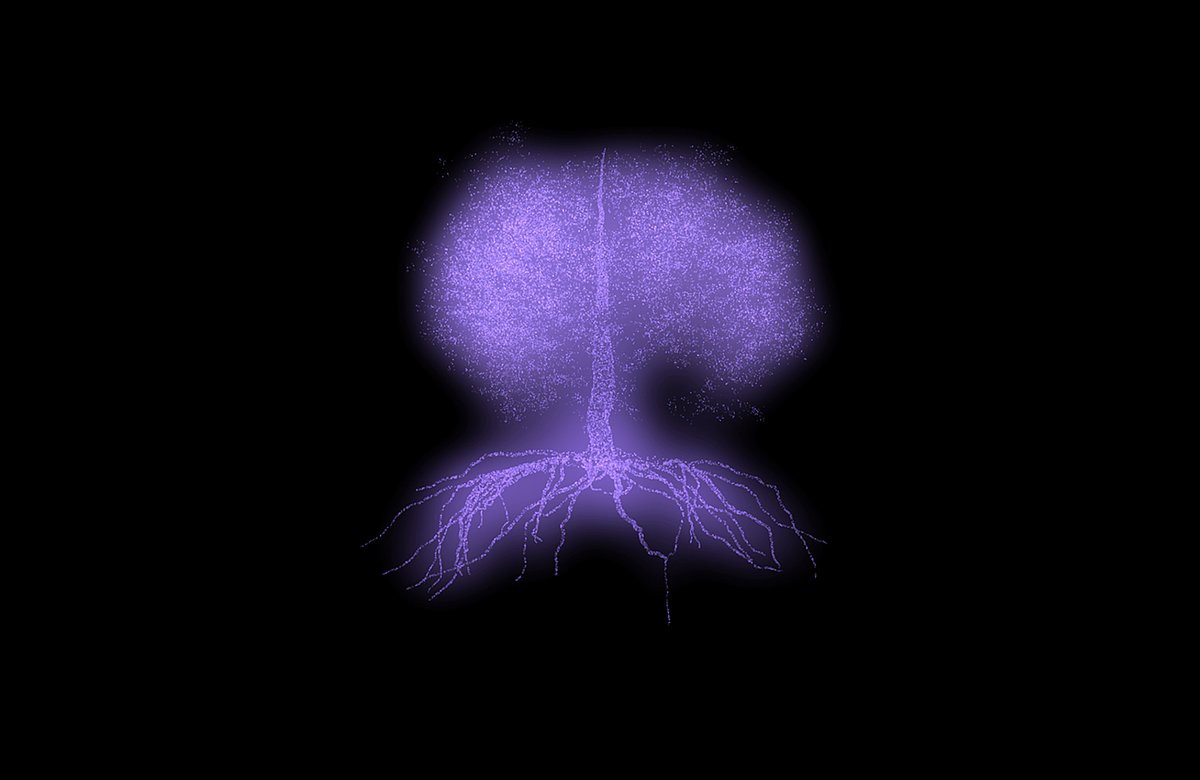
Spectral Roots is an interactive installation linking 19th-century and contemporary extraction. A projected tree morphs into cables and mineral crystals, referencing Palaquium gutta, a nearly extinct tree extracted under colonial rule to insulate the first submarine telegraph cables, and the rare minerals in today’s devices. The piece is traversed by wireless signals from devices in the space, which reshape transitions and reveal that the invisible is anchored to matter extracted from the earth.
Ausstellungsort: Hauptplatz ATTAC Containers
Collective Instrument of Maintenance
inspired by worm ecologies
Christine Haupt (DE)
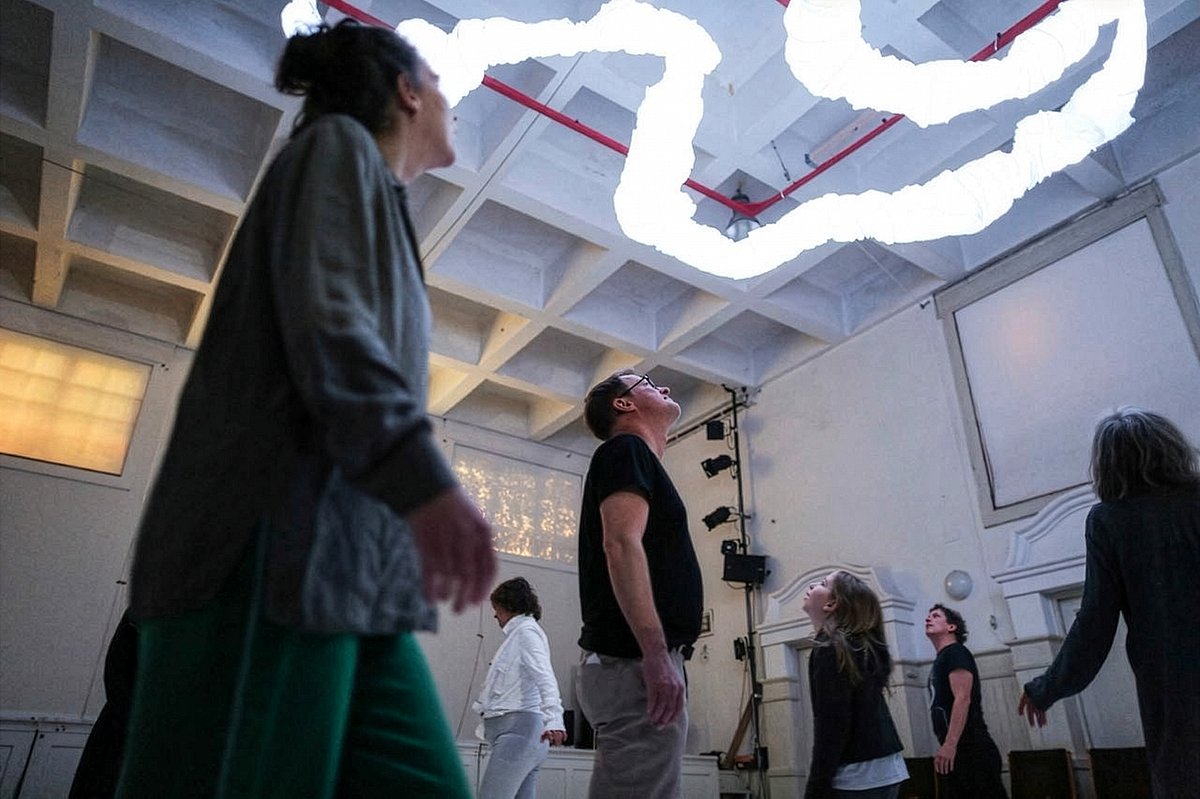
Collective Instrument of Maintenance is an interactive sound sculpture in public space inspired by worm ecologies and the invisible labour that sustains ecological and social systems. A persistent soundscape can only be harmonised through collective action: participants adjust tension lines together, transforming noise into resonance. Referencing the hidden work of earthworms, the installation makes maintenance, care, and cooperation physically and audibly perceptible.
Ausstellungsort: Hauptplatz 6, Courtyard
Vocal Duets
Alireza Khosroabadi (IR) & Sara Karimi (IR)
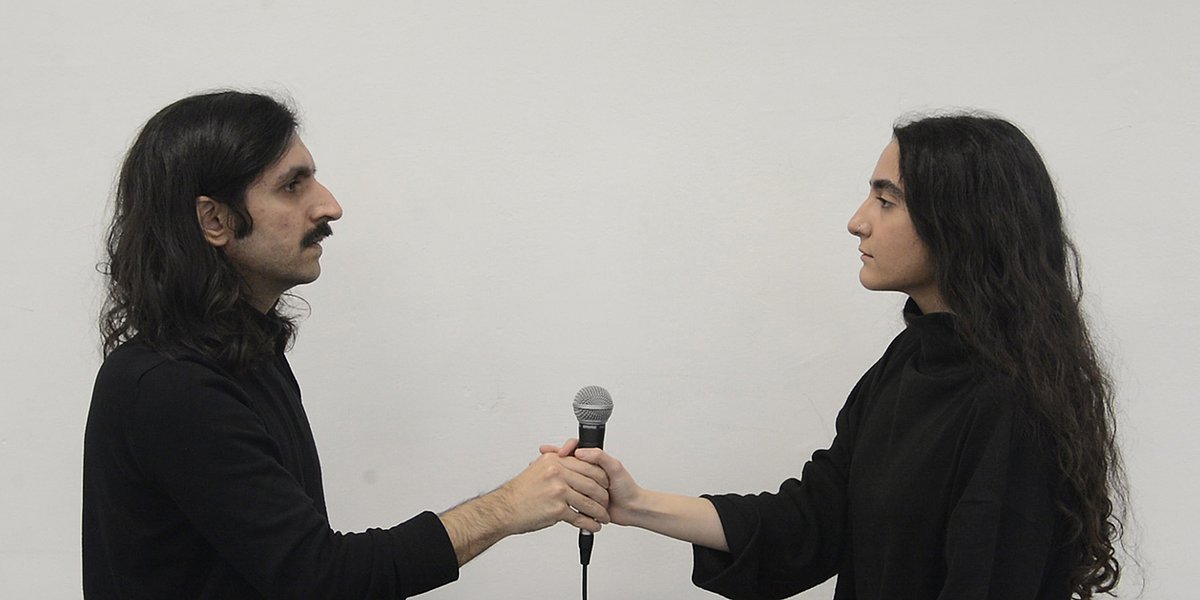
Vocal Duets is shaped around contemporary conflicts between languages and countries, conflicts that take the form of war. With a rhythm that can be observed in hindsight, one side attacks and the other retaliates. While language is generally assumed to be a means of closeness, intimacy, and communication, these duets use the irony of the situation to revive the lost intimacy and peace between the neighbouring alphabets of Russian-Ukrainian, Hebrew-Farsi, and Hebrew-Arabic. The version shown at this year’s exhibition is based on the Hebrew–Farsi language combination.
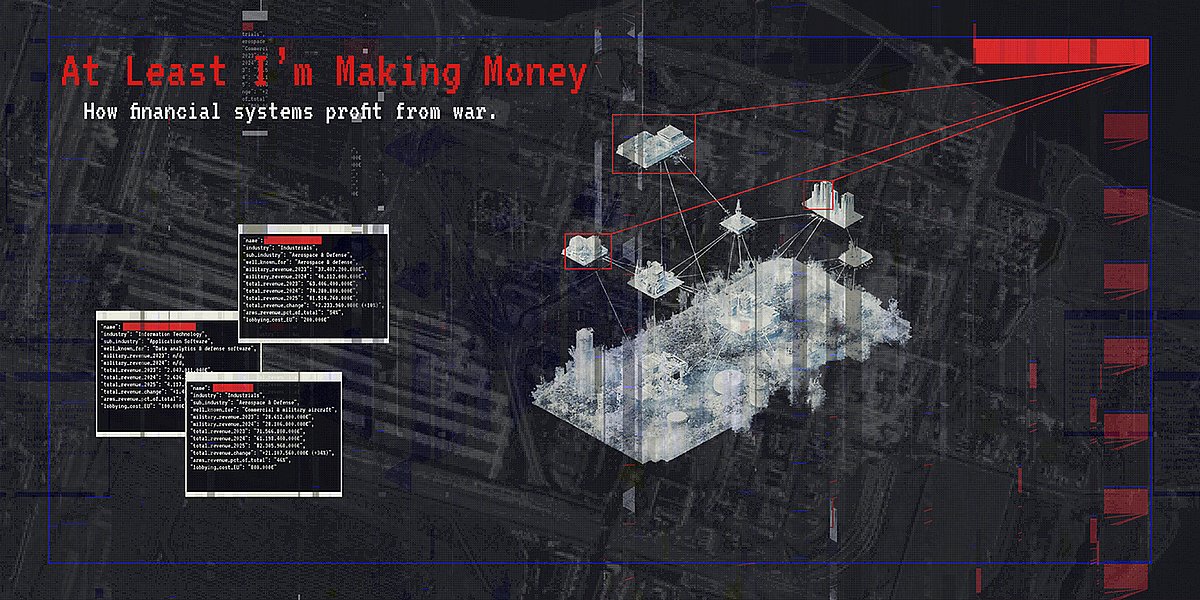
At Least I’m Making Money
How financial systems profit from war
Carolina Sofia Bischof (AT) & Carmen Daniela Córdoba Martínez (CO)
At Least I’m Making Money is an interactive
installation about how money, power and the arms industry uphold modern war. War is usually framed as a conflict between nations like the USA vs. Iran, Russia vs. Ukraine, or Israel vs. Palestine, but this hides another dimension. War is also a financial event. These layers are so abstract that we forget how they sustain it. As systems collapse, the cost is counted in numbers, never in the people paying for it.
Technical support: Joshua Mattson (CA)
Ausstellungsort: Hauptplatz ATTAC Containers
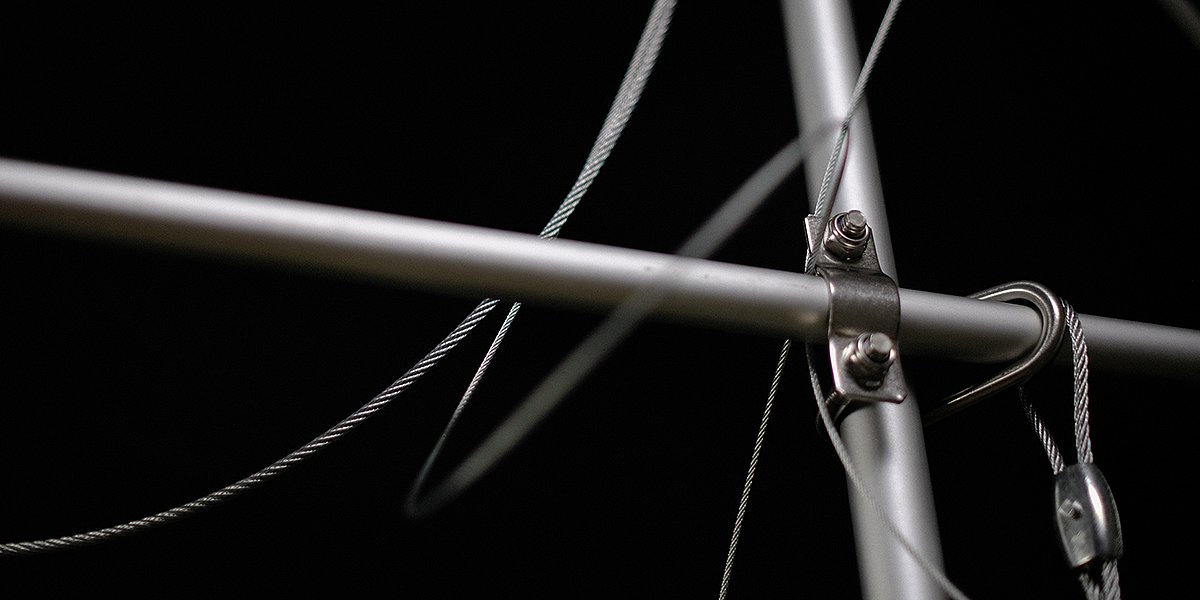
Into the air
m22 (Vlada Oleinik & Nail Gainulla) (AT)
Birds leave the places where the war is sounding. Infrasound and seismic waves generated by weapon detonations and explosions disrupt avian spatial orientation, magnetoreception, alter nesting patterns, migration routes, and trigger hyperresponsive stress reactions that mirror PTSD-like symptoms observed in combat veterans. These same waves could provide acoustic evidence of ongoing war: in 2023, the researchers from NORSAR developed a methodology to identify air strikes in Ukraine in near-real time, using infrasound and seismic data.
m22 connects these two forces within a single technological installation: three antenna structures, reminiscent of the objects birds use to perch on, linked by cables that translate the data from a monitoring station in Northern Ukraine into audible and visible vibrations. A small LCD screen on the switch box displays the exact time, date, and location of each registered strike.
Ausstellungsort: Hauptplatz ATTAC Containers
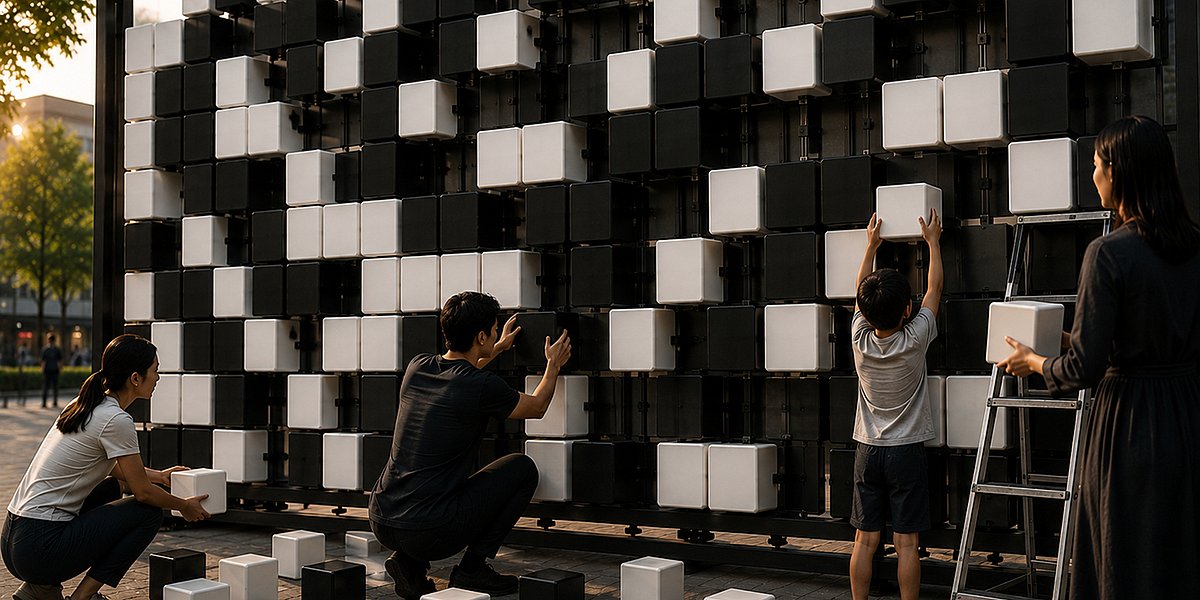
Shared Act
Saumil Bhandari (IN)
A participatory kinetic sculpture driven by global conflict data. As violence escalates, structural support is continuously withdrawn, causing the sculpture to collapse. Only the physical intervention of passing strangers can restore and sustain it. The work proposes shared maintenance over automated mediation, suggesting that a common world is sustained through the continuous collective care of strangers.
Ausstellungsort: Hauptplatz ATTAC Containers

Animal Rituals!
at the event: Glitch & Leak
11. September 2026, 19.30 Uhr
Performance; Duration: 30 Minuten
Nyx Günther
What happens when humanity is left behind?
In the middle of Linz, a pack of strange, gender queer furry beings gathers at Hauptplatz. They dance, twitch, howl and glitch; caught somewhere between animal, machine and human. Their masks are more than costumes: sensors translate movement and proximity into a shifting landscape of glitches and noise. Bodies react to sound, sound reacts to bodies. A feedback loop emerges, blurring the boundaries between performer, animal and machine. “Animal Rituals!” is a ritual of becoming other; animal, cybernetic, genderless, uncanny. A temporary escape from the categories that define what a body, a human, or a cyborg is allowed to be. It celebrates queer tradition and therein posthuman unbecoming.
Ausstellungsort: Hauptplatz Linz

Processing Community Day (PCD)
Creative Coding Open House @Innovationshauptplatz / Pfarrgasse 1
13. September 2026, 13.00 bis 18.00 Uhr
Amir Bastan, Cécile Bucher, Chris Coleman, Raphaël de Courville, Joreg, Laleh Mehran, Xin Xin, Moon Davé, Alessandro Ambrosini, Yasmin Bock, Sara Bravin, Paul Eßer, Grace Kim, Joshua Mattson, Natalia Muñoz Carpintero, Guilia Olivieri, Students and Alumni of University of Arts Linz, Processing Community, p5.js Community
Have you ever wanted to try out Processing or p5.js? Join us for a day celebrating 25 years of Processing - a gathering for beginners, experienced users, and everyone in between. Come by to see how easily hands, faces, and bodies can be tracked with ml5.js and p5.js, explore how Processing can be used to create immersive Deep Space applications, discuss what's next for Processing and p5.js, or exchange ideas about using AI tools in your creative practice or teaching.
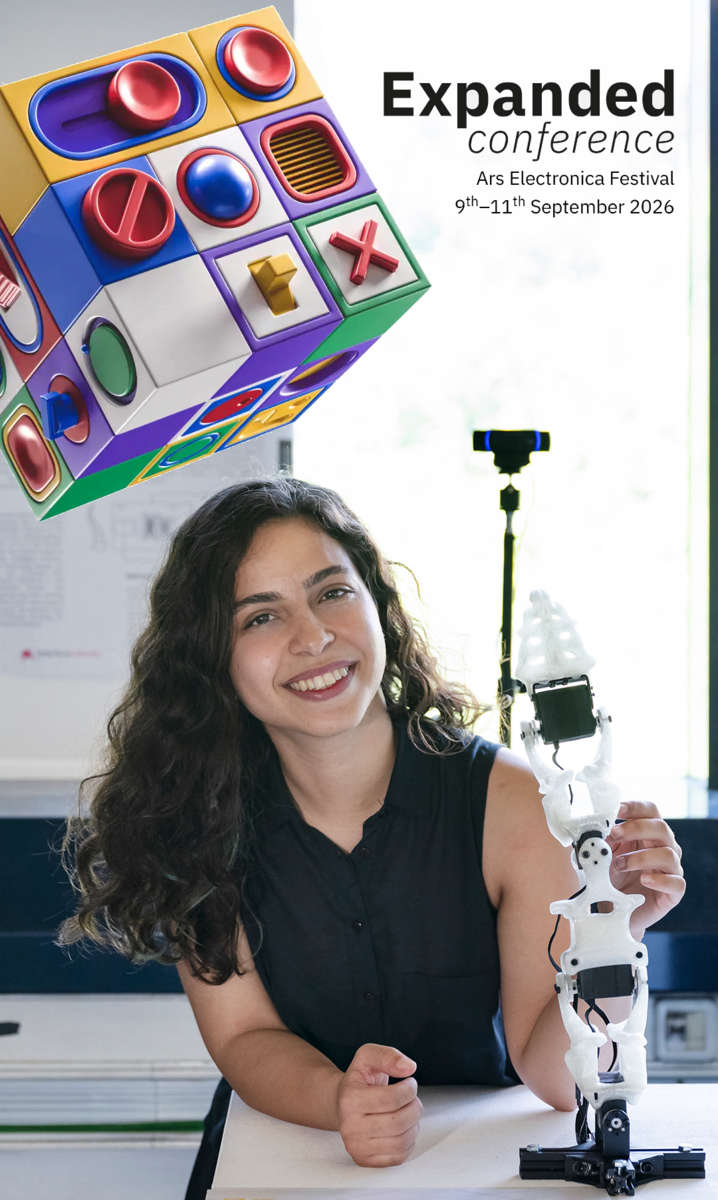
(at the) Expanded Conference 2026
Ars Electronica Festival 2026, skyloft at Ars Electronica Center
Conference on Expanded Animation and Interactive Art
Opening: 9th of September 2026 at 17.15 at the Skyloft of Ars electronica center;
Duration: 9. bis 11. September 2026
the artist: Ghazal Hosseini
Co-authors of the paper: Ghazal Hosseini, Hanif Haghtalab, Philipp Wintersberger
Research Paper Presentation “Feel.Back.Loop”: Affective Co-Adaptation between Humans and Embodied Intelligent Systems through Reinforcement Learning
This talk presents a research paper on Feel.Back.Loop — a robotic tail that learns from human emotion — exhibited as part of the Interface Cultures campus exhibition at Ars Electronica Festival 2025. Drawing on the animal tail as a metaphor for non-verbal communication, the work uses affective computing and reinforcement learning to read facial expressions in real time, using detected affect as a reward signal to evolve its movement behavior and develop, through interaction, a movement language that was never explicitly authored.
The paper examines the conceptual framework, technical architecture, and interaction dynamics of the installation, drawing on observations from the festival and a structured user study.
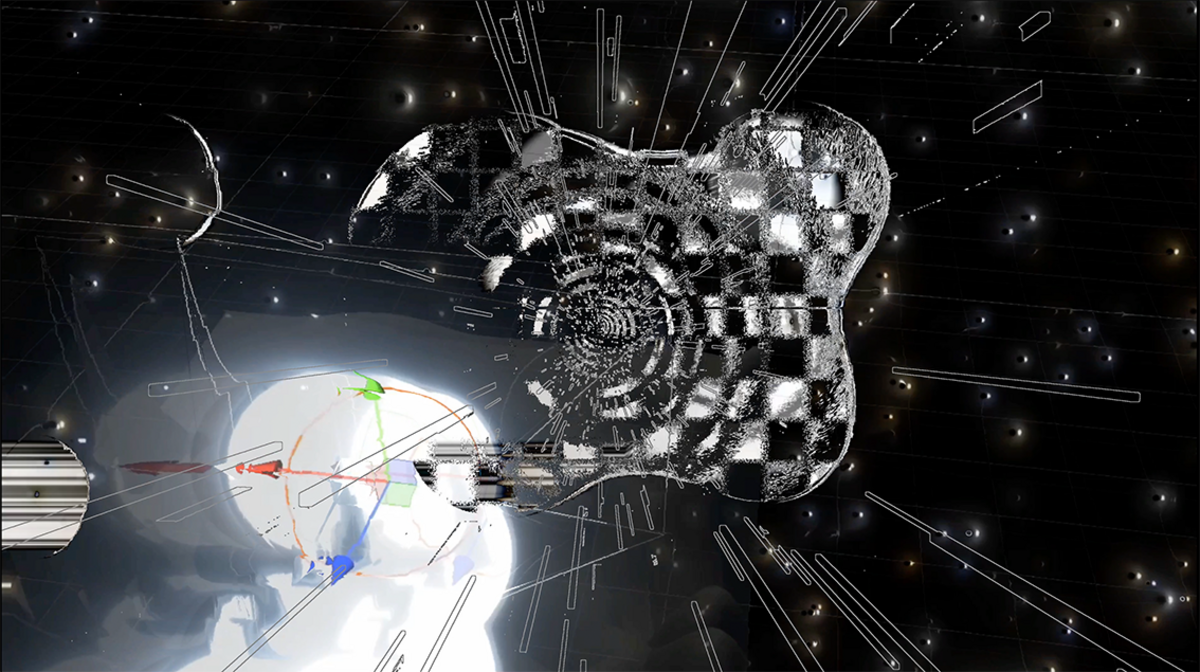
By the Time We Looked
Patricia Soto Molina (ES)
Studio 1, Friday, 11th of September 2026, 4-7pm
By the Time We Looked is a live audiovisual performance developed through research into the Standard Model, the Higgs boson and event reconstruction methodologies at CERN. It follows a speculative journey of particles inside the accelerator, where fields guide their movement towards collision. Particle physics approaches this event through the traces they leave behind. Detectors register their effects, while reconstruction gives scattered fragments a possible coherence. Across many collisions, recurrent patterns may acquire statistical significance. The work brings this process into dialogue with the construction of live images and the contingent logic of performance, asking how realities emerge from what reaches us only partially and through the systems that make it perceptible.Time unfolds without belonging to a single scale: fleeting subatomic processes encounter human observation and the longer history of matter, extending towards unresolved questions such as dark matter.
Developed in dialogue with CERN researcher Antonio Gómez Delegido, the project connects the live event with an archival installation at the Kunstuni Campus Exhibition. This collaboration continues in the talk Art & Science in Practice, on Saturday, 12 September, 13:00–14:00 in Audimax C, concluding with an expanded continuation of the performance.
Ausstellungsort: Studio 1
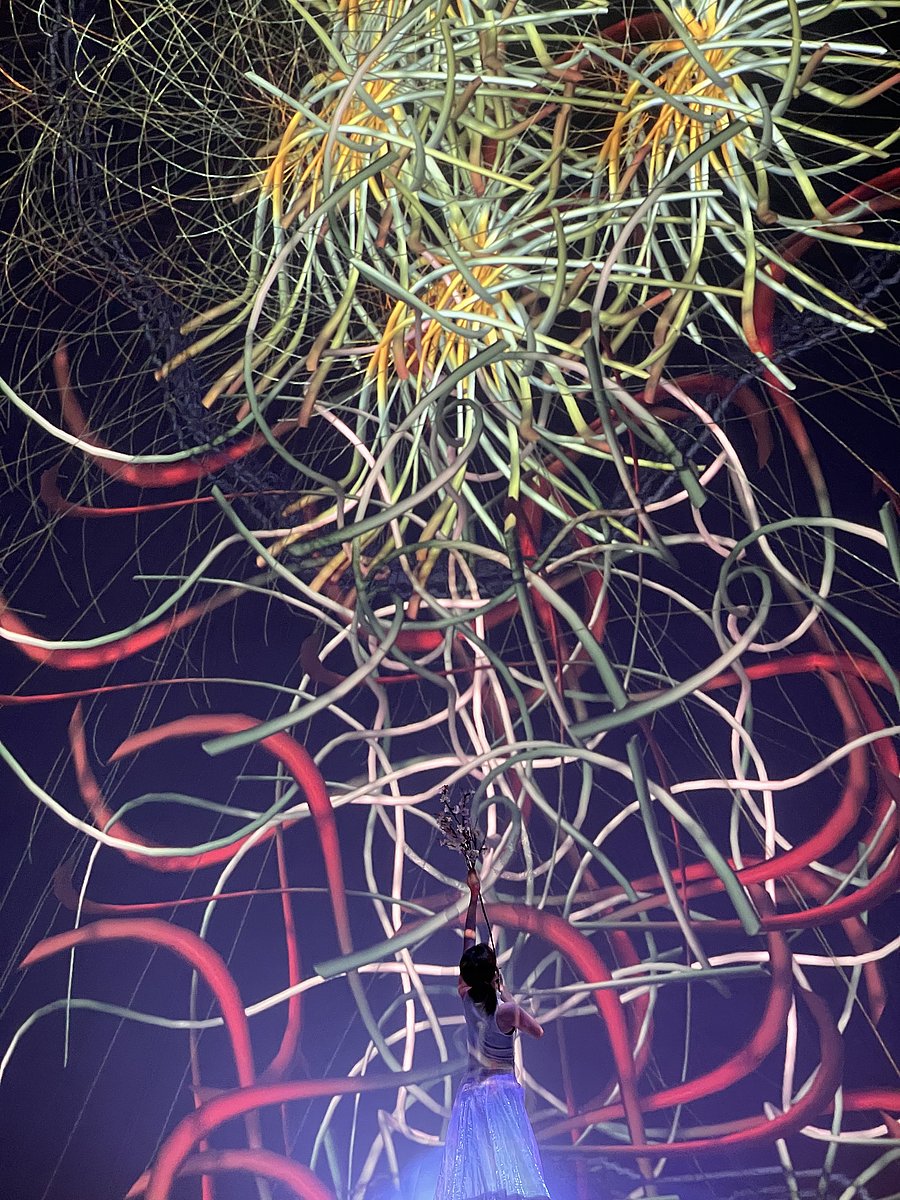
Samsara of Blossom: Resonance
Location: Deep Space
9. September 2026, 19.30 bis 20.00 Uhr
Razieh Kooshki & Vahid Qaderi
“Samsara of Blossom: Resonance” explores how movement rooted in Korean traditional dance can be reimagined through media art. In the first collaboration between Jajack Movement and media artists (Visuals & music) Razieh Kooshki & Vahid Qaderi, performers interact with an evolving visual landscape that responds to breath, rhythm and motion. The work connects Korean cultural heritage with contemporary digital practice, revealing new forms of resonance between body, technology and perception.
ars.electronica.art/samsara-of-blossom-resonance
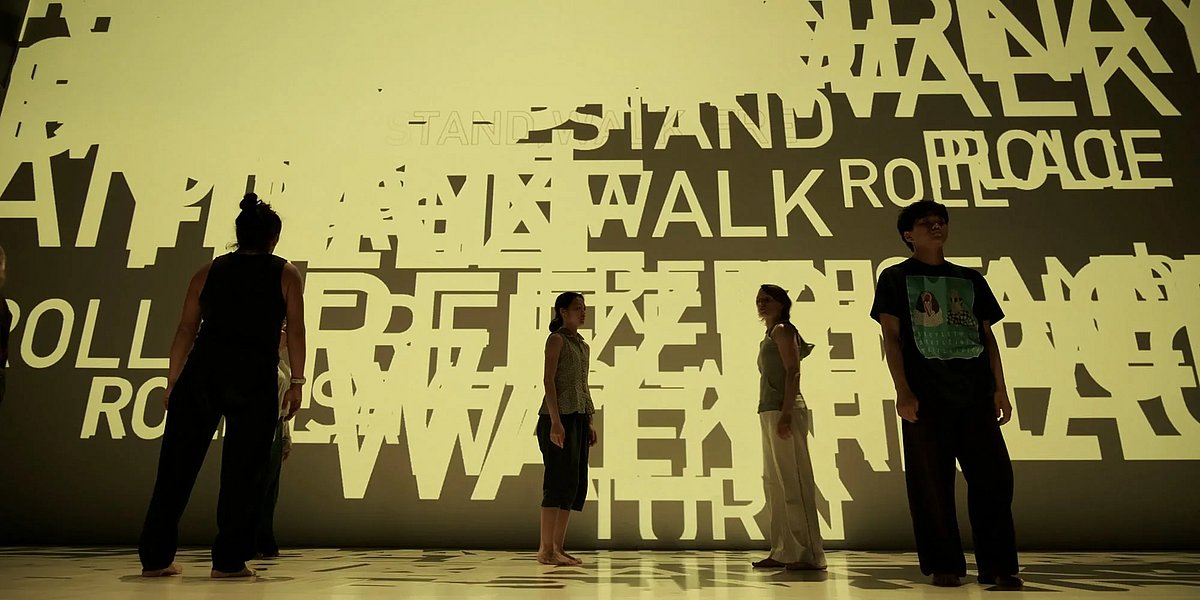
[not] breaking the cycle
Ars Electronica Center, Deep Space
Thursday, 10th September 2026 7-7.30 pm
Darya Sheiko (BY), Darya Kostskina (BY), Zhuojun Li (CN), Luisa Heilbron (BR), Sophie Hofmann (AT), Seojin Moon (KR), Tura Gómez Coll (ES), Bo-Jia Huang (TW), Alina Lugovskaya (RU), Reinier Martinez Badilla (CR), Yasmin Bock (DE/US), Patricia Soto Molina (ES), Monika Machútová (SK), ShuTing Wang (CN), Kate Yalovetsky (RU), Joann Lee (Yuseung) (KR), Ling-Hsuan Hsu (TW)
An exploration of the way we move through different cyclical phases, from order to chaos back to order again. Trying to find the answers to questions, such as: How do things interact when they attract? How can our perceptions be distorted and how do they change upon observation? In finding answers, we return to the start—learning from scratch. Ultimately, the point is not to break the cycle, but find movements with(in) it.
Veranstaltungen im Rahmen der Ausstellung

Leonardo LASER talks Linz 2026
Lab Songs Vol. III - Sobremesas
Curated by Fabricio Lamoncha
Leonardo LASER is an international program that brings together artists, scientists, academics, and the public to share their work and inspire one another through presentations, performances, and discussions.
Our recurring LASER series Lab Songs explores evolving cultures of experimentation. Scientific and artistic breakthroughs arise not only from discoveries, but from transformations in practices, methodologies, and systems of care. As a result, laboratories are increasingly reimagined as spaces where aesthetic, technological, ecological, and theoretical forms of knowledge come into proximity.
For this year's Sobremesas, we gather around the dining table as a site of encounter. Much like the laboratory, it is a place where experiences are shared, differences remain present, and knowledge is collectively digested. Join us in celebrating the conversations, relationships, and acts of care through which new understandings emerge and unexpected encounters unfold.