IC @ Rundgang 2026

Ausstellung von 18. bis 20. Juni 2026
This year’s exhibition arises from a moment marked by acceleration, fragmented attention, and the constant production of images, information, and the endless triggering of emotional responses. In a time increasingly shaped by mediated realities and distant forms of conflict, we are compelled to ask: who constructs the narratives through which we perceive the world, and what forms can still create shared meaning? While information expands through endless accumulation, stories and rituals establish moments of closure; they render time inhabitable, creating structures of attention, repetition, and resonance through which new imaginaries and unexpected forms of coexistence unfold.
Interface Cultures students do not simply present works; but their own personal systems and situations that operate as new forms of code and ritual. Through new materialities that move within and beyond the screen, they activate new spaces of encounter, friction, and collective imagination. These have become environments for trial and error, for productive misuse, for getting into trouble together, but also for practicing care, play, and celebration. Rather than presenting finished statements, this exhibition should be understood as a celebration of process itself. Not a conclusion but a moment of pause, a temporary suspension of productivity where projects begin their life beyond the exhibition space.
exhibited student work:

Foto © Mark Sengstbratl
This Person Did Not Exist
Aisling Phelan (IR)
‘This Person Did Not Exist‘ is a sculptural installation examining the translation of synthetic identities into physical form. Faces generated using the generative adversarial network (GAN) platform thispersondoesnotexist.com are translated through 3D printing, mould-making, and casting into sculptural forms made from recycled plastic. Once melted and reformed, the plastics lose all trace of their source, mirroring the aggregated and untraceable datasets from which the faces are generated.

Alessandro Ambrosini; Foto © Mark Sengstbratl
Anti-Work-Simulator
made by 4L34M
Alessandro Ambrosini (IT)
If u’ve ever been trapped in the 9to5 prison, u know how hard it is to escape. Some of us don’t have the privilege to even think about it. I designed this piece with that in mind. Think of it as a gym for the civil disobedience muscle. A button in the bottom right camouflages the screen as Excel if u don’t wanna get caught. U’re not alone: the worker before u left something behind. The game is a tool. Use it at work. Start small. Steal an hour. Then another.
Sengstbratl
Retrons
Dagmar Schürrer (AT/DE)
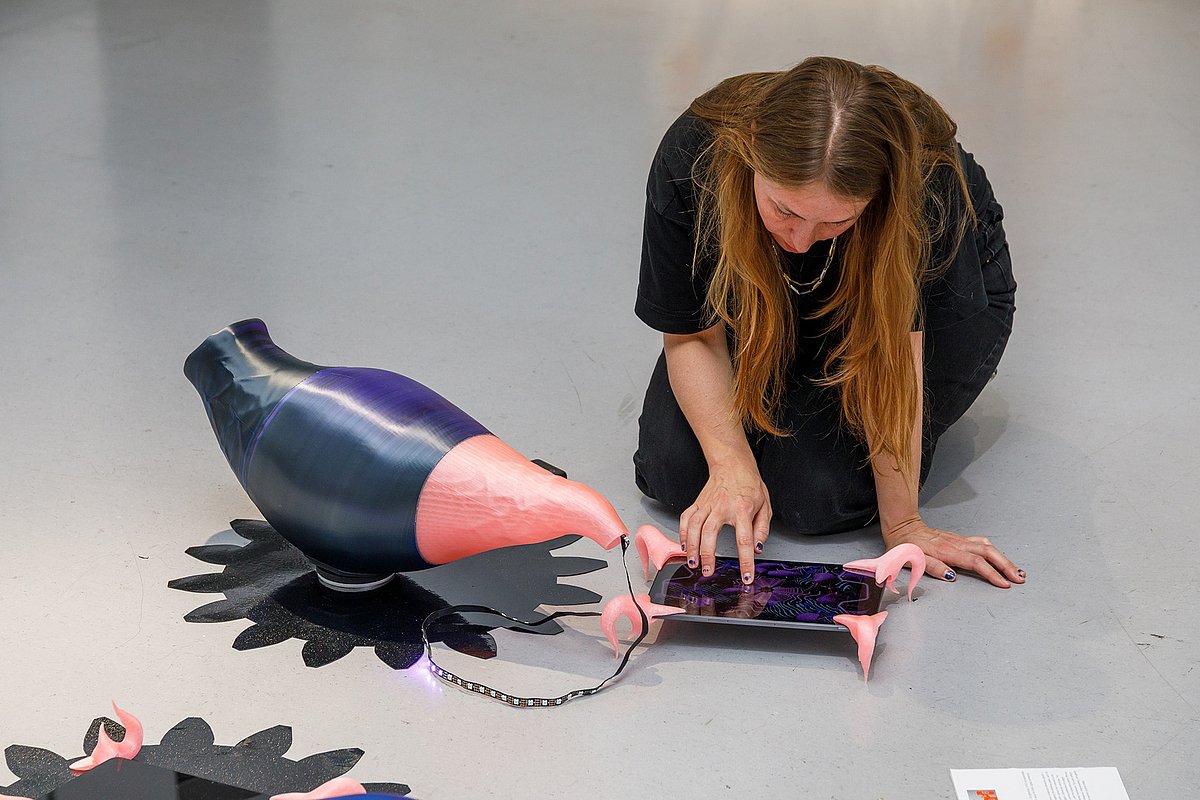
The installation consists of a series of identical interactive objects — the Retrons — distributed throughout the exhibition space. Each 3D-printed sculpture is equipped with a sensor that responds to the proximity of visitors, which triggers a dismissive retraction. The Retrons can be understood as sensing extremities of a larger, underlying machinic structure, with the connected screens offering only a partial glimpse of its internal mechanisms. The work reflects on the growing complexity of behaviour, responsiveness, and agency exhibited by technological and machinic systems today.
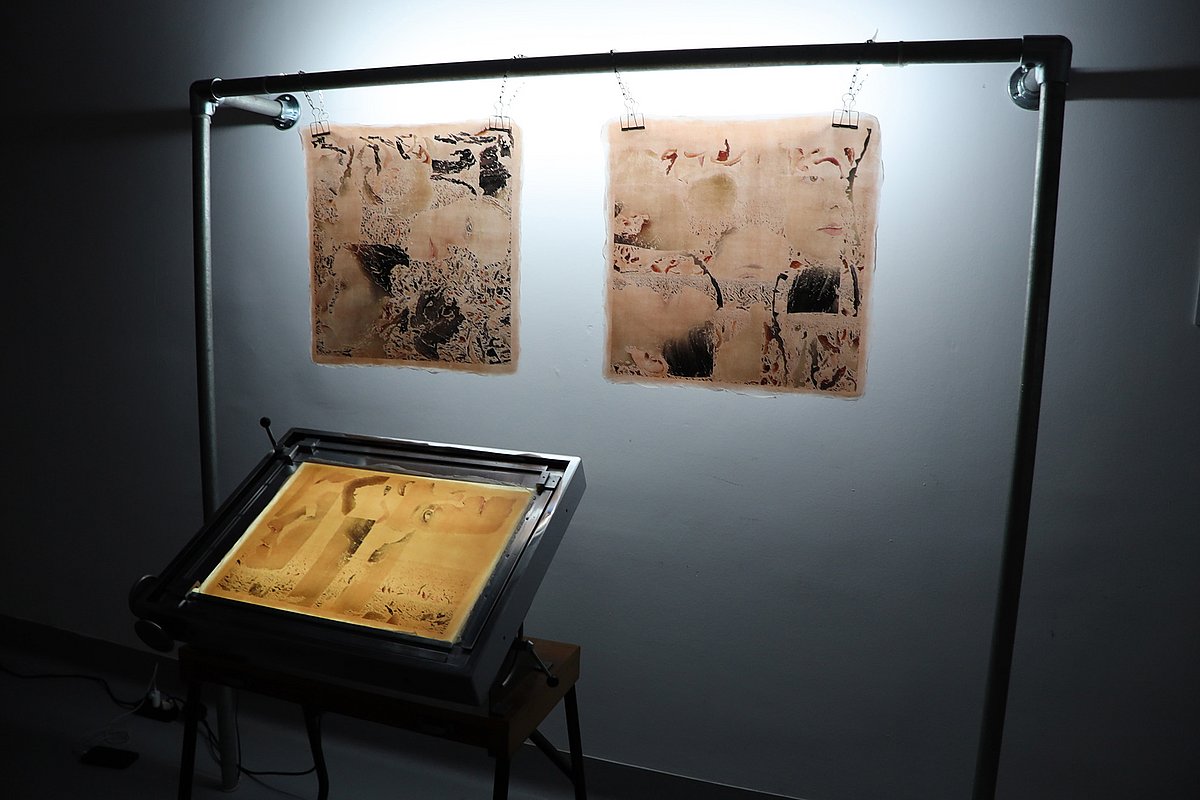
Foto © Carmen Martinez
Non-Human Topographies
Giulia Olivieri (IT)
Non-Human Topographies is a series of portraits of non-human entities: fragmentary representations of digital figures that retain only physiognomic residues of human faces. The three-dimensionality of the human figure, captured through photogrammetry, is annulled. The object of investigation becomes the texture map, which is transposed onto latex, as though it were a skin-like surface. These maps are legible to computational logic yet difficult for the human eye to reassemble into a unified whole. Thus, hybrid and disorganic creatures emerge: fragments of digital bodies resurfacing from a future past as cartographies to be explored.
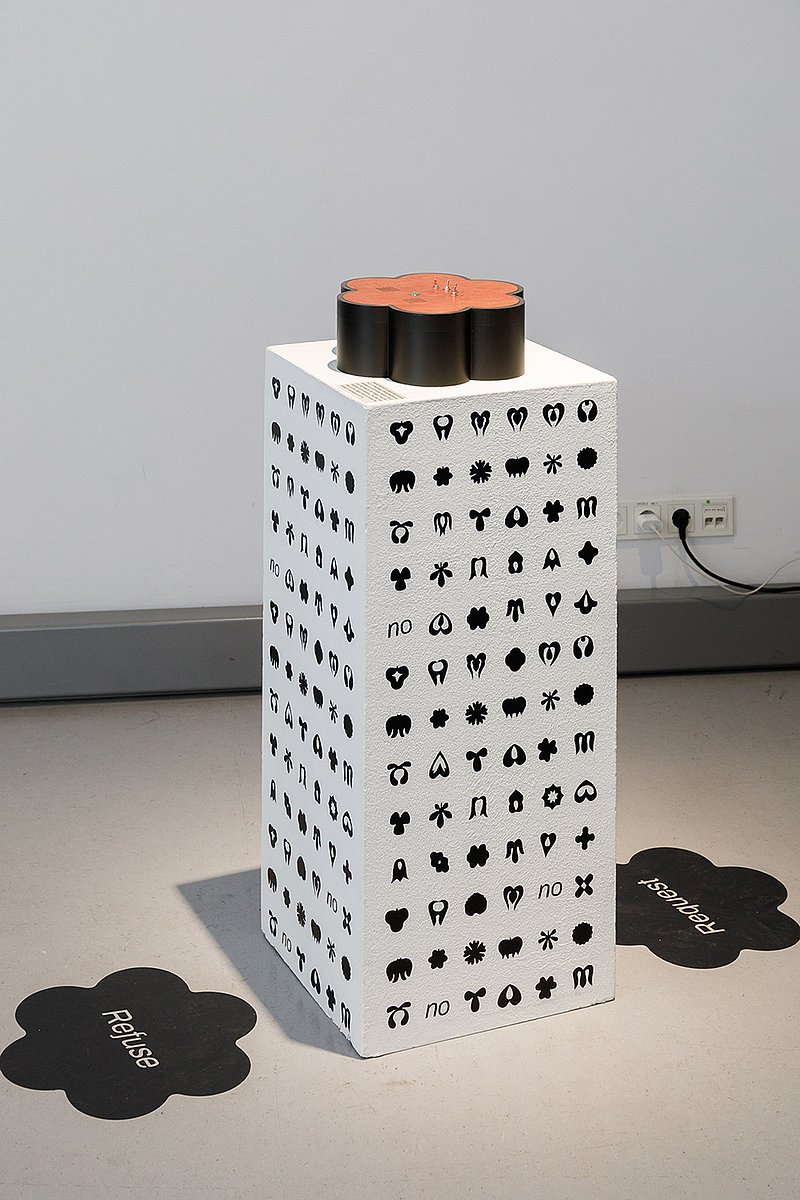
Foto © Mark Sengstbratl
No-machine / Nein-maschine
Grace Kim (US)
No Machine is an interactive device that offloads the emotional toll and potential consequences of saying ‘no’ to a machine. Using toggles, the No Machine
allows the user to calibrate a refusal across axes of tone and intent (‘Flat/Expressive’, ‘Cold/Warm’, ‘Hesitant/Firm’, and ‘Sincere/Sarcastic’) to produce a bespoke ‘no’ appropriate for the situation. The No Machine is a vessel for the fantasy of a consequence-free refusal, utilizing an automated sys

Foto © Mark Sengstbratl
Naturally Unnatural (2026)
Yasmin Bock (DE)
‘Naturally Unnatural’ is a biosculptural project by Yasmin Bock. It explores what it means for something or someone to be alien: something familiar yet unfamiliar; something recognizable and foreign; something both natural and unnatural. In order to achieve this, the artist used natural materials and organic shapes in an attempt to create creatures that feel alien. The sculptures are made from homemade bioplastics on a gelatin base, colored with lemon peel, blueberry powder and blue spirulina.

von Joshua Mattson; Foto © Mark Sengstbratl
Defence Contractor Fantasy World
by freeculture.api
Joshua Mattson (CA)
Defence Contractor Fantasy World is a deployable incremental game demonstrating the violent progression of AI-powered warfare concealed behind digital veils. The game interface is inspired by real
AI-amplified military hardware designed to put networks of automated sensors, weapons, and analysis systems into the hands of a single operator, accelerating the speed at which destruction can be inflicted. The user engages with this interface intimately by interlocking fingers with a vampiric demon hand, materializing the violent and extractive nature of technology-based warfare masked by the abstraction of digital systems.
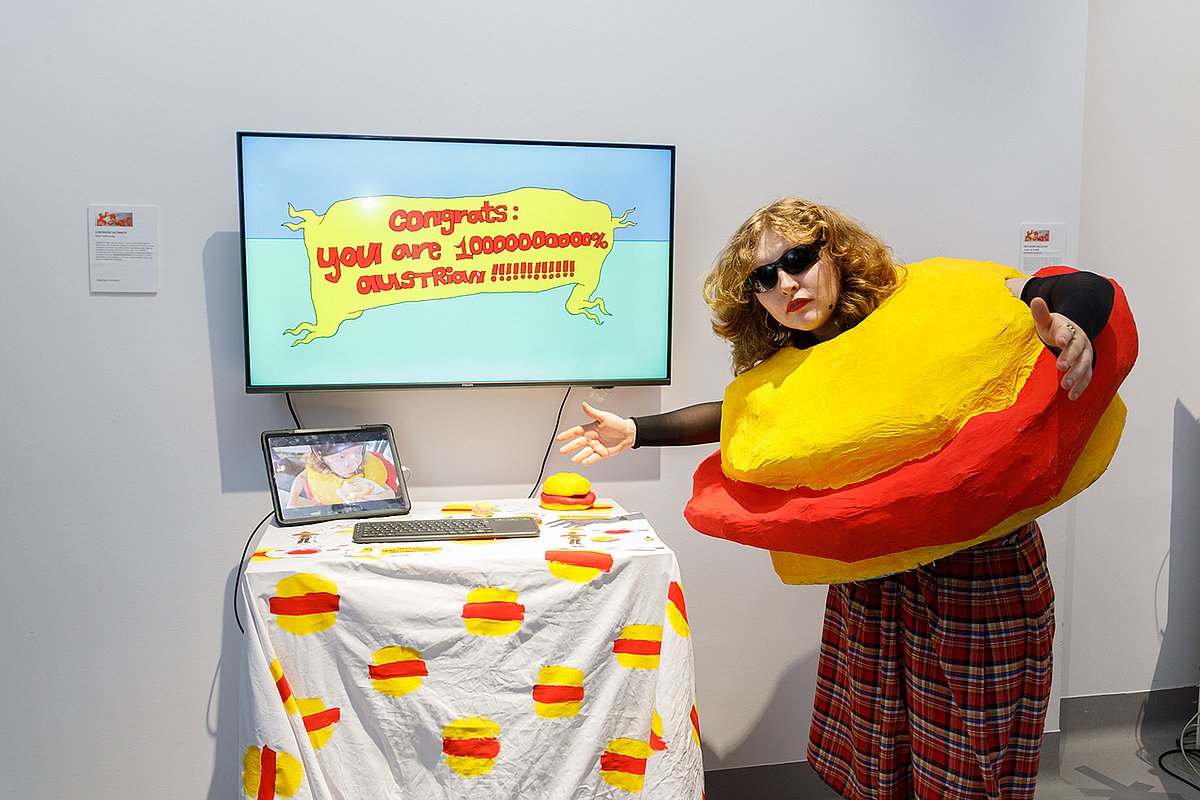
Foto © Mark Sengstbratl
Leberkäse Ultimate
Kate Yalovetsky (RU)
Imagine it’s night, around 2:00 a.m., you’re drunk and hungry for adventures, but everything is closed in the beloved city of Linz. Eating Leberkäse
(2 semmel buns with a pinkish substance inside) might be a fulfilling and sacred experience at this point. The installation includes the artist impersonating a Leberkäse, a video game where the goal is to reach 100000000000000000% Austrianness, a critical promotional sales catalogue, and other related artefacts. Take a risk and visit LEBERKÄSE ULTIMATE.
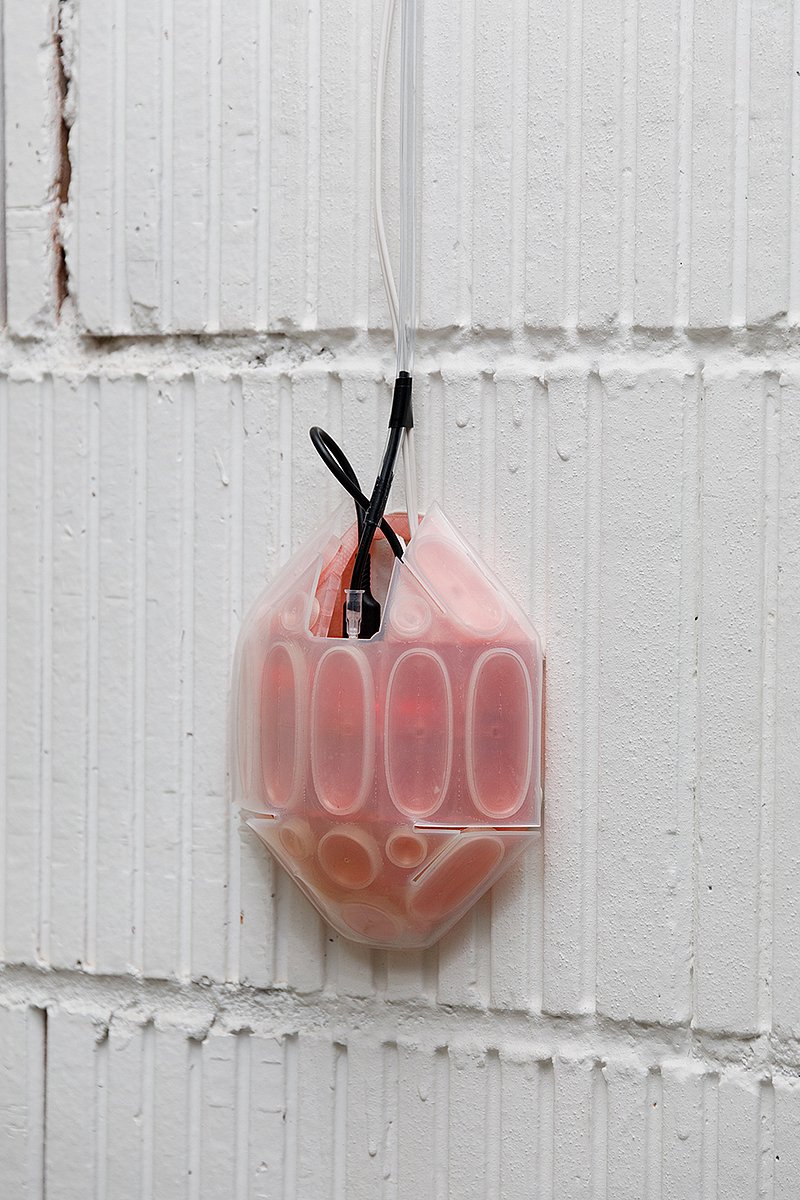
air_roto
Marwin Nehl (DE)
air_roto is a synthetic species perceiving its surroundings through WiFi signals. By working in a network of many nodes, it senses the observer’s presence, location and breathing rate. Communication is done through movement of its flexible parts using vacuum pressure from the network of nodes.
Viewers can experience air_roto connecting to
their body and explore the exposed components.
The work focuses on experimental sensing and
communication, looking to nature for inspiration to make the most of limited information.
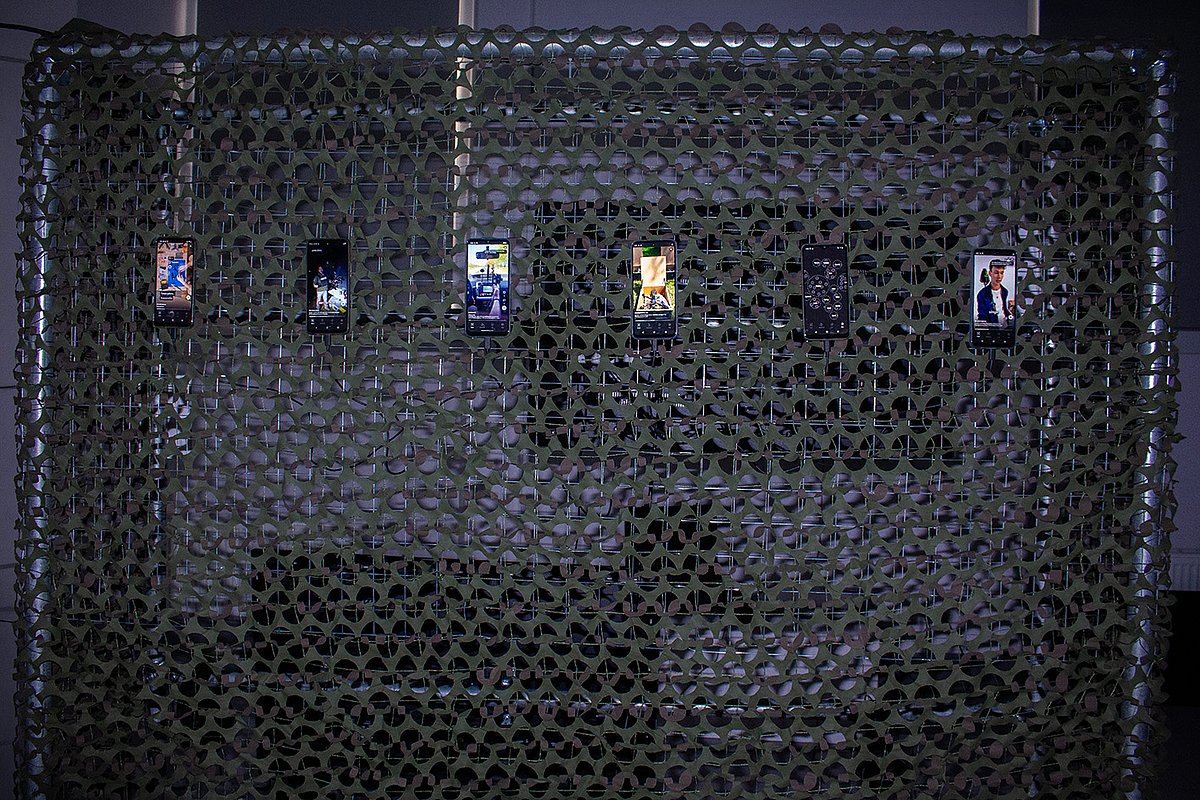
Oleinik); Foto © Carmen Martinez
Warscrolling
m22 (Nail Gainulla & Vlada Oleinik) (AT)
War has become mundane in algorithmic social media. It could be casually observed while eating our meal or relieving ourselves. Simultaneously, the platforms serve forensic investigation: combatants share DIY weapons, ammunition details, and field methods, making viewers closer to destruction than ever. Warscrolling is a form of doomscrolling that documents the hyperreality of war: videos collected via social media algorithms, displayed through a custom app mimicking the short-video scroll interface.

Foto © Mark Sengstbratl
Ways to coexist
Natalia Muñoz Carpintero (CL)
Ways to coexist presents an artistic research process examining interspecies relationships between humans and non-humans. The work documents excursions to different spaces of human/nature coexistence as a methodology for becoming and making sense,
using a three-organism-wearable device that senses shared electrical and environmental activity to unveil the imperceptible nature of our shared vital energy.
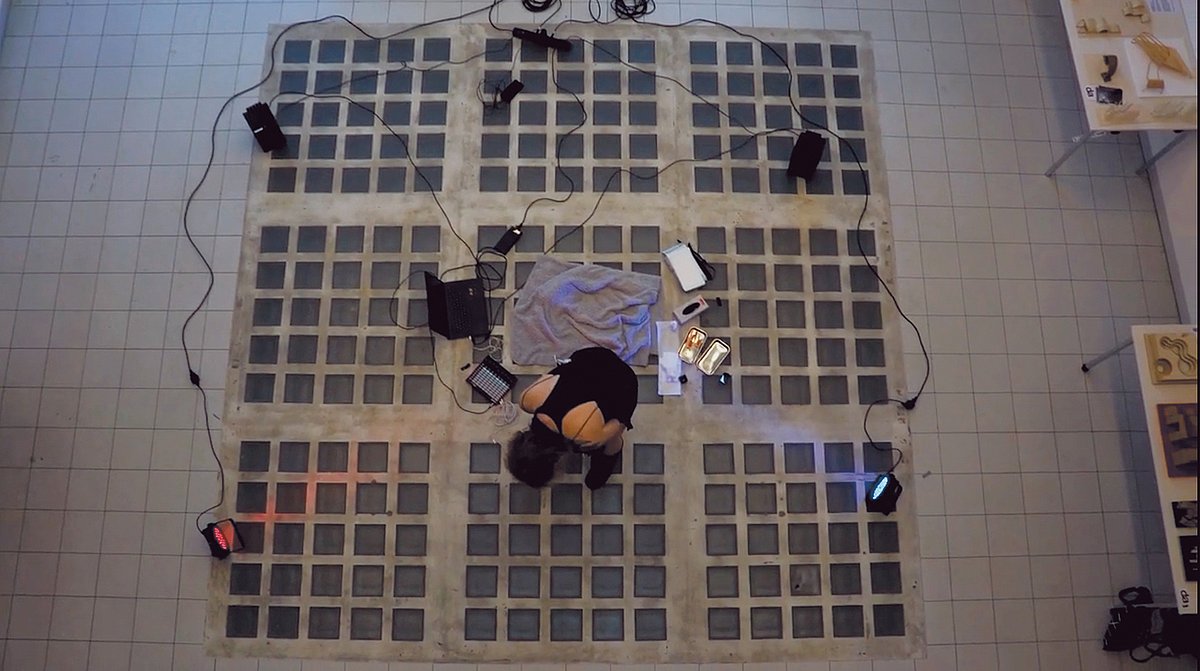
Cyborg Puppy Play!
Nyx Günther (DE)
In this sound performance, artist Nyx explores how queer, transgender and furry identities can open up a view on the posthuman condition, while eluding technocratic power structures. Through body modification, here by piercing herself, she proposes a playful, queer, feminist approach to becoming a furry cyborg. In a greater context, this project follows the tradition of electronic music production, body modification and a touch of drag - all of those being queer expressions in their own right.
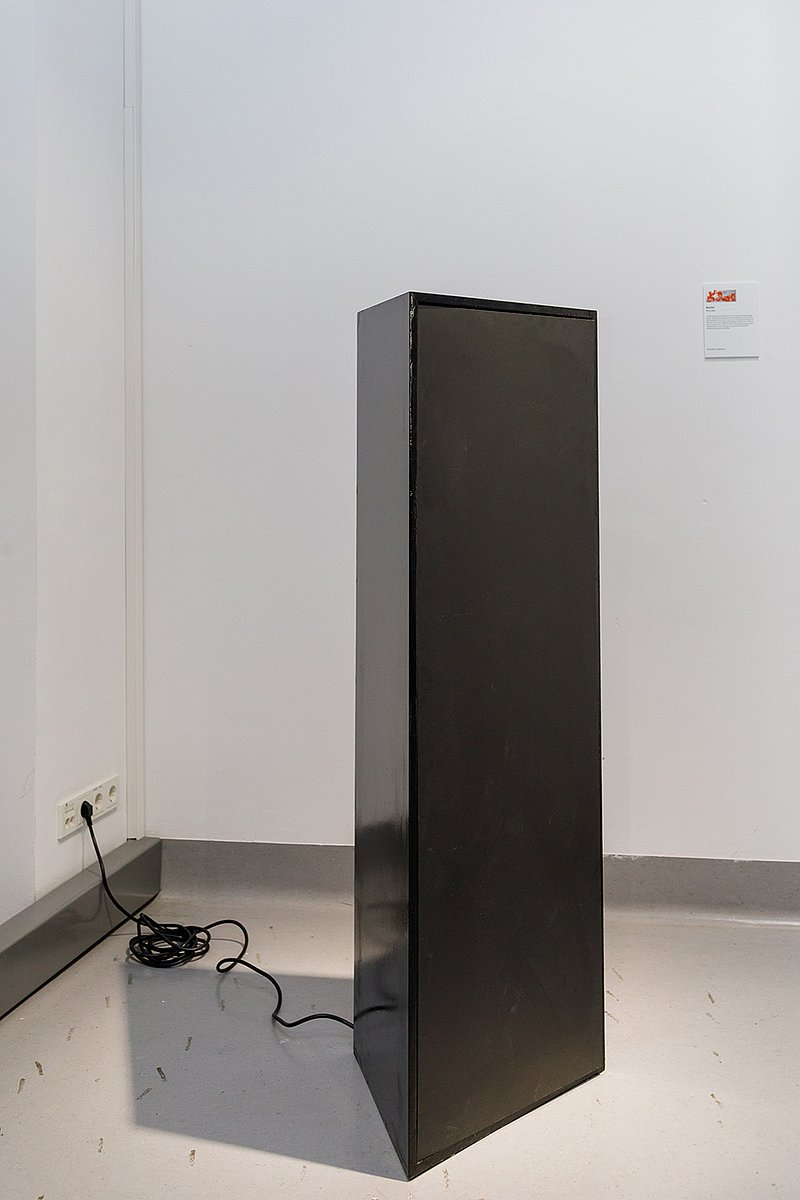
Basilisk
Paul Eßer (DE)
AI safety discourse is closely tied to the marketing of large language models, while often sidelining ethical and ecological concerns tied to their production. The artwork investigates these potential dangers of illicit use. The structure consists of an exciter speaker with a real-time text-to-speech system. Inside, an open-source large language model’s safety precautions are repeatedly circumvented using harmful prompts with poetry-like wording.

Rainbow Bicycle Project
Suzuki Mitsuyasu (JP)
The Rainbow Bicycle sprays a mist that becomes a real rainbow when the sun is behind you. I have ridden it around the world; the rainbow makes people smile. It can change how we see the world, yet this useless act can seem a deceptive escape from reality. Does it give false hope, or offer the bonds people need to live? Torn between deception and salvation, I keep pedalling. The exhibition centres on a documentary; on sunny days, visitors make rainbows themselves.
Deep Space Experience
[not] breaking the cycle
Curated by Kevin Blackistone
This explores the way we move through different phases of cycle, from order to chaos to order again. Trying to find the answers to questions, such as:
How do things interact when they attract each other? How can what we perceive be distorted? How do things change when they are observed? Even if we ever find those answers, we end up at the starting point, having to learn everything from scratch. In the end, the point is not to break the cycle, but to find a way to move with(in) it. This performance was created as a collaborative project between visual artists from Kunstuniversität and dancers from Anton Bruckner Privatuniversität.