Welcome at the Interface Culture program website.
Acting as creative artists and researchers, students learn how to advance the state of the art of current interface technologies and applications. Through interdisciplinary research and team work, they also develop new aspects of interface design including its cultural and social applications. The themes elaborated under the Master's programme in relation to interactive technologies include Interactive Environments, Interactive Art, Ubiquitous Computing, game design, VR and MR environments, Sound Art, Media Art, Web-Art, Software Art, HCI research and interaction design.

The Interface Culture program at the Linz University of Arts Department of Media was founded in 2004 by Christa Sommerer and Laurent Mignonneau. The program teaches students of human-machine interaction to develop innovative interfaces that harness new interface technologies at the confluence of art, research, application and design, and to investigate the cultural and social possibilities of implementing them.
The term "interface" is omnipresent nowadays. Basically, it describes an intersection or linkage between different computer systems that makes use of hardware components and software programs to enable the exchange and transmission of digital information via communications protocols.
However, an interface also describes the hook-up between human and machine, whereby the human qua user undertakes interaction as a means of operating and influencing the software and hardware components of a digital system. An interface thus enables human beings to communicate with digital technologies as well as to generate, receive and exchange data. Examples of interfaces in very widespread use are the mouse-keyboard interface and graphical user interfaces (i.e. desktop metaphors). In recent years, though, we have witnessed rapid developments in the direction of more intuitive and more seamless interface designs; the fields of research that have emerged include ubiquitous computing, intelligent environments, tangible user interfaces, auditory interfaces, VR-based and MR-based interaction, multi-modal interaction (camera-based interaction, voice-driven interaction, gesture-based interaction), robotic interfaces, natural interfaces and artistic and metaphoric interfaces.
Artists in the field of interactive art have been conducting research on human-machine interaction for a number of years now. By means of artistic, intuitive, conceptual, social and critical forms of interaction design, they have shown how digital processes can become essential elements of the artistic process.
Ars Electronica and in particular the Prix Ars Electronica's Interactive Art category launched in 1991 has had a powerful impact on this dialog and played an active role in promoting ongoing development in this field of research.
The Interface Cultures program is based upon this know-how. It is an artistic-scientific course of study to give budding media artists and media theoreticians solid training in creative and innovative interface design. Artistic design in these areas includes interactive art, netart, software art, robotic art, soundart, noiseart, games & storytelling and mobile art, as well as new hybrid fields like genetic art, bioart, spaceart and nanoart.
It is precisely this combination of technical know-how, interdisciplinary research and a creative artistic-scientific approach to a task that makes it possible to develop new, creative interfaces that engender progressive and innovative artistic-creative applications for media art, media design, media research and communication.
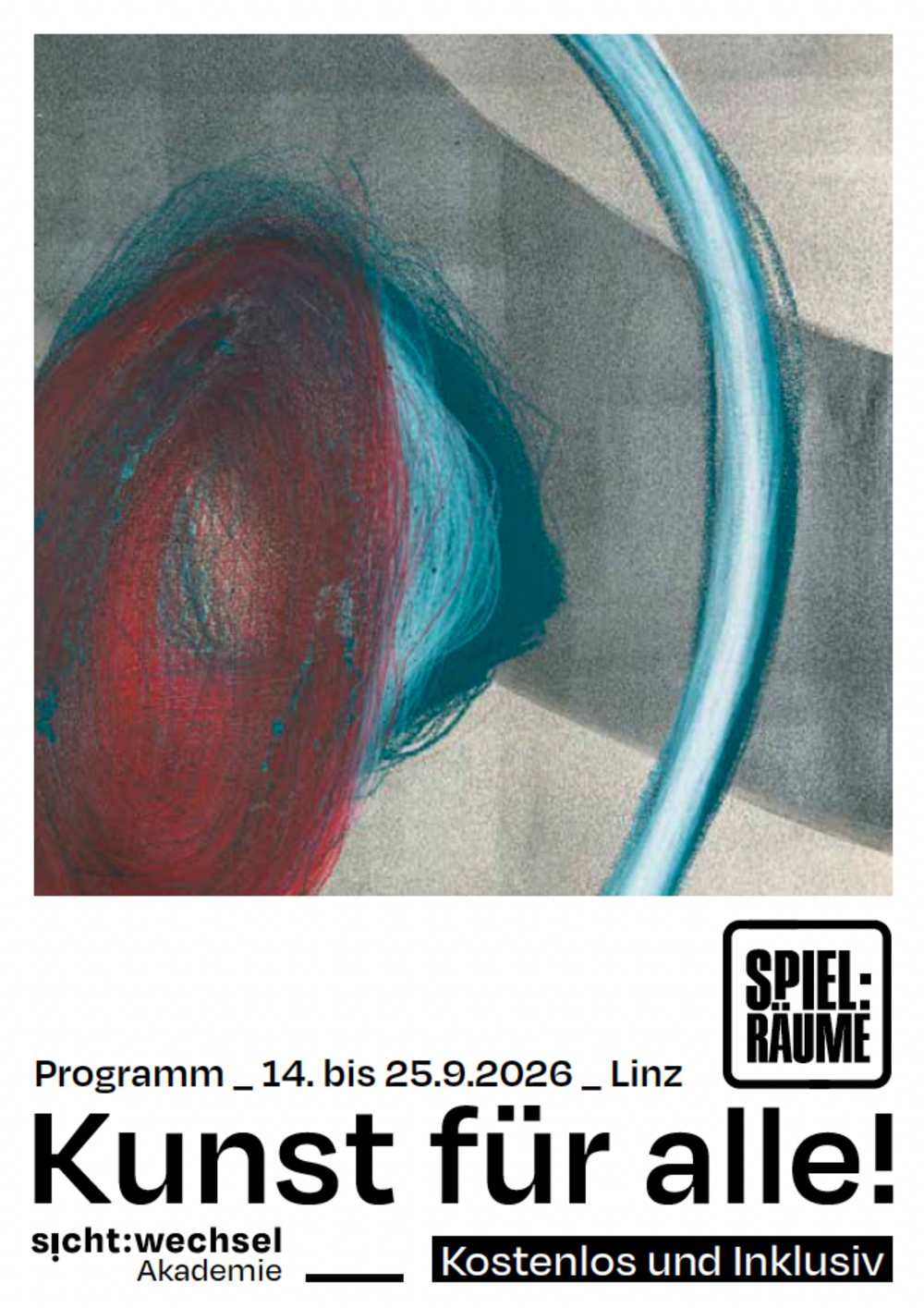
Akademie spiel:räume
14. bis 25. September 2026 Anton Bruckner Privatuniversität und Kunstuniversität Linz
Auch dieses Jahr gibt es im Zuge der spiel:räume Akademie die Möglichkeit, Workshops an der Anton Bruckner Privatuniversität und an der Kunstuniversität Linz zu besuchen.
Bereits zweimal fand an der Anton Bruckner Privatuniversität und an der Kunstuniversität Linz die sicht:wechsel Akademie spiel:räume statt. Menschen mit und ohne Behinderung hatten jeweils eine Woche lang die Möglichkeit, bei den unterschiedlichsten Workshopangeboten ihre künstlerisch kreativen Fähigkeiten auszuprobieren bzw. zu vertiefen. Dabei reichte das Angebot vom 5-tägigen Theaterworkshop über Tanz, Puppentheater, Musizieren, einer Schreibwerkstatt bis hin zu Portraits- und Comic-Zeichnen sowie Video und Fotografie. Die Nachfrage war erfreulich groß, sodass fast alle Workshops ausgebucht oder zumindest sehr gut besucht waren. Die Rückmeldungen von Teilnehmer*innen wie Dozent*innen waren gleichermaßen positiv und begeistert. Alle äußerten den ausdrücklichen Wunsch nach einer Wiederholung der Akademie, nach Vertiefung und Verfestigung der neu erlernten kreativen Fähigkeiten und nach mehr künstlerischen Angeboten für Menschen mit Behinderungen. Und nun ist es soweit: Die Akademie spiel:räume findet wieder statt!
Diesmal zwei Wochen lang, von 14. - 25. September 2026 können in insgesamt 30 Workshops auf der Anton Bruckner Privatuniversität und der Kunstuniversität Linz neue Fähigkeiten erlernt und vertieft werden. Zudem gibt es ein Online-Angebot, das sich ausdrücklich an Betroffene von ME/CFS richtet.
sicht:wechsel ist ein politischer Raum.
Ein Raum, in dem verhandelt wird, wer teilhat und unter welchen Bedingungen.
In Ateliers, Workshops und Ausstellungen wird an der Kunstuni Linz gemeinsam gearbeitet, entschieden und gestaltet.
Sichtbarkeit entsteht.
Zugänge werden möglich, wenn Räume geteilt und Strukturen geöffnet werden.
Es ist unsere Verantwortung, Räume, Wissen und Praxis zu teilen und uns selbst dabei zur Diskussion zu stellen.
sicht:wechsel ist kein fertiges Modell, es ist ein Prozess.
Und genau darin liegt seine Kraft.
Univ.-Prof.in Mag.a art. Gitti Vasicek
Vizerektorin für Kunst und Lehre an der Kunstuniversität Linz
Programm
zum gesamten Programm (PDF)
Programm Kunstuniversität Linz (PDF)
Programm Bruckneruniversität Linz (PDF)
Verbindliche Anmeldung erforderlich. Die Workshops sind ab 1. Juni über die einzelnen Veranstaltungen buchbar!
Links: