Welcome at the Interface Culture program website.
Acting as creative artists and researchers, students learn how to advance the state of the art of current interface technologies and applications. Through interdisciplinary research and team work, they also develop new aspects of interface design including its cultural and social applications. The themes elaborated under the Master's programme in relation to interactive technologies include Interactive Environments, Interactive Art, Ubiquitous Computing, game design, VR and MR environments, Sound Art, Media Art, Web-Art, Software Art, HCI research and interaction design.

The Interface Culture program at the Linz University of Arts Department of Media was founded in 2004 by Christa Sommerer and Laurent Mignonneau. The program teaches students of human-machine interaction to develop innovative interfaces that harness new interface technologies at the confluence of art, research, application and design, and to investigate the cultural and social possibilities of implementing them.
The term "interface" is omnipresent nowadays. Basically, it describes an intersection or linkage between different computer systems that makes use of hardware components and software programs to enable the exchange and transmission of digital information via communications protocols.
However, an interface also describes the hook-up between human and machine, whereby the human qua user undertakes interaction as a means of operating and influencing the software and hardware components of a digital system. An interface thus enables human beings to communicate with digital technologies as well as to generate, receive and exchange data. Examples of interfaces in very widespread use are the mouse-keyboard interface and graphical user interfaces (i.e. desktop metaphors). In recent years, though, we have witnessed rapid developments in the direction of more intuitive and more seamless interface designs; the fields of research that have emerged include ubiquitous computing, intelligent environments, tangible user interfaces, auditory interfaces, VR-based and MR-based interaction, multi-modal interaction (camera-based interaction, voice-driven interaction, gesture-based interaction), robotic interfaces, natural interfaces and artistic and metaphoric interfaces.
Artists in the field of interactive art have been conducting research on human-machine interaction for a number of years now. By means of artistic, intuitive, conceptual, social and critical forms of interaction design, they have shown how digital processes can become essential elements of the artistic process.
Ars Electronica and in particular the Prix Ars Electronica's Interactive Art category launched in 1991 has had a powerful impact on this dialog and played an active role in promoting ongoing development in this field of research.
The Interface Cultures program is based upon this know-how. It is an artistic-scientific course of study to give budding media artists and media theoreticians solid training in creative and innovative interface design. Artistic design in these areas includes interactive art, netart, software art, robotic art, soundart, noiseart, games & storytelling and mobile art, as well as new hybrid fields like genetic art, bioart, spaceart and nanoart.
It is precisely this combination of technical know-how, interdisciplinary research and a creative artistic-scientific approach to a task that makes it possible to develop new, creative interfaces that engender progressive and innovative artistic-creative applications for media art, media design, media research and communication.
Eine Parabel über Enden und Anfänge, die wir noch nicht kennen, Teil 2: Das kolossale Landtier
Eröffnung: 26. September 2026, ab 12.00 Uhr; bis 23. Dezember 2026 < rotor >, Volksgartenstraße 6a, Graz
Beteiligung von Barbara Schmid
Eröffnungszeremonie: 19.00 Uhr
Teilnehmende Künstler:innen:
Francesca Aldegani • Catherina Jarau, Anna Mora Moll, Laila Reichenpfader • Oskar Jocham • Ernst Koslitsch • Folke Köbberling • Consuelo Méndez • Rena Rädle & Vladan Jeremić • Frenzi Rigling • Barbara Schmid • Joulia Strauss • Moira Zoitl, Marina Pittau, Ralf Hoedt
AYOCOTL Saatgutbibliothek für Alle
Kuratiert von: Margarethe Makovec & Anton Lederer
Die Ausstellung ist Teil eines thematischen Bogens, der sich auf mythologische Wesen bezieht, die in verschiedenen Zeiten und Kulturen erscheinen. Sie begleiten Transformation, bringen Vertrautes ins Wanken und können dazu ermuntern, sich auf Ungewissheit und Wandel einzulassen. Der zweite Teil befasst sich mit einem Wesen, das in mythologischen Erzählungen als gewaltiges Landtier erscheint – bei Báyò Akómoláfé, dessen Schriften die Ausstellungsreihe inspiriert haben, ist es Behemoth.
Die künstlerischen Beiträge der Ausstellung bewegen sich zwischen Schwere und Transformation, zwischen Erdung und Übersättigung, zwischen Ordnung und karnevalesker Auflösung. Das Landtier wird als Auslöser von Druck, Trägheit und Widerstand aufgefasst, aus denen heraus sich andere Formen der Relation, des Handelns und des Wahrnehmens ableiten lassen.
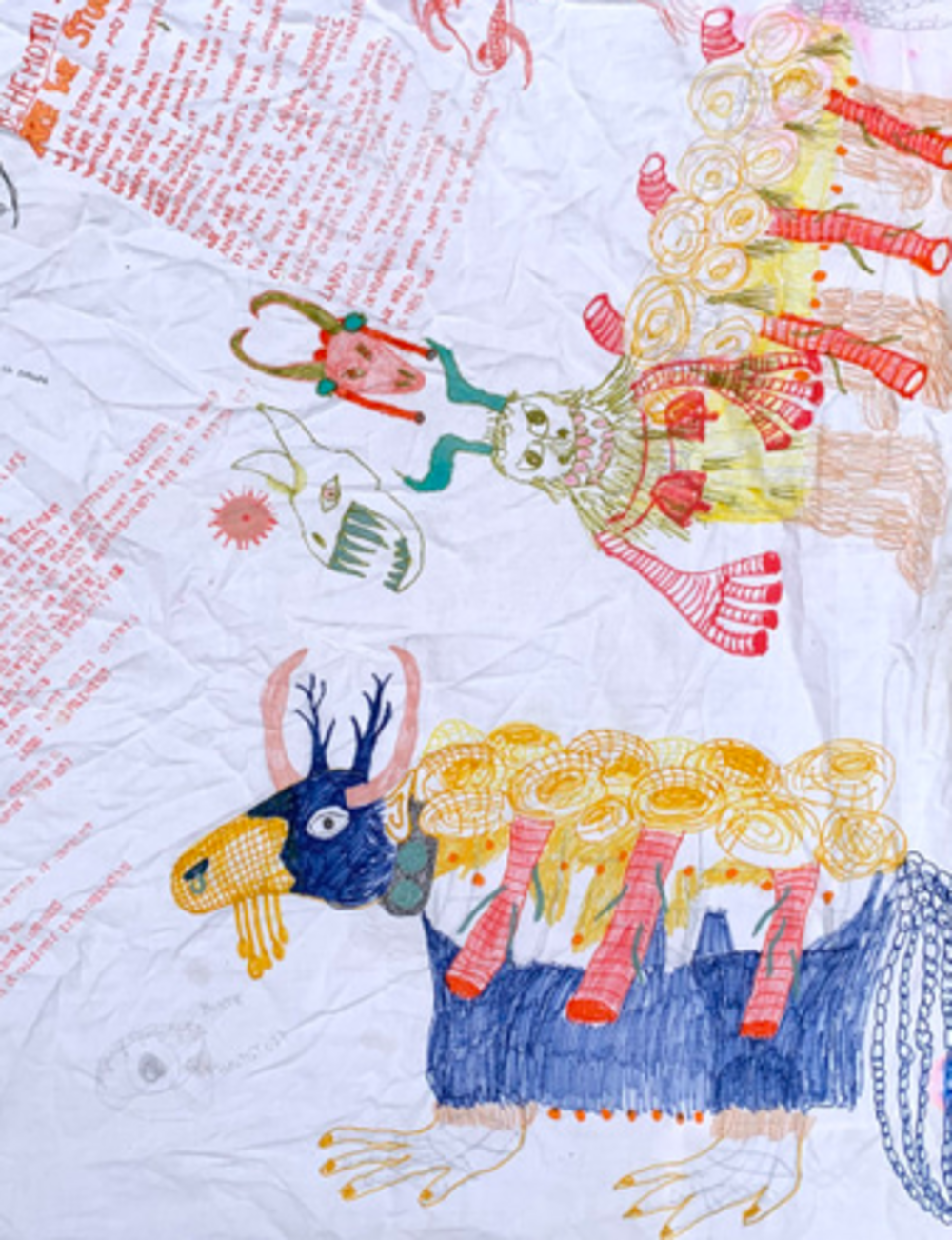
Catherina Jarau, Anna Mora Moll, Laila Reichenpfader, kollektive Skizze für das Landwesen, 2026