Welcome at the Interface Culture program website.
Acting as creative artists and researchers, students learn how to advance the state of the art of current interface technologies and applications. Through interdisciplinary research and team work, they also develop new aspects of interface design including its cultural and social applications. The themes elaborated under the Master's programme in relation to interactive technologies include Interactive Environments, Interactive Art, Ubiquitous Computing, game design, VR and MR environments, Sound Art, Media Art, Web-Art, Software Art, HCI research and interaction design.

The Interface Culture program at the Linz University of Arts Department of Media was founded in 2004 by Christa Sommerer and Laurent Mignonneau. The program teaches students of human-machine interaction to develop innovative interfaces that harness new interface technologies at the confluence of art, research, application and design, and to investigate the cultural and social possibilities of implementing them.
The term "interface" is omnipresent nowadays. Basically, it describes an intersection or linkage between different computer systems that makes use of hardware components and software programs to enable the exchange and transmission of digital information via communications protocols.
However, an interface also describes the hook-up between human and machine, whereby the human qua user undertakes interaction as a means of operating and influencing the software and hardware components of a digital system. An interface thus enables human beings to communicate with digital technologies as well as to generate, receive and exchange data. Examples of interfaces in very widespread use are the mouse-keyboard interface and graphical user interfaces (i.e. desktop metaphors). In recent years, though, we have witnessed rapid developments in the direction of more intuitive and more seamless interface designs; the fields of research that have emerged include ubiquitous computing, intelligent environments, tangible user interfaces, auditory interfaces, VR-based and MR-based interaction, multi-modal interaction (camera-based interaction, voice-driven interaction, gesture-based interaction), robotic interfaces, natural interfaces and artistic and metaphoric interfaces.
Artists in the field of interactive art have been conducting research on human-machine interaction for a number of years now. By means of artistic, intuitive, conceptual, social and critical forms of interaction design, they have shown how digital processes can become essential elements of the artistic process.
Ars Electronica and in particular the Prix Ars Electronica's Interactive Art category launched in 1991 has had a powerful impact on this dialog and played an active role in promoting ongoing development in this field of research.
The Interface Cultures program is based upon this know-how. It is an artistic-scientific course of study to give budding media artists and media theoreticians solid training in creative and innovative interface design. Artistic design in these areas includes interactive art, netart, software art, robotic art, soundart, noiseart, games & storytelling and mobile art, as well as new hybrid fields like genetic art, bioart, spaceart and nanoart.
It is precisely this combination of technical know-how, interdisciplinary research and a creative artistic-scientific approach to a task that makes it possible to develop new, creative interfaces that engender progressive and innovative artistic-creative applications for media art, media design, media research and communication.
Marianne.von.Willemer – Preis für digitale Medien 2026
Den Marianne.von.Willemer – Preis für digitale Medien 2026 erhält Oona Valarie Serbest.
Sie wird für ihr Werk „Augmented Resistance Walk Linz“ ausgezeichnet.
Herzliche Gratulation!
Der mit 5.000 Euro dotierte „Marianne.von.Willemer–Preis für digitale Medien“ der Stadt Linz geht heuer an Mag.a art. Oona Valarie Serbest.
Die in Linz lebende Medienkünstlerin erhält die Auszeichnung für ihre Einreichung „Augmented Resistance Walk Linz“.
Der „Augmented Resistance Walk“ ist ein AR-Spiel, das Linzer Stadtgeschichte in digitaler immersiver Form anhand bedeutender Linzer Pionierinnen erzählt.
Das Frauenressort der Stadt Linz stiftet im Gedenken an die aus Linz stammende Autorin Marianne von Willemer, geborene Jung, einen Preis für Frauen, die digitale Medien als künstlerisches Werkzeug und Ausdrucksmittel nutzen. Strukturelle Ungleichheiten prägen nach wie vor den Kunst- und Kulturbereich – ein Bereich, in dem Frauen trotz ihrer herausragenden Leistungen nach wie vor unverhältnismäßig unsichtbar sind. Macht und Ressourcen sind ungleich verteilt und genau hier setzt der Marianne.von.Willemer-Preis an und zeichnet exzellente künstlerische Arbeiten aus.
Teilnahmeberechtigt waren Frauen, die „Digitale Medien“ gestaltend, experimentell und künstlerisch nutzen und in ihrer Einreichung einen Zusammenhang zur Stadt Linz (Linz-Bezug) darlegen. Eine hochkarätige dreiköpfige Fachjury bestehend aus Priv.-Doz.in Dr.in Gerda Lampalzer-Oppermann (Kunstuniversität Linz), Prof.in (FH) Mag.a art. Dr.in Rosa von Suess, (Professorin an der Fachhochschule St. Pölten, Department Medien und Digitale Technologien) und Univ.-Prof.in Mag.a art. Brigitte Vasicek (Vizerektorin für Kunst und Lehre an der Kunstuniversität Linz) bewertete und sichtete mit großer Sorgfalt die eingereichten künstlerischen Arbeiten.
Die diesjährige Preisverleihung fand am Donnerstag, 22. September 2026, um 19.00 Uhr im Audimax der Kunstuniversität Linz statt.
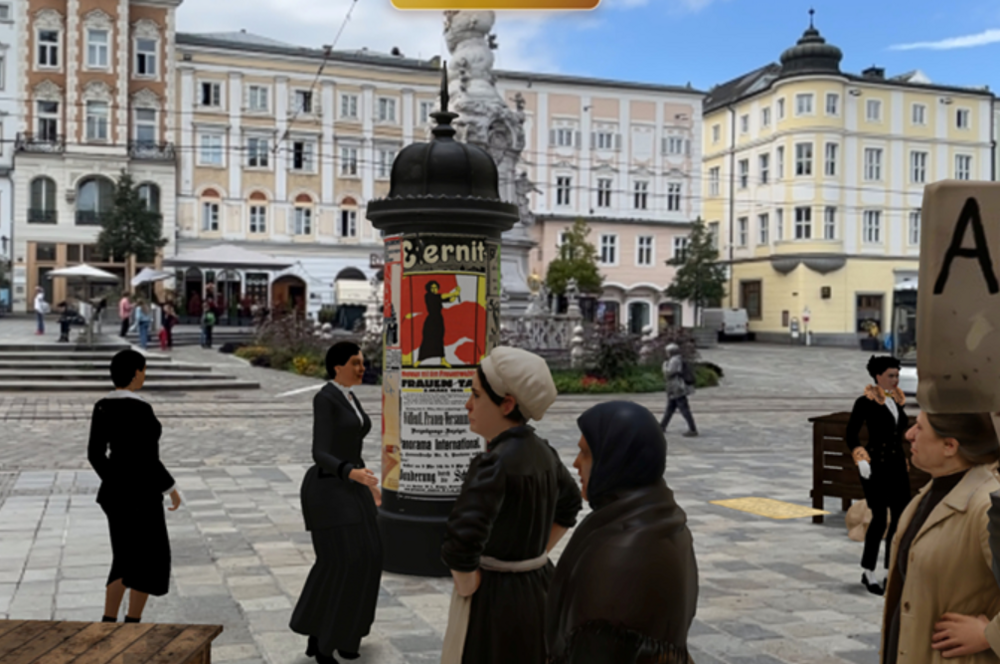
Bild: Footage AR Walk