Welcome at the Interface Culture program website.
Acting as creative artists and researchers, students learn how to advance the state of the art of current interface technologies and applications. Through interdisciplinary research and team work, they also develop new aspects of interface design including its cultural and social applications. The themes elaborated under the Master's programme in relation to interactive technologies include Interactive Environments, Interactive Art, Ubiquitous Computing, game design, VR and MR environments, Sound Art, Media Art, Web-Art, Software Art, HCI research and interaction design.

The Interface Culture program at the Linz University of Arts Department of Media was founded in 2004 by Christa Sommerer and Laurent Mignonneau. The program teaches students of human-machine interaction to develop innovative interfaces that harness new interface technologies at the confluence of art, research, application and design, and to investigate the cultural and social possibilities of implementing them.
The term "interface" is omnipresent nowadays. Basically, it describes an intersection or linkage between different computer systems that makes use of hardware components and software programs to enable the exchange and transmission of digital information via communications protocols.
However, an interface also describes the hook-up between human and machine, whereby the human qua user undertakes interaction as a means of operating and influencing the software and hardware components of a digital system. An interface thus enables human beings to communicate with digital technologies as well as to generate, receive and exchange data. Examples of interfaces in very widespread use are the mouse-keyboard interface and graphical user interfaces (i.e. desktop metaphors). In recent years, though, we have witnessed rapid developments in the direction of more intuitive and more seamless interface designs; the fields of research that have emerged include ubiquitous computing, intelligent environments, tangible user interfaces, auditory interfaces, VR-based and MR-based interaction, multi-modal interaction (camera-based interaction, voice-driven interaction, gesture-based interaction), robotic interfaces, natural interfaces and artistic and metaphoric interfaces.
Artists in the field of interactive art have been conducting research on human-machine interaction for a number of years now. By means of artistic, intuitive, conceptual, social and critical forms of interaction design, they have shown how digital processes can become essential elements of the artistic process.
Ars Electronica and in particular the Prix Ars Electronica's Interactive Art category launched in 1991 has had a powerful impact on this dialog and played an active role in promoting ongoing development in this field of research.
The Interface Cultures program is based upon this know-how. It is an artistic-scientific course of study to give budding media artists and media theoreticians solid training in creative and innovative interface design. Artistic design in these areas includes interactive art, netart, software art, robotic art, soundart, noiseart, games & storytelling and mobile art, as well as new hybrid fields like genetic art, bioart, spaceart and nanoart.
It is precisely this combination of technical know-how, interdisciplinary research and a creative artistic-scientific approach to a task that makes it possible to develop new, creative interfaces that engender progressive and innovative artistic-creative applications for media art, media design, media research and communication.
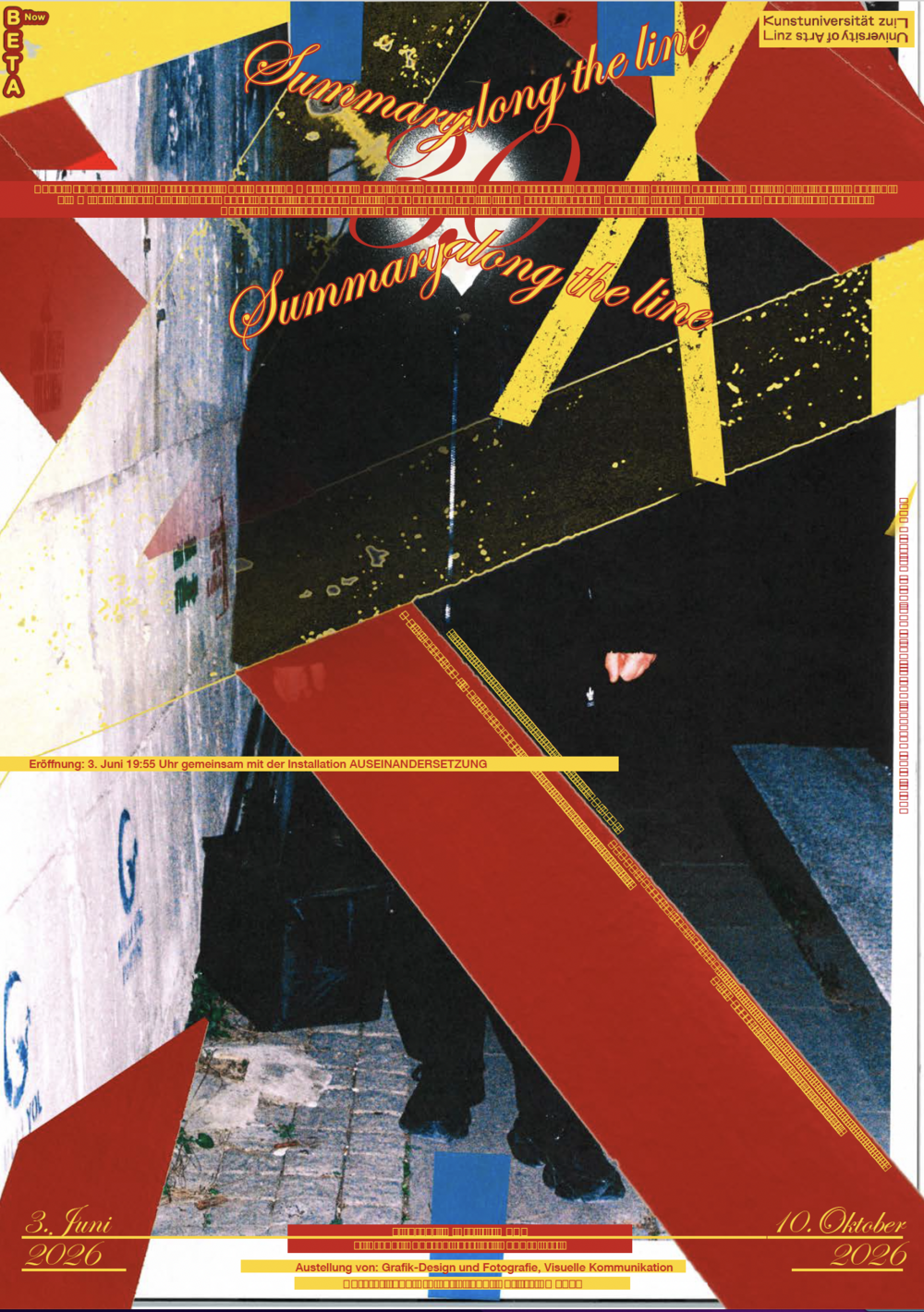
Summary along the line 3.0
Ausstellung bis 10. Oktober 2026 Kunstuniversität Linz, Hauptplatz 8, 4.OG Lichthofgalerie
Die Maske
ASCHE, Abschied von der Erde
Mein Fotoalbum-
DA STA! mein Fotobuch
Eine Ausstellung der Bereiche BA Grafikdesign und Fotografie sowie MA Visuelle Kommunikation der Kunstuniversität Linz. Die Studierenden präsentieren ihre künstlerischen Arbeiten in verschiedenen fotografischen und filmischen Formen sowie in Installationen.
Die unterschiedliche Herangehensweisen an thematische Inhalte führen zu unterschiedlichen persönlichen Ausdrucksweisen. Dadurch entsteht eine große Vielfalt an digitalen und analogen Bildformaten sowie Bewegtbildern. Die Arbeiten wurden in vier verschiedenen Lehrveranstaltungen entwickelt.
Mit der Maske eignen wir uns eine fremde Identität an und geben uns ein anderes Gesicht. In allen Kulturen gibt es Maskenrituale, um in eine andere Welt einzutauchen. In der mitteleuropäischen Kultur ist es der Fasching/Karneval, bei dem sich alle tummeln und Feste der Verwandlung feiern. Diese Zeit der Verwandlung diente dazu, aus dem eigenen Alltag auszubrechen.
In DA STA! wurde eine Spurensuche nach Orten unternommen, welche von uns gehört werden. Mögliche Untersuchungsfelder für Orte sind Erinnerungen, Beziehungen und die Geschichte selbst, die einen Ort personalisieren.
Familienalbum: das Abgebildete folgt sozialen Regeln und erschließt zugleich eine gestalterische Eigenart. Die Bildfolgen können explorativ oder spielerisch, kitschig oder stereotypisch sein. Im Falle eines Hausbrandes versuchen viele Menschen, unter allen Umständen das eigene Fotoalbum zu retten, statt die Pässe oder den Familienschmuck.
ASCHE ist eine Teil einer Trilogie von Elfriede Jelinek, hier wurde ein Dialog aufgebaut, der die fragmentierte Sprachkomposition von Elfriede Jelinek in eine künstlerische Bildkomposition überführt. Mit den Themen der Sterblichkeit und Abschied treibt sie den performativen Ansatz in die Enge und eine Weltuntergangsstimmung betritt den Raum. Künstlerische Betreuung: Tina Frank - Deep Space-Projection & Christa Amadea - Performance. BETA NOW 06
Mit Arbeiten von:
Anna Akopova, Louis Bartscherer, Noel Barz, Emma Bockelmann, Eren Bozkaya, Darya Bukreyeva, Anna Bunina, Natalia Chaykina, Martin Colov, Leyla Dehring, Timm Felder, Lu Hainy, Elena Hauselberger, Johanna Heller, Ann-Kathrin Häupl, Alisa Matern, Lukas Meixner, Clara Müller, Suzuka Nakao, Liza Rashica, Kerstin Reiter, Laura Reither, Camilla Scholz, Ani Shahrikyan, Zere Valeyeva, Euk kung Yoo
Kuratorische Projektleitung: Christa Amadea
Öffnungszeiten: MO bis FR 8.00 bis 18.00 Uhr