Welcome at the Interface Culture program website.
Acting as creative artists and researchers, students learn how to advance the state of the art of current interface technologies and applications. Through interdisciplinary research and team work, they also develop new aspects of interface design including its cultural and social applications. The themes elaborated under the Master's programme in relation to interactive technologies include Interactive Environments, Interactive Art, Ubiquitous Computing, game design, VR and MR environments, Sound Art, Media Art, Web-Art, Software Art, HCI research and interaction design.

The Interface Culture program at the Linz University of Arts Department of Media was founded in 2004 by Christa Sommerer and Laurent Mignonneau. The program teaches students of human-machine interaction to develop innovative interfaces that harness new interface technologies at the confluence of art, research, application and design, and to investigate the cultural and social possibilities of implementing them.
The term "interface" is omnipresent nowadays. Basically, it describes an intersection or linkage between different computer systems that makes use of hardware components and software programs to enable the exchange and transmission of digital information via communications protocols.
However, an interface also describes the hook-up between human and machine, whereby the human qua user undertakes interaction as a means of operating and influencing the software and hardware components of a digital system. An interface thus enables human beings to communicate with digital technologies as well as to generate, receive and exchange data. Examples of interfaces in very widespread use are the mouse-keyboard interface and graphical user interfaces (i.e. desktop metaphors). In recent years, though, we have witnessed rapid developments in the direction of more intuitive and more seamless interface designs; the fields of research that have emerged include ubiquitous computing, intelligent environments, tangible user interfaces, auditory interfaces, VR-based and MR-based interaction, multi-modal interaction (camera-based interaction, voice-driven interaction, gesture-based interaction), robotic interfaces, natural interfaces and artistic and metaphoric interfaces.
Artists in the field of interactive art have been conducting research on human-machine interaction for a number of years now. By means of artistic, intuitive, conceptual, social and critical forms of interaction design, they have shown how digital processes can become essential elements of the artistic process.
Ars Electronica and in particular the Prix Ars Electronica's Interactive Art category launched in 1991 has had a powerful impact on this dialog and played an active role in promoting ongoing development in this field of research.
The Interface Cultures program is based upon this know-how. It is an artistic-scientific course of study to give budding media artists and media theoreticians solid training in creative and innovative interface design. Artistic design in these areas includes interactive art, netart, software art, robotic art, soundart, noiseart, games & storytelling and mobile art, as well as new hybrid fields like genetic art, bioart, spaceart and nanoart.
It is precisely this combination of technical know-how, interdisciplinary research and a creative artistic-scientific approach to a task that makes it possible to develop new, creative interfaces that engender progressive and innovative artistic-creative applications for media art, media design, media research and communication.
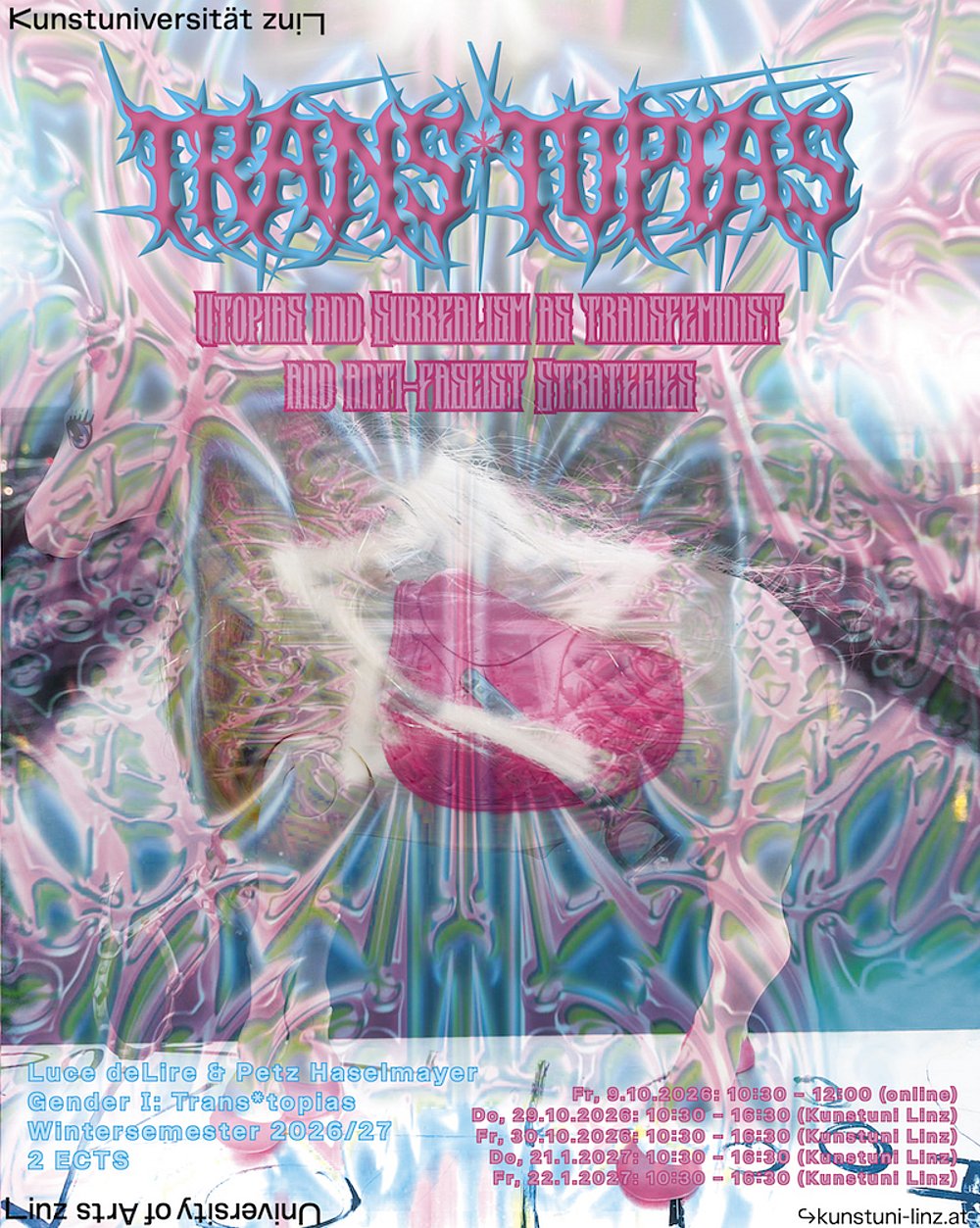
Trans*topias
9. Oktober 2026 - 22. Jänner 2027 Kunstuniversität Linz und online
Der Arbeitskreis für Gleichbehandlungsfragen lädt zum Seminar.
Dieses Seminar verbindet transfeministische Theoriebildung mit künstlerischen Arbeiten, Film, Sub-und Popkultur sowie Care-Praxen. Es fragt nach den ästhetischen Strategien, visuellen Kulturen und alltäglichen Überlebenspraktiken, die aus transfeministischen, dekolonialen, Black und crip Perspektiven entstehen. Im Zentrum steht die Erkenntnis, dass Trans-Themen nicht nur eine Minderheitenfrage sind, sondern das Leben aller Menschen betreffen, wie McKenzie Wark danach fragt:
"Was würde passieren, wenn wir die Perspektive von trans Menschen ernst nehmen würden? Wenn wir ihnen erlauben würden, zu transformieren, wie wir Geschlecht generell betrachten?" - McKenzie Wark
In diesem Sinne ist uns dabei die Verbindung von Theorie und Praxis wichtig: Wir fragen nicht nur nach der Politik der Rechte, sondern nach den „Arts of Survival" ... den subversiven Strategien in Kunst, Humor und Alltagspraxis, die es marginalisierten Gruppen ermöglichen, in einem feindseligen Umfeld zu existieren.
Ein weiteres Augenmerk liegt auf der Schnittstelle von Trans-Theorie und Ästhetik. Da das Jahresthema der Kunstuniversität Linz sich um „Sorge" (Care) dreht, werden die Care-Praxen nicht nur theoretisch diskutiert, sondern sie als politische Handlungsfelder begreifen: Von Mutual Aid und DIY-HRT über postoperative Pflege bis hin zu psychosozialer Unterstützung.
Diese „Dirty Care" wird als Gegenmodell zu staatlicher Vernachlässigung und medizinischer Pathologisierung analysiert. Gleichzeitig verbinden wir dies mit visuellen und kulturellen Studien, indem wir untersuchen, wie Hypersexualisierung, Hypervisibilität und die Politik der Unsichtbarkeit funktionieren. Und fragen auch danach, wie ästhetische Strategien genutzt werden können, um die Politik der Auslöschung zu widerlegen
Trans*topias: Utopien und Surrealismus als transfeministische und anti-faschistische Strategien
[Gender I]
Termine:
Fr, 9.10.2026: 10:30 – 12:00 (online)
Do, 29.10.2026: 10:30 – 16:30 (Hörsaal D, H60504)
Fr, 30.10.2026: 10:30 – 16:30 (Hörsaal D, H60504)
Do, 21.1.2027: 10:30 – 16:30 (Hörsaal D, H60504)
Fr, 22.1.2027: 10:30 – 16:30 (Hörsaal D, H60504)
Anmeldung via ufgonline.ufg.ac.at