Welcome at the Interface Culture program website.
Acting as creative artists and researchers, students learn how to advance the state of the art of current interface technologies and applications. Through interdisciplinary research and team work, they also develop new aspects of interface design including its cultural and social applications. The themes elaborated under the Master's programme in relation to interactive technologies include Interactive Environments, Interactive Art, Ubiquitous Computing, game design, VR and MR environments, Sound Art, Media Art, Web-Art, Software Art, HCI research and interaction design.

The Interface Culture program at the Linz University of Arts Department of Media was founded in 2004 by Christa Sommerer and Laurent Mignonneau. The program teaches students of human-machine interaction to develop innovative interfaces that harness new interface technologies at the confluence of art, research, application and design, and to investigate the cultural and social possibilities of implementing them.
The term "interface" is omnipresent nowadays. Basically, it describes an intersection or linkage between different computer systems that makes use of hardware components and software programs to enable the exchange and transmission of digital information via communications protocols.
However, an interface also describes the hook-up between human and machine, whereby the human qua user undertakes interaction as a means of operating and influencing the software and hardware components of a digital system. An interface thus enables human beings to communicate with digital technologies as well as to generate, receive and exchange data. Examples of interfaces in very widespread use are the mouse-keyboard interface and graphical user interfaces (i.e. desktop metaphors). In recent years, though, we have witnessed rapid developments in the direction of more intuitive and more seamless interface designs; the fields of research that have emerged include ubiquitous computing, intelligent environments, tangible user interfaces, auditory interfaces, VR-based and MR-based interaction, multi-modal interaction (camera-based interaction, voice-driven interaction, gesture-based interaction), robotic interfaces, natural interfaces and artistic and metaphoric interfaces.
Artists in the field of interactive art have been conducting research on human-machine interaction for a number of years now. By means of artistic, intuitive, conceptual, social and critical forms of interaction design, they have shown how digital processes can become essential elements of the artistic process.
Ars Electronica and in particular the Prix Ars Electronica's Interactive Art category launched in 1991 has had a powerful impact on this dialog and played an active role in promoting ongoing development in this field of research.
The Interface Cultures program is based upon this know-how. It is an artistic-scientific course of study to give budding media artists and media theoreticians solid training in creative and innovative interface design. Artistic design in these areas includes interactive art, netart, software art, robotic art, soundart, noiseart, games & storytelling and mobile art, as well as new hybrid fields like genetic art, bioart, spaceart and nanoart.
It is precisely this combination of technical know-how, interdisciplinary research and a creative artistic-scientific approach to a task that makes it possible to develop new, creative interfaces that engender progressive and innovative artistic-creative applications for media art, media design, media research and communication.
Vier Tage Film und Begegnung in Linz
14. bis 17. Oktober 2026 City-Kino und Kunstuniversität Linz
Von 14. bis 17. Oktober 2026 wird Linz erneut zum Treffpunkt für internationales Kurzfilmkino. Das Linz International Short Film Festival (Linz ISFF) geht in seine neunte Ausgabe und bringt Filmschaffende, Nachwuchstalente, Fachleute aus der Filmbranche und ein filminteressiertes Publikum aus Österreich und der ganzen Welt zusammen.
Neben den Filmvorführungen stehen Begegnung und Austausch im Mittelpunkt. Filmgespräche, Diskussionen und Branchenveranstaltungen schaffen Raum für neue Kontakte und Kooperationen und verbinden die Linzer Kulturszene mit der internationalen unabhängigen Filmwelt.
Von 4.043 Einreichungen zum Festivalprogramm
Mit 4.043 Filmeinreichungen aus 121 Ländern verzeichnet das Festival 2026 eine starke internationale Resonanz. Die Einreichungen kommen aus nahezu allen Teilen der Welt – von Europa, Afrika und dem Nahen Osten über Asien bis nach Nord-, Mittel- und Südamerika. Filme aus Ländern wie Spanien, Iran, Brasilien, Deutschland, Ägypten, Nigeria, Mexiko, Indien, China, Südafrika, Argentinien, Indonesien, Italien und Österreich machen die große geografische und kulturelle Vielfalt der diesjährigen Einreichungen sichtbar.
Im Zentrum der vier Festivaltage stehen Kurzfilme aus den Bereichen Fiction, Documentary und Animation. Ergänzt wird das Filmprogramm durch Sonderprogramme, Gespräche und Diskussionen sowie die Film Talent Academy mit Residencies und Pitch Sessions.
Hinter der Auswahl der rund 60 Filme steht ein mehrstufiger kuratorischer Prozess. Ein sechsköpfiges internationales Preselection-Team sichtete und bewertete 2026 gemeinsam mit der Festivalleitung Parisa Ghasemi und Ashkan Nematian die Einreichungen und wählte jene Arbeiten aus, die in das diesjährige Festivalprogramm aufgenommen werden.
Die ausgewählten Filme erzählen Geschichten aus unterschiedlichen gesellschaftlichen und kulturellen Kontexten und zeigen vielfältige filmische Handschriften. Das Linz ISFF versteht den Kurzfilm als eigenständige Kunstform und zugleich als Medium, das gesellschaftliche Entwicklungen reflektiert, neue Perspektiven eröffnet und Raum für experimentelle Formen des Erzählens schafft.
Das detaillierte Festivalprogramm mit den ausgewählten Filmen, Spielzeiten, Gästen und weiteren Programmpunkten wird über die offiziellen Kanäle des Linz International Short Film Festival bekannt gegeben.
Festivalpässe und Einzeltickets sind ab sofort erhältlich unter:
kupfticket.com/events/linz-international-short-film-festival-2026
Für Studierende und Mitarbeiter*innen der Kunstuni Linz stellt das ISFF stark ermäßigte Festivalpässe für 7 Euro zur Verfügung. Ebenfalls erhältlich online über Kupfticket.com und vor Ort.
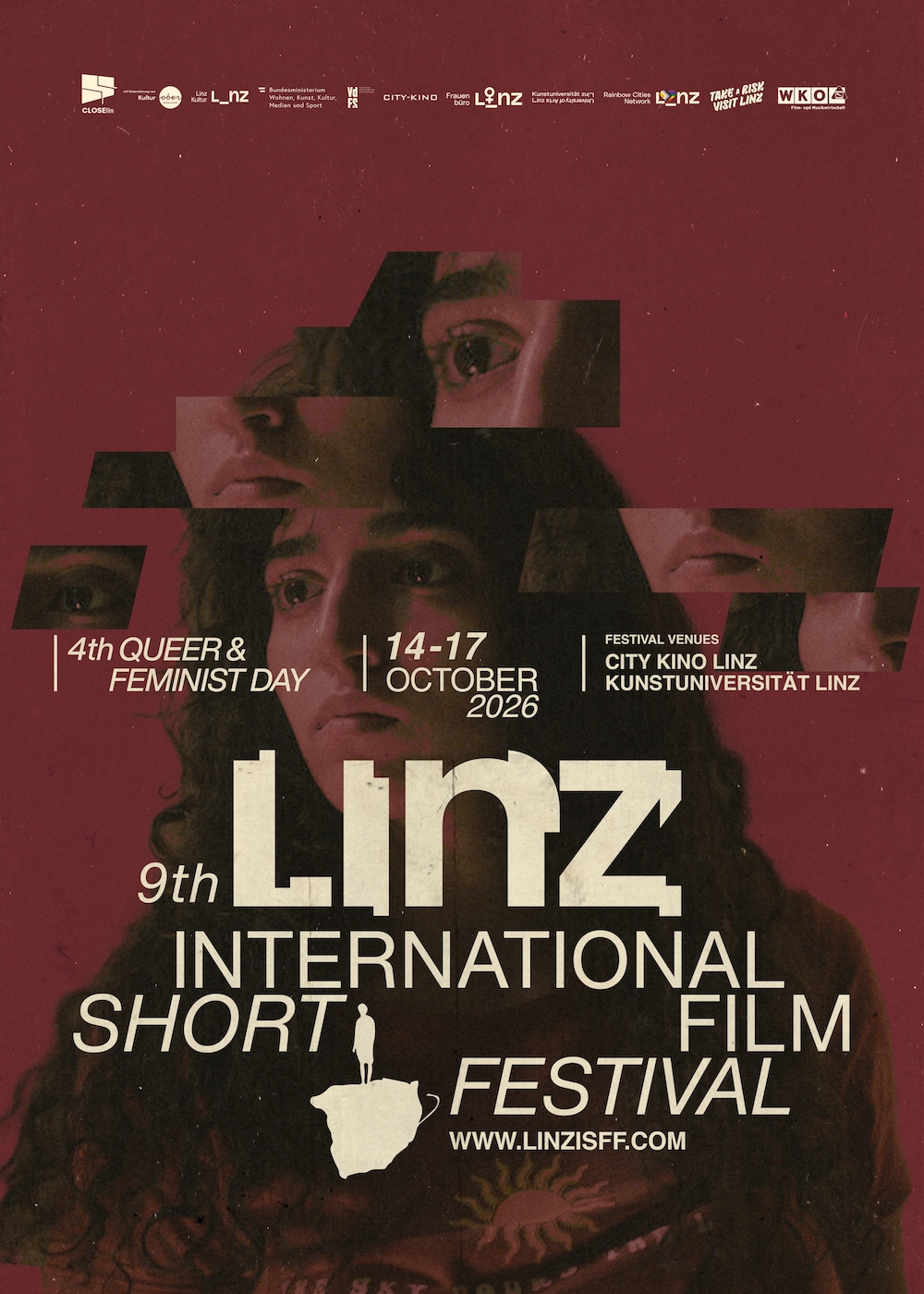
Sujet Design: Maryam Baradaran Filmstill: „Almost Certainly False“ von Cansu Baydar - Gewinnerfilm Linz ISFF 2025